Whole House Remodel in Altadena: Gut Renovation Costs and Sequencing
Key Facts
- LA full-home renovation runs $125–$500+ per square foot, per Sweeten's cost guide.
- Labor consumes 50–60% of most renovation budgets, according to 2026 industry data.
- Contractor bids on identical scopes can vary 20–40%, remodeling guidance warns.
- Removing a load-bearing wall costs $8,000–$15,000 including engineering and beam work, renovation analysis shows.
- A full gut remodel ($90K–$300K+) costs far less than teardown-and-rebuild ($150K–$400K+), per HomeGuide data.
- Pre-1985 homes need a 15–25% budget contingency because knob-and-tube wiring and asbestos hide in walls, contractors advise.
- A full traditional rebuild in Altadena takes an estimated 2–2.5 years, industry estimates suggest.
Why Altadena Gut Remodels Cost More Than You Think
If you're budgeting a whole-house remodel on an Altadena Craftsman or mid-century ranch, you're working without a local price map — no published source offers Altadena-specific gut-remodel pricing, so LA-wide benchmarks are the best available baseline. And those benchmarks vary widely depending on who's counting.
HomeGuide pegs a full gut-and-remodel at $60–$150+ per square foot, while Sweeten's Los Angeles-specific guide puts full-home renovation at $125–$500+ per square foot. A third set of contractor benchmarks lands in the middle, citing $100–$300+ per square foot for mid-range work and $200–$300+ for high-end finishes. The gaps reflect differing scope definitions and finish levels — not sloppy math.
The honest answer for a 1,500–2,000 square foot Altadena home: expect a total investment somewhere in the six-figure range, with kitchens and bathrooms driving the biggest swings. Sweeten's LA data shows a 200-square-foot kitchen running from roughly $24,500 on a budget build to $100,000+ at the high end, while a 35-square-foot bathroom starts near $18,000. Labor alone consumes 50–60% of most renovation budgets.
Then there's the part nobody budgets for on the first pass: what's inside the walls. Altadena's housing stock is heavily pre-1978, and homes of that era routinely hide:
- Knob-and-tube wiring and undersized 60–100 amp panels, versus the 200-amp service modern homes require
- Galvanized or cast-iron plumbing at or past the end of its service life
- Asbestos in insulation, flooring, and texture coatings
- Lead paint on original trim, siding, and window frames
As one contractor analysis puts it, "these finds are common. They are not exceptions" — none of them show up in a pre-renovation walkthrough, and all of them surface the moment walls open. Hazardous-material remediation alone can add tens of thousands of dollars to a project.
This is why a 15–25% contingency is non-negotiable for any Altadena home built before 1985. On a $250,000 gut remodel, that's $37,500–$62,500 you should expect to spend — not hope you won't. Contractor bids themselves can vary 20–40% between firms, so it pays to collect at least three quotes from licensed contractors and weigh reputation alongside price. At Altadena ADU Builder, we consistently tell homeowners that the contingency line item is the difference between finishing a remodel and abandoning one mid-rough-in.
One more factor specific to Altadena right now: the Eaton Fire recovery environment. LA County's recovery hub offers an express lane for rebuilding, one-stop Permit Centers, and fee waivers, and new Title 24 Wildland-Urban Interface standards now apply to fire-affected areas. If your remodel touches exterior materials or systems, those hardened, fire-resistant requirements belong in your budget conversation from day one — not as a change order in month six.
Gut Remodel vs. Teardown: Which Path Makes Sense in Altadena
Standing in an Altadena living room with the walls stripped to studs, every homeowner eventually asks the same question: should we rebuild what's here, or start over? The answer hinges on cost, character, and — in post-Eaton Fire Altadena — the clock running on your insurance benefits.
On pure cost, gutting wins. A full gut remodel typically runs $90,000–$300,000+, while a teardown-and-rebuild starts at $150,000–$400,000, with new construction at $180–$450+ per square foot, according to HomeGuide's cost data. For a structurally sound home, that gap is hard to justify.
A full gut makes sense when the problems run deep. Remodeling guidance identifies clear triggers: structural damage, unsafe electrical or plumbing systems, hazardous materials throughout, or a floor plan that simply no longer works. If your systems are sound and you're updating finishes, a standard remodel suffices.
- Choose a gut remodel when the bones are good but the wiring, plumbing, and layout need a full reset
- Choose teardown when damage is extensive, fire loss is severe, or you want total design freedom
- Choose a standard remodel when systems are sound and you're refreshing kitchens, baths, and finishes
Character matters here. Many Altadena homes are classic Spanish or Craftsman structures that renovation preserves — a value no rebuild can replicate. The trade-off: rebuilding delivers modern Title 24 compliance and, as one LA contractor notes, a "new construction" tag that "almost always commands a massive premium" at resale.
The post-fire context changes the math. A full traditional rebuild in Altadena takes an estimated 2–2.5 years start to finish, per industry estimates, and more than a year after the Eaton Fire, most displaced homeowners face pressing ALE insurance time pressure. New Title 24 Wildland-Urban Interface standards — fire-resistant materials, hardened vents — now apply to fire-affected areas regardless of how a home is built. LA County does offer an express lane for rebuilding, one-stop Permit Centers, and fee waivers through its Eaton Fire recovery program.
Whether you're weighing a gut remodel or rebuilding and adding an ADU to maximize your lot, getting local guidance early matters. Altadena ADU Builder offers a free feasibility consultation with a cost-quiz concept render, and our featured builder, JMB Builders LLC (CSLB #1103479), is an Altadena-based licensed contractor handling whole-home remodels and Eaton Fire rebuilds.
The Six-Phase Gut Renovation Sequence (and What Each Phase Costs)
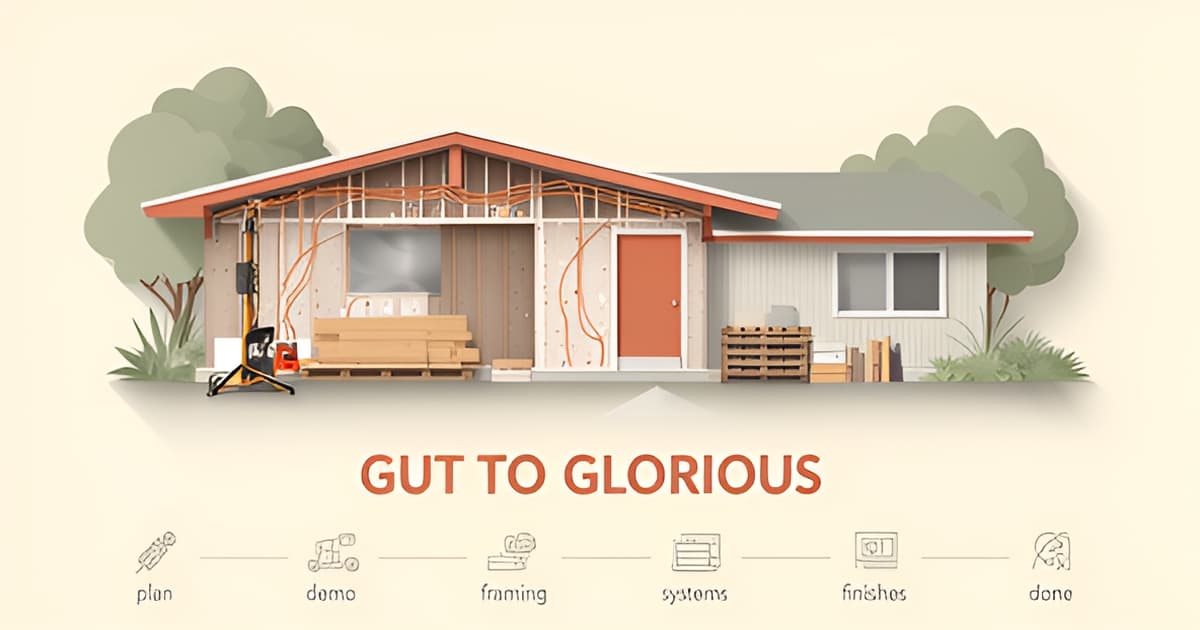
Gut renovation succeeds or fails on sequence. Across contractor guidance, the same six-phase order appears again and again: planning and design, permits, demolition, structural and mechanical rough-in, insulation and drywall with finishes, then final inspection and punch list. Skipping ahead anywhere in that chain usually costs more than the phase it saves.
Phase one is design — working with a structural engineer or design-build firm to lock the floor plan, especially any load-bearing changes. Structural work is the single biggest per-square-foot cost multiplier; removing a load-bearing wall typically runs $8,000–$15,000 once engineering ($300–$800) and beam installation ($2,000–$6,000) are included, according to renovation cost analysis.
Permits come next. In the LA area, express permits for projects without structural or layout changes run roughly $500–$1,000, while structural modifications start around $5,000 and can climb to $20,000 in stricter jurisdictions, per LA renovation cost data. The permit itself is rarely the expensive part — the inspection timeline is. Submit a complete package the first time; incomplete submissions go to the back of the queue.
Demolition follows, at $2–$8 per square foot for interior work — $3,000–$16,000 for a 1,500–2,000 square foot home. A professional crew guts a small house in days; DIY demo can drag on for months. In Altadena's pre-1978 housing stock, opening walls often reveals knob-and-tube wiring, galvanized plumbing, or asbestos, which is why practitioners recommend a 15–25% contingency for older homes.
Phase four — rough-in — is where sequencing discipline matters most:
- Design plumbing, electrical, and HVAC together as one system, not room by room.
- Complete all structural framing and beam work before mechanical trades begin.
- Schedule rough-in inspections before any insulation or drywall goes up.
- Upgrade electrical service to 200–400 amps as part of the whole-home scope.
Never close walls before rough-in inspections pass — a missed plumbing or electrical sign-off behind finished drywall means tearing work back out. Kitchens deserve their own budget line here: LA pricing for a 200-square-foot kitchen ranges from $24,500 at budget level to $85,000+ for high-end work, with wet rooms starting near $400 per square foot versus roughly $100 for dry rooms.
The final phases — insulation, drywall, and finishes, then the punch list and sign-off — move fastest when everything behind the walls was done right. If you're weighing a whole-home remodel alongside an ADU in Altadena, Altadena ADU Builder offers a free feasibility consultation with a cost-quiz concept render to help you scope both projects before you commit. Our featured builder, JMB Builders LLC (CSLB #1103479), handles whole-home remodels and Eaton Fire rebuilds locally.
Where the Money Goes: LA Labor, Wet Rooms, and Hidden Costs
If your gut-remodel budget feels bigger than expected, it's because the money rarely goes where homeowners think it does. Understanding the real cost drivers before demolition starts is the difference between a controlled project and a runaway one.
Labor is the largest line item. According to 2026 industry data, labor accounts for 50–60% of most renovation budgets — which is why major-metro pricing can run double rural rates. In Los Angeles, full-home renovation costs range from $125 to $500+ per square foot, and where each room falls on that spectrum matters enormously.
Not all square footage is priced equally:
- "Wet" rooms — kitchens and baths — start near $400 per square foot in LA; a 200-square-foot kitchen runs $24,500 on the budget end and $76,000–$85,000 high-end.
- "Dry" rooms like bedrooms and living areas come in around $100 per square foot.
- A 35-square-foot bathroom still costs $18,000–$25,000 at the budget level because plumbing, ventilation, and waterproofing concentrate the work.
- Structural changes are the single biggest per-square-foot multiplier — removing a load-bearing wall runs $8,000–$15,000 once engineering and beam costs are included.
Older Altadena homes hide predictable costs. Pre-1978 housing stock frequently conceals knob-and-tube wiring, galvanized plumbing, asbestos, and lead paint — none of which show up in a walkthrough, and all of which surface when walls open. Hazardous-material remediation alone can add tens of thousands of dollars, which is why practitioners recommend a 15–20% contingency, or 15–25% for homes built before 1985.
Two California-specific factors also shape the budget. First, the state has banned new gas lines in new construction — no gas stoves in new builds — though existing gas-line homes are unaffected; check current codes before planning appliance selections. Second, for fire-affected properties, the 2026 Title 24 Wildland-Urban Interface standards apply regardless of construction method, requiring fire-resistant materials and hardened vents.
For budgeting rules of thumb, the National Kitchen & Bath Association recommends allocating 10–15% of your home's value to a kitchen remodel. And when comparing bids, expect 20–40% variance between firms — which is why we advise Altadena homeowners to get at least three quotes from licensed contractors and weigh reputation alongside price. For readers considering an ADU alongside their remodel, Altadena ADU Builder offers a free feasibility consultation with a cost-quiz concept render.
ctaText: Planning a whole-house remodel or ADU in Altadena? Get a free ADU feasibility consultation with a cost-quiz concept render from Altadena ADU Builder.
socialProofText: Featured builder: JMB Builders LLC (CSLB #1103479), an Altadena-based licensed general contractor specializing in whole-home remodels and Eaton Fire rebuilds.
Your Action Plan: Bids, Permits, and Living Arrangements
Once your budget and sequencing plan are on paper, the remodel lives or dies by execution — and execution starts with three phone calls, one permit strategy, and honest answers about where you'll sleep.
Get at least three bids — and expect them to swing wildly. Contractor estimates on the same scope can vary by 20 to 40 percent between firms, so remodeling industry guidance recommends collecting a minimum of three quotes from licensed contractors before locking your budget. When bids arrive, resist the temptation to take the lowest number — cost-guide experts advise weighing reputation and workmanship alongside price, since a cheap bid that misses knob-and-tube wiring or an undersized electrical panel will cost more later.
Budget for temporary housing from day one. A gutted house has no walls, electricity, or running water, and living through demolition and hazardous-material removal is generally neither safe nor practical. Most Altadena homeowners plan for months of rental housing or an extended stay with family — a real line item that deserves its own place in the budget, not an afterthought.
Use LA County's Eaton Fire recovery resources. The county operates an official recovery hub with an express lane for rebuilding, one-stop Permit Centers, and fee waivers or refunds for fire-affected properties (see LA County's Eaton Fire recovery resources). Skipping permits entirely is a false economy: unpermitted work can trigger fines or even forced demolition. Your permit checklist should include:
- Confirming eligibility for the county's express permit lane and fee waivers before submitting plans
- Verifying your project meets the 2026 Title 24 Wildland-Urban Interface standards now required in fire-affected areas
- Submitting a complete package the first time — incomplete applications lose weeks in the queue
- Scheduling inspections around rough-in, since walls can't close until mechanical work passes
Sign early to lock material prices. Signing with a contractor early lets you lock in material prices and secure a start date, according to Sweeten's Los Angeles renovation guide — meaningful protection when a full traditional rebuild in Altadena can stretch 2 to 2.5 years and ALE insurance payouts run on their own clock.
When you're ready to talk to builders, look for licensed local firms with whole-home remodel and Eaton Fire rebuild experience. JMB Builders LLC (CSLB #1103479) is an Altadena-based licensed general contractor featured on this site (paid placement) whose custom homes, ADUs, and remodel work is documented at jmb-builders.com. Altadena ADU Builder also offers a free ADU feasibility consultation with a cost-quiz concept render — useful if you're weighing whether a backyard unit belongs in your remodel plans.
Frequently Asked Questions
How much does a whole-house gut remodel cost in Altadena?
Why do older Altadena homes need such a big contingency budget?
Should I gut remodel or tear down and rebuild?
What order should a gut renovation follow?
Can I live in my house during a gut remodel?
How do the Eaton Fire recovery rules affect my Altadena remodel?
Your Altadena Remodel, Mapped From Demo to Punch List
A whole-house remodel in Altadena isn't one decision — it's a chain of them: a realistic six-figure budget, a 15–25% contingency for what's hiding behind pre-1985 walls, and the discipline to follow the six-phase sequence without closing walls before rough-in inspections pass. With LA renovation costs running $125–$500+ per square foot and labor consuming 50–60% of most budgets, the homeowners who finish on budget are the ones who plan for surprises rather than hope against them. Your next steps are concrete: collect at least three licensed-contractor bids, confirm whether your property qualifies for LA County's Eaton Fire recovery express lane and fee waivers, and budget temporary housing from day one. If you're weighing a whole-home remodel alongside a backyard ADU, Altadena ADU Builder offers a free feasibility consultation with a cost-quiz concept render — real costs, real permits, real builders — so you can scope both projects before committing to either.