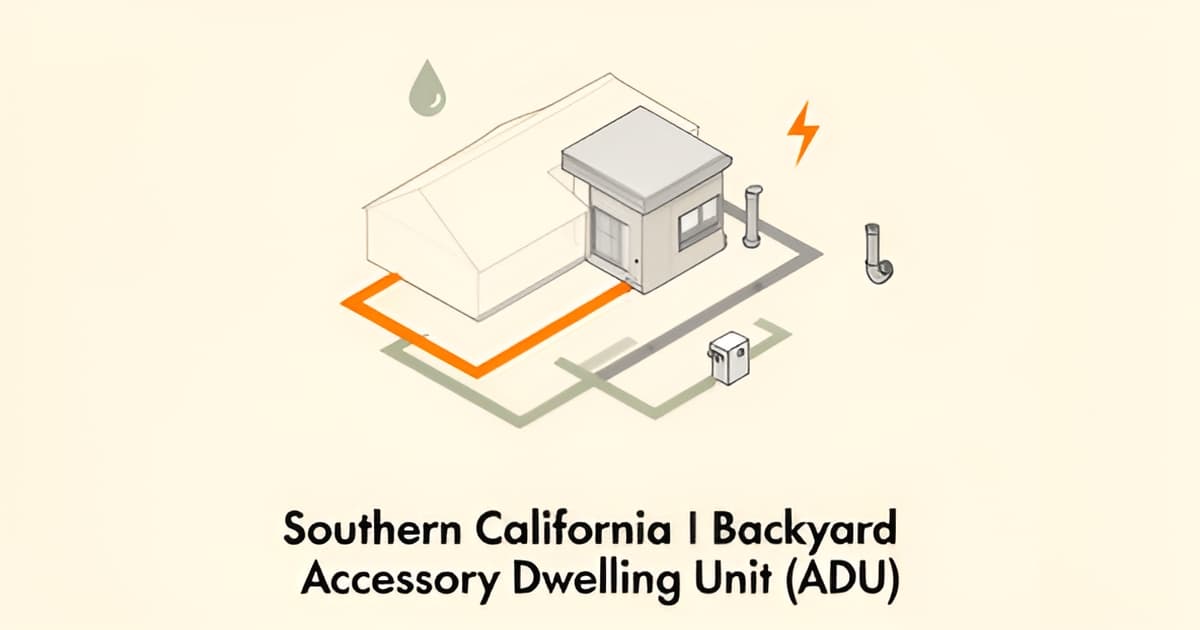
Site Utilities for an ADU: Sewer, Water, and Power Costs in LA County
Key Facts
- Full electrical service upgrades requiring utility coordination cost $5,000–$30,000 and add 3–6 months to ADU timelines, according to panel cost research.
- Pre-1960 Altadena homes with 60-amp service face $4,000–$8,000 panel upgrades, plus $10,000–$30,000 if knob-and-tube rewiring is discovered, per contractor cost data.
- A $3,000–$5,000 smart panel system can eliminate the need for a full service upgrade and skip the 3–6 month utility coordination window, research shows.
- LADWP takes roughly 100 calendar days to process and install small water services, with fees contingent on site-specific requirements, per the department's published timelines.
- Missing will-serve letters commonly cause 4–8 week schedule slips, and letters typically expire within 1–2 years, according to a licensed professional engineer.
- LA ADU planning guidance recommends 15–20% contingency for hillside, utility-heavy, or difficult-access projects versus 8–10% for straightforward conversions, per ADU cost planning data.
- Utility work cannot be priced responsibly from an ADU floor plan alone, as one LA County contractor warns — a low bid may simply omit trench, meter, or panel costs.
Why Utilities Decide Whether Your Altadena ADU Is Feasible
Most Altadena homeowners spend weeks comparing floor plans and finish packages before discovering that their ADU's fate was decided long ago — by the sewer line at the back of the lot, the amperage on their electrical panel, and the path a water line has to travel to reach the street. As one Los Angeles architect puts it, a second unit means real infrastructure, and if upgrades are needed, cost and timeline can change significantly.
The three questions that matter most are deceptively simple: How far is the sewer, and can it flow by gravity? Does your panel have spare capacity? Where can a water line run without trenching through hardscape or a neighbor's easement? Utility work cannot be priced responsibly from a floor plan alone — a low estimate may simply omit the lateral, meter, trench, or provider coordination your property actually requires.
Your ADU type changes the utility burden. Detached new-builds require full mechanical, electrical, and plumbing systems plus trenching and tie-ins, while attached units can share existing infrastructure. Garage conversions look cheaper on paper, but their feasibility often hinges on electrical panel capacity and sewer distance — two conditions the existing garage was never designed around.
Altadena's older housing stock raises the stakes considerably. Pre-1960 homes still operating on 60-amp service can face panel upgrades of $4,000–$8,000, with knob-and-tube rewiring adding another $10,000–$30,000. Full service upgrades requiring utility coordination can run $5,000–$30,000 and stretch timelines by three to six months.
This is also why typical all-in ADU budgets mislead Altadena homeowners. Planning-level estimates for Los Angeles — $140k–$245k for garage conversions, $219k–$459k for detached builds — explicitly exclude "unusual sewer or water upgrades." On a hillside lot with a long utility run, those exclusions aren't edge cases; they're the project. Budgeting guidance reflects this: straightforward conversions call for 8–10% contingency, but hillside, utility-heavy, or difficult-access projects warrant 15–20%.
The practical takeaway for Altadena homeowners:
- Walk your property and locate existing utility runs before hiring an architect or builder.
- Get a licensed electrical load calculation early — don't assume your panel can carry an ADU.
- Request will-serve letters as soon as you engage a civil engineer; missing letters commonly cause 4–8 week schedule slips.
- Treat any ADU estimate that prices utilities without a site visit as incomplete.
As one planning guide bluntly notes, the cheapest ADU is often not in the cheapest neighborhood — it sits on the simplest lot in a workable neighborhood. That's why Altadena ADU Builder starts every project conversation with a free feasibility consultation: a site-specific cost quiz and concept render that surfaces sewer, water, and power conditions before you fall in love with a floor plan.
The Four Cost Drivers: Sewer Distance, Panel Capacity, Water Routing, and Trenching Access
Ask two contractors for an ADU utility estimate and you'll often get two wildly different numbers — and neither may be wrong. The difference isn't the floor plan; it's the four site conditions that determine what's actually under your lot.
Electrical panel capacity carries the most reliable dollar data. Standard panel upgrades run $1,000–$5,000, while full service upgrades requiring utility coordination run $5,000–$30,000, according to a contractor cost guide citing federal sources. For Altadena's older housing stock, the numbers climb further: pre-1960 homes with 60-amp service typically need $4,000–$8,000 in panel work, plus potentially $10,000–$30,000 in knob-and-tube rewiring if it's discovered during the upgrade.
Sewer is the second driver, and here the honest answer is a range of variables rather than a fixed fee. The key question is whether your ADU can drain by gravity to the existing lateral or whether the run is too long, too shallow, or uphill. Because no LA County-specific sewer lateral pricing appears in published sources, treat any flat "sewer connection" line item with suspicion.
Water routing is third. In the City of LA, LADWP reports that small services (3-inch or smaller) take roughly 100 calendar days to process and install, with charges that are "contingent upon your site-specific service requirements" — meaning no two lots produce the same invoice. A one-year street-cut moratorium on freshly resurfaced streets can also force expensive workarounds.
Trenching access ties it all together. Long utility runs across hillside lots, limited equipment access, and street restoration all multiply cost — which is why LA planning guides recommend a 15–20% contingency for hillside, utility-heavy, or difficult-access projects, versus 8–10% for straightforward conversions.
The practical takeaway: compare bids only when the assumptions match. As one LA County contractor puts it, water, sewer, and electrical work "cannot be priced responsibly from the ADU floor plan alone," and a low number may simply omit the panel, lateral, meter, trench, restoration, or provider coordination your property actually needs.
- Panel upgrade scope: standard ($1,000–$5,000) versus full service with utility coordination ($5,000–$30,000)
- Sewer feasibility: gravity flow to the existing lateral, or a long, shallow, or uphill run
- Water service: meter size, routing distance, and LADWP-style timelines near 100 days
- Trenching access: run length, hillside conditions, and street restoration requirements
At Altadena ADU Builder, our free feasibility consultation with a cost-quiz concept render is built around exactly this framework — walking your lot's actual utility conditions before any number is trusted. Featured builder JMB Builders LLC (CSLB #1103479) brings local experience with older Altadena homes, where panel capacity and rewiring surprises are common.
Timelines and Paperwork: Will-Serve Letters and Water Service Lead Times
Most ADU budgets account for framing, finishes, and permits — then discover that a single sheet of paper from a water district can stall the entire project. Will-serve letters and utility lead times are the schedule risks homeowners consistently underestimate, and they can quietly add months before a single shovel hits the ground.
A will-serve letter is a utility provider's written commitment that it can serve your property. Without one, most planning agencies won't accept an entitlement application or issue a building permit, and completeness reviews often won't even start until all required letters are in hand, according to guidance from a licensed professional engineer. That makes the letter a gate, not a formality.
The timing math matters. Typical turnaround runs 4–6 weeks for water and sewer agencies, with optimistic cases at 2–3 weeks — but missing letters cause 4–8 week schedule slips on projects that skip them early. Letters are typically valid for 1–2 years, so requesting one before you need it carries little risk. The expert advice is blunt: request will-serve letters the same week you hire your civil engineer.
For context on how long utility work itself takes, look at LADWP's published timelines. The department quotes roughly 100 calendar days for processing and installation of small water services (3-inch or smaller), and about 140 days for large services. Its fees fall into three categories — the Water Main Charge (WMC), Acreage Supply Charge (ASC), and Street Damage Restoration Fee (SDRF) — all "contingent upon your site-specific service requirements."
LADWP also enforces a one-year street-cut moratorium: streets resurfaced less than a year before a proposed excavation cannot be cut unless the benefiting party paves the entire City block. If your street was recently slurry-sealed, your water service route may need a rethink — or a very large check.
Key takeaways for your project calendar:
- Request will-serve letters the same week you engage your civil engineer, not after design is complete.
- Budget 4–6 weeks for typical water and sewer agency turnaround, and plan for 4–8 week slips if a letter is missing at submittal.
- Remember letters expire — typically within 1–2 years — so don't request them years ahead of construction.
- Check whether your street was resurfaced in the last 12 months before planning any water line excavation.
One important caveat for Altadena homeowners: Altadena is unincorporated LA County, so LADWP's City of LA procedures and timelines serve as useful context, not exact requirements. Your water provider, sanitation district, and permitting authority will differ. Because utility work cannot be priced responsibly from a floor plan alone, Altadena ADU Builder recommends confirming your actual providers and timelines early — a free ADU feasibility consultation can map your lot's specific utility picture before you commit to a schedule.
How to Budget Smart: Contingency, All-Electric Design, and the Simplest-Lot Strategy
Two identical lots can produce ADU budgets $50,000 apart, and the difference is almost never the floor plan — it's what's under and around it. Smart budgeting in Altadena means planning for the site you actually have, not the one in the rendering.
Start with contingency. Planning-level guidance for Los Angeles ADUs calls for 8–10% contingency on straightforward conversions and 15–20% on hillside, utility-heavy, or difficult-access projects, per LA ADU cost planning data. On a $250,000 detached ADU, that gap is the difference between a $25,000 buffer and a $50,000 one — and Altadena's slope lots and older housing stock put most projects in the higher tier.
Next, look for ways to avoid the most expensive utility coordination entirely. A full electrical service upgrade requiring utility coordination can run $5,000–$30,000 on the West Coast and add 3–6 months to your timeline, according to electrical panel cost research. A smart panel system ($3,000–$5,000) can eliminate the service upgrade need and skip that 3–6 month coordination window — often the single best cost-and-schedule trade available. Lower-cost options like subpanels ($800–$2,000) or circuit-sharing devices ($400–$900) may also work depending on your load calculation.
Then consider going all-electric. Many new ADUs are designed without gas entirely, which avoids routing a new gas line across the site and pairs naturally with heat-pump HVAC and heat-pump water heating. For a garage conversion or detached unit on a tight Altadena lot, deleting the gas run removes one trench, one trade, and one coordination headache.
Finally, embrace the simplest-lot principle: "The cheapest Los Angeles ADU is often not in the cheapest neighborhood. It is on the simplest lot in a workable neighborhood." In practice, that means prioritizing:
- Short sewer runs with gravity flow toward an existing lateral
- Adequate panel capacity — or a smart-panel workaround — before design is finalized
- All-electric mechanical design to skip gas routing
- Trenching paths with clear, unobstructed access
None of these numbers can be confirmed from a floor plan alone. Utility work "cannot be priced responsibly from the ADU floor plan," as one LA-serving contractor puts it — a licensed load calculation, a camera inspection of the sewer lateral, and a walk of the property come first. That's exactly why Altadena ADU Builder offers a free feasibility consultation with a cost-quiz concept render: to surface your lot's utility realities before they surface in your budget. Featured builder JMB Builders LLC (CSLB #1103479) brings local experience with hillside lots and Eaton Fire rebuilds, though every project's final costs depend on site-specific conditions.
Your Next Step: Get a Site-Specific Feasibility Read on Your Altadena Lot
Every reliable ADU budget in Altadena starts the same way: with the lot, not the floor plan. Utility conditions — sewer distance, panel capacity, water routing — are what determine whether your project pencils out, and no honest number can be attached to them from a desk.
The experts converge on a simple implementation path. Architect Daniel Ziese advises homeowners to walk the property before hiring anyone and ask one question: "Where do utilities run now?" That walk tells you whether your ADU sits near an existing sewer lateral or faces a long trench, whether the panel has headroom, and whether trenching access is realistic on a hillside lot.
From there, the recommended sequence is concrete:
- Commission a licensed load calculation to determine whether your existing electrical service can carry the ADU — or whether you're facing a panel upgrade.
- Get a camera inspection of the sewer lateral to confirm connection depth, condition, and gravity feasibility.
- Identify will-serve requirements early; missing letters can cause 4–8 week schedule slips, and most agencies won't begin entitlement reviews without them.
- Compare contractor bids only when the underlying assumptions match — a low number may simply omit the panel, lateral, meter, trench, or provider coordination your property actually needs.
The stakes are real. Standard panel upgrades run $1,000–$5,000, but full service upgrades requiring utility coordination can reach $5,000–$30,000 — and pre-1960 homes with 60-amp service, common in Altadena's older neighborhoods, may face $4,000–$8,000 upgrades plus potential rewiring. That's why contingency planning matters: guidance for LA ADUs suggests 15–20% reserves for hillside, utility-heavy, or difficult-access projects, a category that describes much of Altadena.
This is precisely why we built the free ADU feasibility consultation at Altadena ADU Builder around a site-specific read rather than a generic estimate. You complete a short cost quiz, receive a concept render of your property's ADU potential, and get a feasibility picture grounded in your lot's actual utility conditions — not a citywide average.
For homeowners who want to move forward with a licensed professional, our featured builder is JMB Builders LLC (CSLB #1103479), an Altadena-based general contractor whose ADU, custom home, and Eaton Fire rebuild work is documented at jmb-builders.com. As with any contractor on your shortlist, ask them to price from the same load calculation and sewer inspection data — not from assumptions.
The cheapest ADU in Los Angeles isn't in the cheapest neighborhood; it's on the simplest lot. Your feasibility read is how you find out which kind of lot you have.
Frequently Asked Questions
How much does it cost to upgrade an electrical panel for an ADU in Altadena?
What is a will-serve letter and why does my ADU project need one?
Can my contractor estimate ADU utility costs from the floor plan alone?
How long does it take to get a new water service connection in LA County?
How much contingency should I budget for ADU utilities on an Altadena hillside lot?
Should my ADU be all-electric to save on utility connection costs?
Your Lot Already Knows the Answer
Before you pick finishes or fall for a floor plan, your Altadena ADU's fate is largely decided by what's already in the ground: sewer distance and gravity flow, panel capacity, water routing, and trenching access. As this article has shown, panel upgrades alone can range from $1,000–$5,000 to $5,000–$30,000 when utility coordination is required, and hillside, utility-heavy projects warrant 15–20% contingency rather than the standard 8–10%, according to LA ADU cost planning data. The path forward is practical: walk your lot and trace existing utility runs, commission a licensed load calculation, get a camera inspection of your sewer lateral, and request will-serve letters the same week you engage your civil engineer. Then compare bids only when the underlying assumptions match. Altadena ADU Builder's free feasibility consultation was built for exactly this moment — a short cost quiz and concept render that surfaces your lot's utility realities before they surface in your budget. Take the quiz, get your render, and find out whether you're sitting on a simple lot or an expensive surprise.