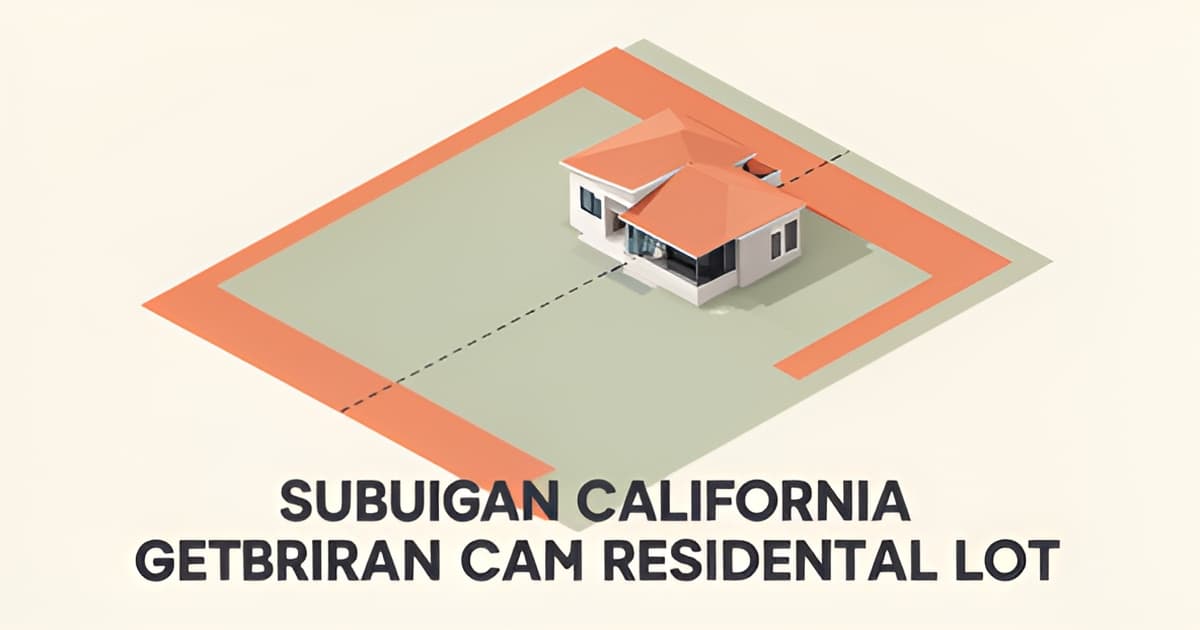
SB 9 Lot Split in California: Requirements and Costs
Key Facts
- An SB 9 lot split costs $40,000–$70,000 in planning work alone, before any construction begins.
- Los Angeles received 28 SB 9 lot split applications but approved zero through November 2022, Terner Center research found.
- LA permitted 5,064 ADUs in 2021 versus just 38 SB 9 units, early data shows.
- Each SB 9 parcel must be at least 1,200 square feet, with no more than a 40/60 size split.
- Very high fire severity zones, earthquake fault zones, and floodplains are entirely excluded, LA County Planning confirms.
- Applicants must sign an affidavit committing to live on the property for at least three years.
- Fewer than 2% of single-family lots can realistically use SB 9's full four-unit potential, Terner Center estimates.
- In unincorporated LA County, a final map must be recorded before any construction starts.
Why Altadena Homeowners Ask About SB 9 — and Why So Few Follow Through
On paper, SB 9 sounds like a windfall for Altadena homeowners: split one lot into two legal parcels, get ministerial approval with no discretionary hearings, and create a new real estate asset where only one existed before. The reality, so far, looks very different.
One year into the law's implementation, a Terner Center study found that Los Angeles had received just 28 lot split applications through November 2022 — and approved zero. During that same period, the city permitted 5,064 ADUs in 2021 alone, and ADUs now account for nearly a fifth of all new units permitted statewide.
Why the gap? Planners reported high inquiry volumes about SB 9 that never converted into applications, citing the time, resources, and costs involved. The numbers tell the story:
- Planning-level costs for a lot split typically run $40,000–$70,000 — before a single nail is hammered for any new construction.
- The applicant must sign an affidavit committing to live on the property as their principal residence for at least three years from approval.
- Each new parcel must be at least 1,200 square feet, with no more than a 40/60 split of the original lot.
- Properties in very high fire severity zones — along with earthquake fault zones and flood hazard areas — are excluded entirely, a constraint LA County Planning confirms applies to unincorporated areas like Altadena.
There's also a procedural wrinkle specific to Altadena. Because it sits in unincorporated LA County, LA County Planning requires a recorded final map before any construction can begin, followed by a Ministerial Site Plan Review for the proposed development. That's a lengthy subdivision process, not a quick permit.
The contrast with ADUs is stark. Planners attribute ADUs' dominance to more permissive rules: fee limits, no owner-occupancy requirement, and larger allowed unit sizes. Cities with heavy ADU production — San Diego permitted 871 ADUs in 2021 — saw almost no SB 9 activity. Homeowners are voting with their applications.
That doesn't mean a lot split is never the right move. The Terner Center found SB 9 works best on larger lots where the home isn't centered on the parcel, and in markets where high sale prices make splitting financially worthwhile. Some Altadena properties may fit that profile. But it does mean the honest question isn't "Can I split my lot?" — it's "Which path creates more value for my specific property?"
At Altadena ADU Builder, we help homeowners work through exactly that comparison with a free ADU feasibility consultation, including a cost-quiz concept render. Given that the most expensive SB 9 projects are often the ones where homeowners spend money in the wrong order, a feasibility-first approach is the smart starting point — whichever direction you ultimately take.
The Eligibility Checklist: Does Your Altadena Lot Even Qualify?
Before you spend a dollar on surveys or subdivision maps, you need a blunt answer to one question: does your Altadena parcel actually qualify under SB 9? The statute looks permissive on paper, but a short list of hard requirements quietly disqualifies a surprising number of hillside lots.
Start with the geometry. Under the HOME Act's statutory framework, each new parcel must be at least 40% of the original lot's size — a maximum 40/60 split — and each parcel must measure at least 1,200 square feet. A 6,000-square-foot lot barely clears the bar; anything smaller is out.
Then come the one-shot rules. No sequential splits are allowed: you cannot split the same parcel twice, and you cannot participate in a split of an adjacent parcel under common ownership. The property must also sit within a city or the urbanized portion of an unincorporated county — which Altadena, as unincorporated LA County territory, satisfies on its face.
- Each new parcel at least 40% of the original size (40/60 maximum split)
- Minimum 1,200 sq ft per newly created parcel
- No sequential splits or coordinated splits of adjacent parcels
- Site must be in a city or urbanized unincorporated area
- No demolition of affordable, rent-controlled, or tenant-occupied housing within the last three years
The exclusions are where Altadena homeowners hit a wall. The statute bars lot splits on sites in very high fire severity zones, earthquake fault zones, and 100-year flood zones or floodways, along with wetlands, hazardous waste sites, and protected habitat. LA County Planning confirms that fire, earthquake, and flood hazards all constrain SB 9 eligibility in unincorporated areas — a reality check for a foothill community where wildfire mapping covers significant swaths of the landscape.
These constraints are a big reason statewide uptake has been so thin. A Terner Center study found that fewer than 2% of single-family lots can realistically use SB 9 for its full four-unit potential, given qualifying conditions, physical capacity, and financial feasibility.
That's why we at Altadena ADU Builder always recommend a feasibility-first approach before any spending. As one engineering practitioner puts it, the most expensive SB 9 project is often the one where a homeowner spends money in the wrong order. Checking your parcel's hazard-zone status against County maps costs nothing — and for many Altadena lots, a straightforward ADU or a rebuild with a local builder like JMB Builders LLC may prove the far more workable path.
What an SB 9 Lot Split Actually Costs: $40,000–$70,000 Before You Build Anything
Before a single wall goes up on either new lot, an SB 9 lot split in California typically costs $40,000 to $70,000 in planning-level work alone. That figure — which covers feasibility analysis, surveying, mapping, engineering, agency review, and recordation — excludes construction entirely, and it catches many homeowners off guard.
There is no flat statewide price. As one civil engineering firm's cost guide explains, SB 9 is a legal and technical subdivision process, and the total depends heavily on parcel-specific conditions. Simpler properties start near $40,000, while full-service projects typically land in the $60,000–$70,000 range. The estimate also leaves out major utility extensions, unusual grading, lender and title work, legal advice, and financing — so treat it as a floor, not a ceiling.
Several factors push a specific project toward the high end of that range:
- Site constraints: slope, drainage, access, utility locations, irregular lot shape, and existing improvements
- Legal and title complications, including mortgages, lender requirements, easements, and deed conditions
- Local review variation, since each agency sets its own fee structure and process
- Hazard exclusions — very high fire severity zones, earthquake fault zones, and 100-year floodplains are ineligible entirely
That last point matters in Altadena, where LA County Planning confirms that fire, earthquake, and flood hazards constrain eligibility in unincorporated areas. Verifying eligibility before spending anything is essential.
The costliest mistake, practitioners say, is sequencing. "The most expensive version of an SB9 project is often the one where a homeowner spends money in the wrong order," notes Riechers Engineering, which recommends a feasibility review before full commitment. Ordering a survey or map before confirming your parcel qualifies — or discovering a title problem after paying for engineering — wastes money you can't recover.
Beyond the upfront spend, the obligations are real. The applicant must sign an affidavit committing to live on one of the units as a principal residence for at least three years from approval, and any rental must be for terms longer than 30 days — no short-term rentals. In LA County's unincorporated areas, a final map must be recorded before any construction begins.
This is why at Altadena ADU Builder we tell homeowners to weigh a lot split against an ADU honestly. The Terner Center at UC Berkeley found that homeowners overwhelmingly choose ADUs instead — Los Angeles permitted 5,064 ADUs in 2021 but approved zero SB 9 lot splits — largely because ADUs carry fee limits, no owner-occupancy requirement, and fewer procedural hurdles. A free feasibility consultation with a concept render can tell you which path — if either — pencils out for your property before you spend $40,000 learning the hard way.
The LA County Process Sequence: Final Map First, Construction Second
Splitting a lot in Altadena isn't like pulling a permit for a remodel — the sequence matters, and getting it out of order can cost you tens of thousands of dollars. For unincorporated LA County properties, the process runs in a strict order that LA County Planning spells out clearly.
Step 1: Feasibility review before you spend anything. As one engineering practitioner puts it, "the most expensive version of an SB9 project is often the one where a homeowner spends money in the wrong order" — which is why a feasibility-first approach matters. LA County Planning confirms that hazard constraints — fire, earthquake, and flood zones — can disqualify a parcel entirely, a point Altadena homeowners should weigh carefully given local wildfire conditions.
Step 2: Record the final map before construction begins. This is the step that surprises people. Per LA County Planning, a final map must be recorded before any construction can start on either newly created parcel. You cannot begin building while the map is in process.
Step 3: Ministerial Site Plan Review for the proposed development. Once the map is recorded, the county can approve proposed development through a Ministerial Site Plan Review — no discretionary hearings, and per legal analysis of the statute, ministerially approved projects are exempt from CEQA review.
Local objective standards still apply to what you build. Under state law, these standards cannot preclude units under 800 square feet, and the county may require:
- 4-foot side and rear setbacks
- A maximum of 1 parking space per unit (none required within a half-mile of transit)
- Protection of 800 sq ft minimum floor area for proposed units
Planning-level costs for the split itself typically run $40,000–$70,000, excluding construction, per engineering cost estimates. Each new parcel must be at least 1,200 square feet, with no more than a 40/60 size split.
Two honest caveats. First, real-world uptake has been extremely limited — Los Angeles saw just 28 lot split applications with zero approved through November 2022, per Terner Center research. Second, no one can guarantee permits or timelines; agency review varies and planning departments face staffing constraints.
If you're weighing a lot split against a simpler backyard ADU, Altadena ADU Builder offers a free feasibility consultation with a cost-quiz concept render to help you decide which path actually pencils out for your property.
SB 9 vs. ADU: The Honest Comparison Altadena Homeowners Need
If you're weighing a lot split against a backyard ADU, the data makes the choice remarkably clear: California homeowners have voted with their permit applications, and ADUs won in a landslide.
Los Angeles permitted 5,064 ADUs in 2021 while approving just 38 SB 9 units — and Terner Center research found zero approved lot splits in the city through November 2022. ADUs now represent nearly a fifth of all new units permitted statewide. Cities with the highest ADU production, like San Diego with 871 ADUs permitted in 2021, saw almost no SB 9 activity at all.
Why the lopsided preference? Planners point to three structural advantages ADUs hold over SB 9 lot splits:
- Fee limits — ADU law caps many of the impact fees that make SB 9 projects expensive
- No owner-occupancy requirement — SB 9 requires an affidavit to occupy one unit as your principal residence for three years; ADUs don't
- Larger allowed units — local ordinances can shrink SB 9 unit sizes, while ADU law protects reasonable sizes
The cost gap compounds the difference. A lot split runs $40,000–$70,000 in planning costs alone — before a single stud goes up. An ADU skips the subdivision process entirely: no survey, no final map recording, no parcel-level legal work.
That said, a lot split can still make sense for larger Altadena lots where the home isn't centered on the parcel and high property values justify the process. The Terner Center found the strongest lot-split activity in exactly those conditions — Saratoga and Danville, with their large lots and premium home prices, outperformed cities many times their size.
Whichever path fits your property, the sequence matters more than the choice. As one engineering firm bluntly puts it, "the most expensive version of an SB9 project is often the one where a homeowner spends money in the wrong order." A feasibility review before committing funds applies equally to ADUs, especially in Altadena, where LA County Planning confirms fire, earthquake, and flood hazard zones constrain what's buildable.
That's why Altadena ADU Builder starts with feasibility, not construction bids. Book a free ADU feasibility consultation and get a cost-quiz concept render tailored to your lot — no obligation, no permit or timeline promises. Our featured builder, JMB Builders LLC (CSLB #1103479), an Altadena-based licensed general contractor experienced in custom homes, ADUs, and Eaton Fire rebuilds, can help you understand what your property can realistically support before you spend a dollar.
Frequently Asked Questions
How much does an SB 9 lot split actually cost in California?
Can I split my Altadena lot under SB 9 if it's in a fire hazard zone?
Do I have to live in the house after an SB 9 lot split?
Is an SB 9 lot split or an ADU the better choice for my property?
What are the minimum lot size requirements for an SB 9 split?
How does the SB 9 process work in unincorporated LA County like Altadena?
The Right Question Isn't 'Can I Split My Lot?' — It's 'What's the Smartest Move for My Property?'
SB 9 promises a new parcel on paper, but the reality for Altadena homeowners is steep: $40,000–$70,000 in planning costs before any construction, a three-year owner-occupancy affidavit, strict 1,200-square-foot and 40/60 split requirements, hazard-zone exclusions, and a County process that requires a recorded final map before you can build. The market has noticed — Los Angeles saw 28 lot split applications and zero approvals through November 2022, while homeowners permitted thousands of ADUs in the same period. That doesn't mean a lot split is never right — larger, unconstrained lots with homes off-center can still pencil out. But the real decision isn't SB 9 versus nothing; it's SB 9 versus an ADU versus a rebuild, based on your specific parcel. And whichever direction you go, sequence matters: the costliest projects are the ones where money gets spent in the wrong order. Start with feasibility, not bids. Altadena ADU Builder offers a free ADU feasibility consultation with a cost-quiz concept render — and our featured builder, JMB Builders LLC (CSLB #1103479), can help you understand what your lot can realistically support before you commit a dollar.