Prefab ADU in Los Angeles: What the Delivered Price Doesn't Include
Key Facts
- A factory prefab unit priced $80,000–$120,000 typically carries $40,000–$80,000 in site work, per APLA Construction.
- Site preparation typically adds $25,000–$80,000 to a prefab base unit price according to ADUZoning.org.
- In one real LA project, a 75-foot sewer trench helped push plumbing and electrical to $60,000 — about 23% of the $259,000 budget per Cali-ADU's case study.
- Crane set alone runs $3,000–$6,000, and California loads wider than 14 feet require a paid police escort per Maxable's prefab cost guide.
- City of LA permit and plan-check fees run roughly $3,000–$6,000, paid directly by homeowners per a documented LA case study.
- Even 'all-in' prefab contracts exclude property tax reassessment of $500–$1,500 per year per Epic Modulars' own FAQ.
- Utility connections 'often surprise homeowners,' with trenching, 200-amp panel upgrades, and sewer laterals outside the unit price per LADU's cost analysis.
The Sticker Price Is Only the Beginning
That $89,000 "turnkey" backyard studio in the Instagram ad is not turnkey. It's a factory price for a box that doesn't yet sit on your property, connect to your utilities, or hold a permit from the city.
The gap between what prefab vendors quote and what you actually pay is the defining issue in LA ADU pricing. According to APLA Construction's numbers, a factory unit priced at $80,000–$120,000 typically carries $40,000–$80,000 in site work — foundation, utilities, grading, and permits — bringing the total installed cost to $140,000–$230,000. That's often more than a comparable stick-built ADU at $115,000–$200,000.
ADUZoning.org's cost tables tell the same story at every size. A site prep and installation breakdown shows $25,000–$50K added to a studio and $50K–$80K on an 800–1,200 sq ft unit — roughly a third to nearly half of the total installed cost, on top of the sticker price.
What the sticker price typically leaves out:
- Foundation, grading, and site preparation — $8,000–$15,000 in one vendor's own breakdown, but far more on sloped or tree-filled lots
- Utility connections — trenching, panel upgrades, and sewer laterals that "often surprise homeowners"
- Crane and delivery logistics — $3,000–$6,000 for the crane set alone, plus police escorts for loads over 14 feet wide
- Permit and plan-check fees — roughly $3,000–$6,000 in the City of LA, paid directly by homeowners
- In some contracts, the licensed contractor and interior finishes themselves
The savings claims conflict, too — and the conflicts follow the money. Prefab vendors advertise factory-built savings of 20–50%, with Epic Modulars claiming 30–50% and ADUZoning.org citing 20–40%. But the sources arguing from installed cost — APLA and Maxable — conclude that prefab is rarely cheaper once site costs are included. Notably, the optimistic claims come from companies selling prefab; the skepticism comes from contractors who build on-site. Each has a commercial incentive, so treat both as directional, not gospel.
The practical takeaway for Altadena homeowners: always ask for total installed cost, not unit price, and get utilities, crane access, and lot conditions scoped before signing anything. That's why Altadena ADU Builder recommends a feasibility-first approach — a free consultation that starts with your sewer line and your side yard, not a brochure. If you're comparing prefab against a local builder like JMB Builders LLC (CSLB #1103479), ask both for the same deliverable: an all-in number on the same drawings.
The Four Cost Clusters Prefab Quotes Leave Out
When a prefab ADU quote arrives looking like a bargain, the fine print usually tells a different story. Across Los Angeles, site work typically adds $25,000–$80,000 to the base unit price, according to ADU industry cost analysis — and most of that sits in four predictable clusters that factory quotes leave out.
1. Utility connections. This is the most common surprise. Trenching distance, 200-amp panel upgrades, sewer lateral repairs, water meter sizing, and city tie-in fees all fall outside the unit price, and industry reporting on prefab ADU costs notes these items "often surprise homeowners." A real North Hills case study documented the stakes: a 75-foot sewer trench helped push plumbing and electrical to a combined $60,000 — roughly 23% of the project's $259,000 budget.
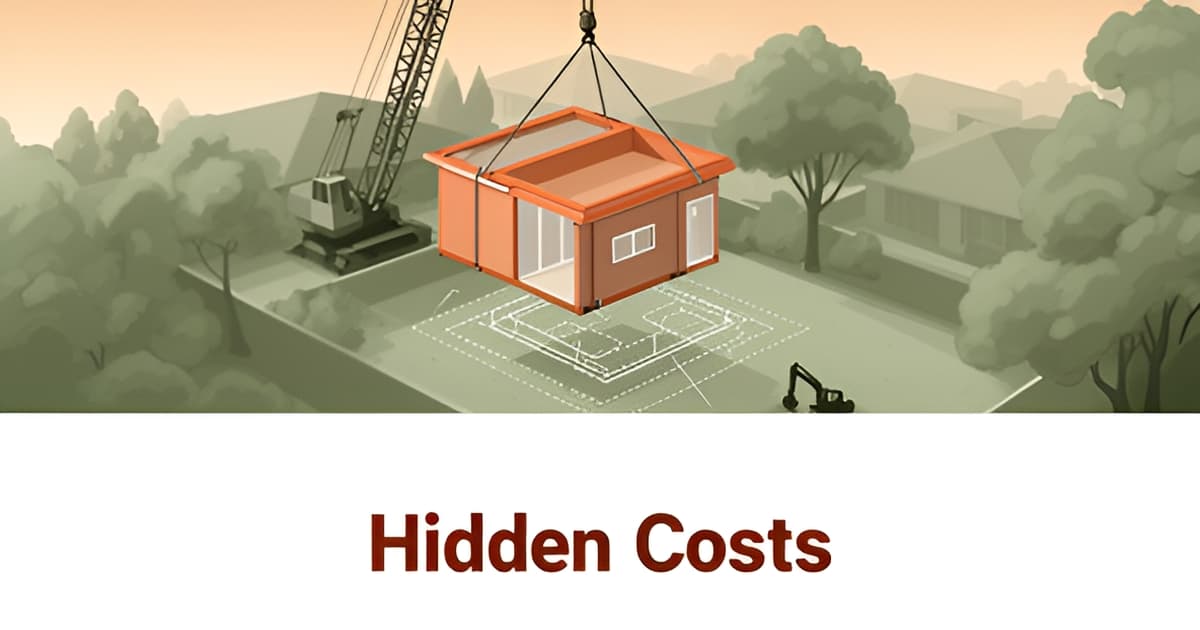
2. Crane and delivery. Getting a factory-built module onto a tight Los Angeles lot is its own line item. Crane set alone runs $3,000–$6,000 per one vendor's breakdown, and California law adds more: loads wider than 14 feet require a paid police escort, and street closures for delivery require a city permit fee, as Maxable's prefab cost guide explains. Low-clearance driveways and overhead power lines can force a larger crane or a multi-piece set entirely.
3. Ground and street issues. Hidden costs, as one design-build team puts it, "tend to cluster around ground and street issues." That includes soil reports and engineering, retaining walls near property lines, tree removal and arborist work, demolition of existing structures, and crane-day traffic control. On a difficult lot — a slope, a pool to fill, hard material under the surface — these items can quietly double the site-work budget.
4. Permits and plan-check fees. Prefab does not skip LADBS permitting, which runs 3–5 months for any ADU type. City of LA permit and plan-check fees of approximately $3,000–$6,000 are paid directly by homeowners and excluded from construction totals, per a line-by-line LA case study. Even small design changes, like swapping windows or doors, can void pre-approved Title 24 calculations and slow the city submittal.
- Utility connections: trenching, panel upgrades, sewer laterals, tie-in fees — potentially $60,000+ in extreme cases
- Crane and delivery: $3,000–$6,000 for the set, plus escorts and street-closure permits for wide loads
- Ground and street: soil reports, retaining walls, tree removal, demolition
- Permits and plan-check: roughly $3,000–$6,000 paid separately by the homeowner
None of these figures are guarantees — lot conditions, not prefab status, drive most of the variance. That's why Altadena ADU Builder's free feasibility consultation starts with a cost-quiz concept render that scopes utilities, access, and site conditions before you compare quotes. For homeowners weighing prefab against a custom build, a licensed local contractor like JMB Builders LLC (CSLB #1103479) can price the full installed cost up front — the number that actually matters.
What Even 'All-In' Prefab Contracts Don't Cover
Even when a prefab company advertises an "all-in" price, the contract itself often stops short of what you'd assume it covers. According to ADU marketplace Maxable, many prefab companies don't include a licensed contractor at all — the homeowner has to hire one separately, negotiate fees, and manage problems on site. Interior finishes may also be excluded entirely, meaning a second contract and a second contractor just to make the unit livable.
That's the fine print worth reading before you sign. Even a bundled contract that genuinely includes delivery, foundation, and utility connections leaves certain costs outside any builder's control. Epic Modulars, a prefab vendor that markets a $79,000 starting price with crane set and site work included, admits in its own FAQ that three costs remain excluded:
- Property tax reassessment after completion, typically adding $500–$1,500 per year
- Extraordinary city impact fees, which vary by jurisdiction and project scope
- Utility service panel upgrades, common when older homes need 200-amp service
None of these show up in a quote, and none are trivial. A panel upgrade or an unexpected impact fee can add thousands of dollars in the final weeks of a project, when you have the least leverage to negotiate.
Then there's the timeline reality. Prefab marketing emphasizes factory speed, and the factory build is genuinely fast — but permitting in Los Angeles still runs 3–5 months for any ADU type, prefab or stick-built. Factory lead time adds another 3–6 months on top, which is why total prefab timelines land at 6–10 months — faster than traditional construction, but not the weeks-long transformation some buyers imagine. The unit can sit in a warehouse waiting on your permits before a single crane arrives.
For Altadena homeowners, the lesson is to read the contract the way a contractor would. Ask who holds the license, who installs finishes, and who pays for permits, panels, and post-completion taxes. At Altadena ADU Builder, our free feasibility consultation includes a cost-quiz concept render so you can see what your specific lot actually requires — and if you'd rather work with a local licensed general contractor who scopes site work up front, our featured builder JMB Builders LLC (CSLB #1103479) builds ADUs across Altadena. The sticker price is only the beginning of the conversation.
How to Compare Bids on an Apples-to-Apples Basis
The sticker price on a prefab ADU quote tells you almost nothing until you know what's standing between that number and a finished, permitted, connected backyard unit. Here's how to make competing bids actually comparable.
Ask for total installed cost — always. The single most reliable way to compare is to require every bidder to quote the complete project: foundation, utilities, permits, delivery, and crane set included. ADUZoning.org's guidance is blunt: site preparation typically adds $25,000–$80,000 to the base unit price, and that range is exactly where misleading quotes live.
Get stick-framed and panelized pricing on the same drawings. One contractor recommends comparing total framing cost, the delivery and lifting plan, and the schedule — not the panel quote alone — because installed prefab costs of $140,000–$230,000 can exceed stick-built equivalents at $115,000–$200,000 for the same size range. Same drawings, same scope, same site assumptions. That's the only apples-to-apples comparison that means anything.
Before signing anything, scope these three items in writing:
- Utility runs — trenching distance, 200-amp panel upgrades, and sewer laterals "often surprise homeowners," per LADU's cost analysis.
- Crane access — crane set alone runs $3,000–$6,000, and California loads wider than 14 feet require a paid police escort, per Maxable's breakdown.
- Lot conditions — soil reports, retaining walls, tree removal, and demolition are the typical hidden-cost cluster.
- Permit fees — roughly $3,000–$6,000 in plan-check costs that homeowners pay directly, per a documented LA case study.
Altadena adds its own degree of difficulty. Hillside lots, tight side yards, and overhead lines can force a larger crane, street closures, or multi-piece modular sets — costs that scale with terrain, not with the factory price. And because Altadena sits in LA County unincorporated territory, permitting runs through the county, not LADBS, so bid assumptions built for city-of-LA projects don't automatically transfer.
That's why working with a licensed local contractor who scopes site work up front matters. A builder like JMB Builders LLC (CSLB #1103479), an Altadena-based firm whose ADU and rebuild work is documented on jmb-builders.com, walks the lot before quoting — measuring trenching distances, checking access, and flagging grading issues while they're still line items, not surprises. Many prefab companies don't include a licensed contractor at all, leaving you to hire one separately mid-project.
Altadena ADU Builder offers a free ADU feasibility consultation with a cost-quiz concept render — a practical first step for scoping your lot before you collect bids. Real costs, real permits, real builders: that's the comparison that protects your budget.
Your Prefab ADU Feasibility Checklist
Before you sign a prefab ADU contract, spend an afternoon verifying what the quote actually assumes. Most disagreements between homeowners and prefab companies trace back to one thing: nobody measured the site before the price was written.
Start with utilities. Walk the route from your main panel, water meter, and sewer lateral to the ADU pad and count the feet. Trenching distance and depth through hardscape, panel upgrades, and city tie-in fees are the costs that most often surprise homeowners, and one real Los Angeles project saw plumbing and electrical alone reach $60,000 — about 23% of the total budget — partly because of a 75-foot sewer trench. Next, check crane and street access: measure your side yard and driveway clearance, note overhead lines, and confirm street width. In California, loads wider than 14 feet require a paid police escort, and any street closure for delivery needs a city permit; crane set alone typically runs $3,000–$6,000.
Then look down and at the paperwork:
- Get a soil report or geotechnical assessment. Slopes, poor bearing soil, retaining walls, and large tree removal are the classic exclusions that turn a flat quote into a change-order budget.
- Confirm who holds the contractor license. Many prefab companies don't include a licensed contractor at all — you hire one separately, and interior finishes may be excluded too. Verify the license number on the CSLB site; a local builder like JMB Builders LLC (CSLB #1103479) scopes site work up front rather than billing it back later.
- Total the true budget. Add permit and plan-check fees (roughly $3,000–$6,000 in the City of LA, paid separately), property tax reassessment of typically $500–$1,500 per year, and any impact fees — even "all-in" prefab contracts leave these outside the contract.
Run the break-even math honestly. A $220,000 installed ADU renting at $2,400 per month takes roughly 7.6 years to recoup — before financing costs and taxes. That's a fine outcome for many Altadena homeowners, but only if the number you're amortizing is the installed cost, not the sticker price. Site work typically adds $25,000–$80,000 to a prefab base price, so the gap between quote and reality is often the difference between a good investment and a strained one.
If you'd rather not guess, Altadena ADU Builder offers a free ADU feasibility consultation: we assess utility distances, crane access, and lot conditions on your specific property, and the cost quiz returns a concept render alongside a realistic installed-cost range. Qualifying homeowners should also ask about the CalHFA ADU grant, which provides up to $40,000 toward an ADU. No guarantees on permits or timelines — just a clear-eyed look at your lot before you commit.
Frequently Asked Questions
How much more than the sticker price does a prefab ADU actually cost in Los Angeles?
Is a prefab ADU cheaper than building one on-site?
What hidden costs do prefab ADU quotes usually leave out?
Does an 'all-in' prefab ADU price really cover everything?
How long does a prefab ADU actually take in Los Angeles?
How do I compare a prefab ADU quote against a local builder's bid fairly?
The Number That Actually Matters
The gap between a prefab ADU's sticker price and its true installed cost is where budgets break. Site work typically adds $25,000–$80,000 to the base unit price, utilities and crane access can surprise even careful planners, and even "all-in" contracts leave permits, panel upgrades, and tax reassessment outside the deal. None of this means prefab is wrong for your lot — it means the quote you sign should reflect your lot, not a brochure. Before comparing bids, walk your utility route, measure your side yard, and demand a total installed cost on the same drawings from every bidder. If you'd rather start with facts instead of estimates, Altadena ADU Builder offers a free feasibility consultation with a cost-quiz concept render that scopes your utilities, crane access, and site conditions up front — and qualifying homeowners can ask about the CalHFA ADU grant of up to $40,000. For those who prefer a licensed local contractor who prices site work before quoting, JMB Builders LLC (CSLB #1103479) builds ADUs across Altadena. Get the real number for your property first — the decision gets easy after that.