Prefab ADU Cost in California: Base Price vs All-In
Key Facts
- Prefab ADU sticker prices in California hide $25,000–$80,000 in site prep, foundations, and utility connections.
- Total installed prefab costs run $140,000–$230,000 — comparable to or above stick-built's $115,000–$200,000 per LA contractor data.
- The same ADU unit can cost tens of thousands more on a hillside lot than on flat ground with good access, according to design-build cost data.
- ADUs under 750 square feet are exempt from impact fees under state law, making sizing a real financial lever per LA-specific research.
- Newly constructed detached ADUs must add solar PV — typically $20,000–$30,000 and 60–90 days under the 2025 Energy Code.
- California construction costs rose 44% from January 2021 to December 2025, turning a $300K ADU into roughly $430K per cost trend data.
- 42% of California homeowners report cost overruns above 15% on their ADU projects according to one cost guide.
The Sticker Price Is Only Half the Story
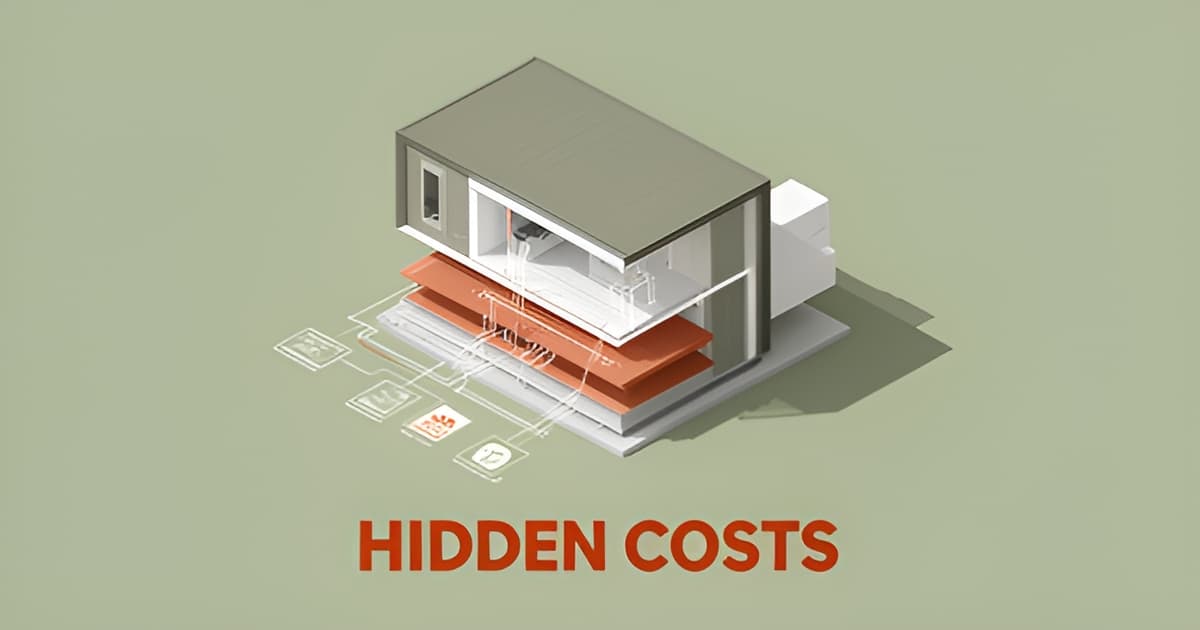
That $89,000 prefab ADU advertised online is not what you'll pay. Across California, base unit prices of $50,000–$220,000 routinely exclude another $25,000–$80,000 in site prep, foundation work, utility connections, delivery, and permits — costs that show up only after you've signed.
The gap is well documented. Site preparation alone typically adds $25,000–$80,000 to the base unit price, according to prefab ADU cost data, and one LA-area contractor puts the site-work add-on even higher, at $40,000–$80,000 per project. Once those costs land, total installed prefab pricing for a 350–600 sq ft unit runs $140,000–$230,000 — comparable to or above the $115,000–$200,000 range for stick-built construction.
Here's how the sticker price stacks up against reality, by unit size:
- Studio (200–400 sq ft): $50K–$100K unit price becomes $75K–$150K installed
- 1BR (400–600 sq ft): $80K–$140K becomes $115K–$200K
- 2BR (600–800 sq ft): $100K–$180K becomes $140K–$250K
- 2–3BR (800–1,200 sq ft): $130K–$220K becomes $180K–$300K
Site conditions explain much of the spread. The same factory unit can cost tens of thousands more on a sloped or hard-to-access lot than on flat ground with good access — and Altadena's hillside properties are exactly the kind of terrain where this variable bites. Foundation type and the distance to utility hookups drive most of the variance in what gets installed.
One honest caveat: nearly all of this cost data comes from vendors and contractors with something to sell — prefab sellers, stick-built builders, lead-generation sites. That's why we present ranges rather than single numbers. A point estimate from a commercially motivated source is marketing; a range is budgeting.
The practical takeaway for Altadena homeowners: when a prefab vendor quotes you a unit price, ask what's excluded. Transport, crane placement, foundation, utility laterals, grading, and permit processing are the usual suspects — and an excluded item is still a cost you'll pay, just one that didn't appear in the ad. If you want a realistic all-in number for your specific lot before you talk to any vendor, Altadena ADU Builder offers a free feasibility consultation with a cost-quiz concept render, and our featured local builder, JMB Builders LLC (CSLB #1103479), can assess site conditions on the ground.
What's Actually in the All-In Number
That $90,000 studio quote from a prefab catalog? It's a factory price, not a project price. The gap between the two is where most ADU budgets go sideways, especially on Altadena's hillside lots.
Site work is the biggest variable. The same unit can cost tens of thousands more on a sloped lot with tight access than on a flat one, according to design-build cost data. Foundation and site prep alone run $15,000–$40,000 nationally, and one LA-area contractor puts total site-work add-ons at $40,000–$80,000 regardless of module cost.
Then come the line items that never appear in a factory quote:
- Permits and fees: $5,000–$20,000 in LA, with a common rule of thumb of $10–$20 per square foot
- Separately billed engineering and permit processing: often $15,000–$30,000 on top of the unit price
- Utility connections and new laterals: $15,000–$30,000+ for separate meters, sewer, water, or septic
- Solar: newly constructed detached ADUs require PV under the 2025 Energy Code — typically $20,000–$30,000 and 60–90 days added
Two of these deserve special attention for LA County homeowners. First, the solar requirement applies only to detached ADUs on the prescriptive path — attached units are exempt, which can matter when you're weighing a garage conversion against a backyard build.
Second, state law exempts ADUs under 750 square feet from impact fees. That makes sizing a genuine financial lever: crossing the 750-square-foot line can trigger fees that run into the tens of thousands in some California markets, per LA-specific ADU cost research. A 749-square-foot two-bedroom often pencils out very differently than a 900-square-foot one.
Put it all together and the LA numbers come into focus: detached ADUs run $150,000–$400,000, roughly $300–$450 per square foot all-in. One worked example from a 600-square-foot LA project landed at $500 per square foot once $40,000 in site prep, $20,000 in design and engineering, and $10,000 in permits were counted.
An excluded item is not free — it's simply a cost someone else will bill you for later. Before comparing any prefab quote, ask the vendor exactly who owns transport, placement, foundation, utility connections, and permits outside the factory contract. Altadena ADU Builder's feasibility consultations walk through exactly these questions for your lot — and a free cost-quiz with a concept render can show you the all-in picture before you sign anything.
Prefab vs. Stick-Built: Who's Right About the Savings?
Ask three "experts" whether prefab ADUs are cheaper than stick-built, and you'll get three confident answers that don't agree. The honest truth is that the savings depend on your lot, your unit size, and who's doing the math.
Prefab advocates claim meaningful savings. ADU Zoning asserts prefab runs 20–40% cheaper than traditional construction, while prefab vendor Mesocore puts the figure at 10–25%. Both sources sell or promote prefab, so treat those numbers as the optimistic end of the range.
Then there's APLA Construction, an LA-area stick-built contractor with an obvious dog in the fight. Their argument: prefab isn't cheaper once site costs land. They cite a HUD Cityscape study in which 9 of 10 builders reported panel framing costs higher than lumber, and NAHB's 2024 survey showing framing is only 16.6% of construction cost — so even real framing savings barely move the total. Their math puts total installed prefab at $140,000–$230,000 versus $115,000–$200,000 for stick-built in LA.
SnapADU's synthesis lands closest to what Altadena homeowners should take away:
- Prefab can genuinely win for smaller units on flat, accessible lots
- Larger and two-story ADUs are "often a wash" between the two methods
- Site conditions — slope, access, utility distance — drive more variance than construction method
That third point matters most here. Hillside lots, common throughout Altadena's foothills, are exactly where prefab economics get stressed: the same unit can cost tens of thousands more on a challenging property than on a flat lot with good access.
Prefab marketing leans hard on speed, but the numbers converge fast. LA permitting takes 3–5 months regardless of construction method, which means total prefab timelines of 6–10 months versus 7–12 months for stick-built — a gap measured in weeks, not the dramatic head start brochures imply.
The practical takeaway: compare fully-loaded, all-in quotes from both methods for your specific lot before choosing. A flat lot with easy access and a small unit favors prefab; a sloped hillside lot with a two-story design usually doesn't. Altadena ADU Builder's free feasibility consultation exists precisely for this — a site-specific cost-quiz and concept render that shows which method actually wins on your property, with local builder JMB Builders LLC (CSLB #1103479) available for on-the-ground assessment.
Your Prefab Quote Checklist: Questions That Expose Hidden Costs
A prefab quote that looks $30,000 cheaper than a competitor's often isn't — it's just less complete. Industry guidance is blunt on this point: "an excluded item remains a cost to resolve; it is not free." Your job before signing is to force every excluded item onto the page.
Start with the core question that cuts through prefab marketing: who owns each responsibility outside the factory contract? A prefab project is really factory scope plus transport, placement, foundation and on-site completion, and vendors routinely leave the second half vague. Demand written answers on:
- Transport and crane placement — who pays for delivery, and who handles the crane set on your specific lot?
- Foundation — is it quoted, or contingent on soil and grading conditions nobody has priced yet?
- Utility connections — sewer, water, electrical, and any separate meter; distance from existing lines drives cost.
- Permits and fees — many builders charge $15,000–$30,000 separately for permit processing and engineering.
- Exclusions — ask every bidder to identify included work, area measurement, taxes, allowances, and exclusions before comparing rates.
The stakes are real. Site preparation, foundation, utility connections, permits, and crane delivery typically add $25,000–$80,000 to the base unit price — which is why an LA-area contractor pegs total installed prefab costs at $140,000–$230,000 for 350–600 square feet. And overruns aren't hypothetical: 42% of California homeowners report cost overruns above 15%.
Two rules protect you. First, insist on a fully itemized all-in quote before signing anything — compare fully-loaded project costs, not just the unit itself. Second, make uncertainty visible: an unknown foundation condition or utility capacity should appear as unresolved scope with an allowance, not disappear behind a fixed-looking headline price. The same unit can cost tens of thousands more on a challenging property than on a flat lot with good access, and Altadena's hillside lots and older utility infrastructure make that variance worth pricing explicitly.
This is exactly what we walk through in Altadena ADU Builder's free feasibility consultation and cost quiz, which includes a concept render — and if you want a local contractor to assess your lot, our featured builder, JMB Builders LLC (CSLB #1103479), provides Altadena-specific site evaluation.
Why Waiting Won't Save You Money in Altadena
Waiting to build an ADU in Altadena is one of the most expensive strategies a homeowner can choose. The math on California construction costs makes that clear — and the grant programs many buyers were counting on have already run dry.
According to cost trend data, the California Construction Cost Index rose 44% from January 2021 to December 2025, with little meaningful price decline over that period. That means a $300,000 ADU in 2021 costs roughly $430,000 in 2026. Every year of delay doesn't just postpone your project — it inflates the bill.
The grant assumption you should delete from your budget: CalHFA's ADU grant funding is fully allocated as of September 2026. No homeowner should build a pro forma around a hoped-for $40,000 grant that no longer exists. A project that only pencils with subsidy money isn't a viable project — it's a wish.
If you've been waiting for prefab prices to drop, the data points the other way:
- Construction costs climbed 44% between early 2021 and late 2025, with no meaningful decline in that window.
- A $300K ADU in 2021 translates to roughly $430K in 2026 at current index levels.
- CalHFA ADU grant funds are fully allocated — that $40K line item is gone.
- Site conditions, not factory prices, drive most cost variance — and your lot's slope, access, and utility distances don't improve with time.
This is why the smart move isn't waiting — it's getting a site-specific all-in estimate before you compare any prefab brochure price. The same unit can cost tens of thousands more on a challenging lot than on a flat one with good access, so your Altadena property's specifics matter more than any sticker price.
Before you shortlist a single vendor, take the free ADU feasibility consultation with a cost-quiz concept render offered through Altadena ADU Builder. You'll see what your actual lot — slope, access, utility hookups, permit path in LA County unincorporated territory — adds to the sticker price. For on-site feasibility assessment, this guide features JMB Builders LLC (CSLB #1103479), an Altadena-based licensed general contractor building ADUs, custom homes, and Eaton Fire rebuilds, with work documented at jmb-builders.com.
The cheapest year to build your ADU was 2021. The second-cheapest is this one.
Frequently Asked Questions
Why is the prefab ADU price I see online so much lower than what contractors actually quote me?
Is a prefab ADU actually cheaper than building one on-site in LA?
What hidden costs should I ask a prefab ADU vendor about before signing?
How much does a prefab ADU really cost all-in for different unit sizes?
Does the size of my ADU affect the permits and fees I'll pay in California?
Should I wait for prefab ADU prices to come down before building in Altadena?
The Real Price Tag: Your Next Move
The pattern across every section of this guide is the same: prefab ADU sticker prices systematically hide $25,000–$80,000 in site prep, foundation, utility connections, delivery, and permits — and once those land, prefab often costs as much as or more than stick-built construction. Site conditions, not factory prices, drive most of the variance, which matters especially on Altadena's hillside lots. And waiting won't help: the California Construction Cost Index rose 44% from early 2021 through late 2025, per cost trend data, while CalHFA's ADU grant funds are fully allocated. Your next steps are straightforward: demand a fully itemized, all-in quote from every bidder, ask who owns transport, placement, foundation, utilities, and permits outside the factory contract, and weigh the under-750-square-foot impact fee exemption when sizing your unit. Before you shortlist a single vendor, take Altadena ADU Builder's free feasibility consultation with a cost-quiz concept render — it shows the all-in picture for your specific lot. For on-the-ground site assessment, featured local builder JMB Builders LLC (CSLB #1103479) evaluates Altadena properties directly. The cheapest year to build was 2021. The second-cheapest is this one.