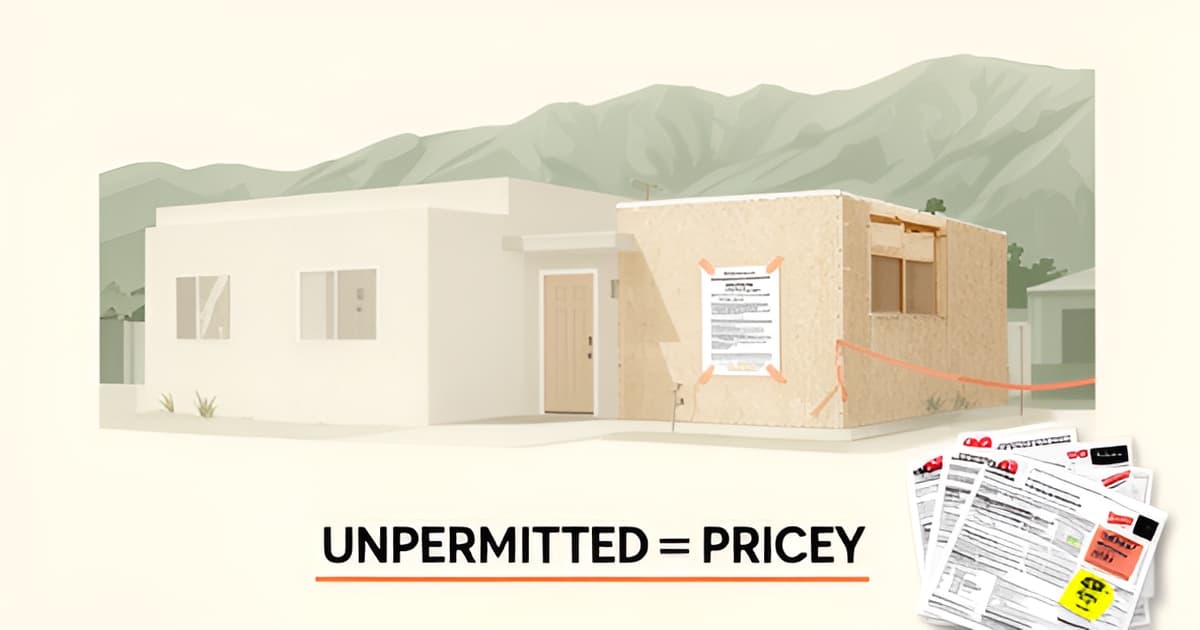
Permit Violation Fines in LA County: What Unpermitted Work Costs
Key Facts
- LA County code enforcement is complaint-driven, and complainant identities remain confidential.
- Retroactive permits often run 2–3x standard fees — $2,000–$5,000 for a typical room addition, per cost estimates.
- As-built plans for unpermitted work cost $3,000–$8,000, according to real estate guidance.
- Post-inspection corrections on unpermitted work commonly cost $2,000–$10,000, per consumer estimates.
- LA County says demolition is often the most cost-efficient fix for unpermitted construction.
- The current owner is liable for an Order to Comply even if a previous owner did the work.
- No official LA County fine schedule exists; the widely cited $5,000+ California fine is a secondhand estimate.
How LA County Finds Unpermitted Work — And Why You'll Probably Get Caught
Most homeowners who skip permits assume no one will notice. In LA County, that assumption fails more often than people expect — and usually at the worst possible moment.
Here's the uncomfortable part: enforcement is largely complaint-driven, and complaints are anonymous. LA County zoning enforcement begins with a complaint or referral, anyone can file one, and all complaint sources remain confidential — you'll never learn who reported you, according to the County's official reporting process. A neighbor's phone call, an email, or even the 24/7 211 LA County Helpline can trigger an investigation.
Complaints aren't the only way unpermitted work surfaces. Common discovery triggers include:
- Visible outdoor work — survey crews and passersby notice additions that don't match records
- Property tax assessor reviews flagging structures missing from the taxable inventory
- MLS updates when a listing reveals square footage the county never permitted
- Refinancing inspections and lender appraisals that compare records to reality
- Proactive code enforcement teams sweeping specific geographic areas
Once the county looks, it classifies what it finds. LA County DPW recognizes three violation categories: Unsafe Buildings, Un-Permitted Work, and Non-Inspected Work — the latter covering permitted projects that skipped required inspections, per the County's code enforcement office. Un-permitted work includes construction, alteration, grading, and electrical, mechanical, or plumbing work done without permits, plus projects abandoned under expired permits.
Then it escalates. Cases begin with an administrative action — typically a Notice to Comply with deadlines attached — and can continue through criminal or civil prosecution if ignored. Ignore long enough and you're facing liens on the property, court summons, court-ordered penalties, enforced demolition, or restoration of the property to its prior condition.
The county's own guidance is blunt about outcomes: because unpermitted work must now meet current code, corrections can mean tearing open walls and ceilings, structural observation by a licensed engineer, or excavating buried wiring. DPW notes that demolition is often "the most cost-efficient solution to unpermitted construction."
For Altadena homeowners weighing a garage conversion or backyard ADU, this is why doing it permitted from day one matters. A licensed contractor — like Altadena-based JMB Builders LLC (CSLB #1103479), the featured builder on Altadena ADU Builder — can pull permits properly rather than leaving you to legalize after the fact. A free ADU feasibility consultation before you break ground costs nothing; a violation notice later can cost you the structure itself.
The Fine Is the Smallest Part: The Real Cost of Legalizing Unpermitted Work
The fine itself may be the least of your worries. When LA County discovers unpermitted work, the real bill comes from legalizing it — and that process routinely costs several times what the original permit would have.
The first shock is the permit fee. According to real estate cost estimates, retroactive permits often run double or triple the standard fee, with a typical room addition running $2,000–$5,000. Then comes the paperwork: as-built plans drafted by a licensed architect or engineer typically cost $3,000–$8,000, because the county needs documentation of work nobody officially recorded.
The third layer is the most unpredictable. Because LA County requires unpermitted work to meet current codes — not the codes in effect when the work was done — inspectors can require opening up walls, removing ceiling coverings, foundation retrofitting, structural observation by a licensed engineer, or even excavating buried wiring and plumbing. Correction budgets commonly range from $2,000 to $10,000, and the full legalization process can stretch three to six months.
Here is the part most homeowners don't expect: the County itself acknowledges that demolition is often the most cost-efficient fix. When an unpermitted addition or garage conversion can't be brought up to current code without essentially rebuilding it, tearing it out may be cheaper than legalizing it.
A few honest caveats about the fine figures you'll see online:
- No official LA County fine schedule is published — the County's code enforcement page describes violations and penalties but lists no dollar amounts.
- The widely cited "$5,000+" California fine for building without a permit is a secondhand estimate, not a verified LA County figure.
- Fine structures vary by jurisdiction — flat fines, daily accruing penalties, or double permit fees — so confirm current numbers with your local Building and Safety District Office before budgeting.
The takeaway for Altadena homeowners is straightforward: permitting correctly from day one is almost always cheaper than after-the-fact legalization. If you're weighing a garage conversion or backyard ADU, Altadena ADU Builder offers a free feasibility consultation — including a cost quiz and concept render — so you know the real permitted cost before you build. Our featured builder, JMB Builders LLC (CSLB #1103479), is a licensed Altadena contractor authorized to pull permits, meaning your project never ends up in the retroactive-permit trap.
You're Liable Even If the Last Owner Did the Work
Buying a house with a "charming" converted garage can feel like a win — until an Order to Comply arrives in the mail with your name on it. That's because in Los Angeles, liability follows the property, not the person who broke the rules. Per the LADBS, "the current property owner is responsible for complying with the Order, even if previous owners or tenants have performed the un-permitted work or created the violation" — so the mistake someone else made in 2009 becomes your legal problem today.
New homeowners often first learn about unpermitted work when a Notice to Comply or Substandard Order shows up in the mailbox, sometimes months or years after closing. And the timing is rarely convenient: enforcement is largely complaint-driven in LA County, with anonymous reporting available by phone, email, or the 24/7 211 helpline — meaning a neighbor's grudge can surface decades-old work.
California sellers must disclose known unpermitted work on the Transfer Disclosure Statement, but "known" is doing a lot of work in that sentence. A seller who inherited the garage conversion from a prior owner may genuinely not know it was never permitted. That's why permit-history due diligence is essential before you buy, especially for Altadena properties with garage conversions, backyard studios, or detached structures. Note that LA County building codes date only to March 1933, so pre-1933 structures may have no permit record at all.
The downstream consequences stack up fast:
- Sale derailment: unpermitted ADUs create selling difficulties and reduced sale prices, per consumer real estate guidance.
- Insurance exposure: carriers may cancel policies or void coverage tied to unpermitted structures.
- Refinancing problems: lender inspections routinely surface unpermitted work, freezing the loan.
- Legalization costs: retroactive permits often run 2–3x standard fees — $2,000–$5,000 for a typical room addition — plus $3,000–$8,000 in as-built plans and $2,000–$10,000 in corrections.
Before buying an Altadena property with any secondary structure, request the full permit history from the county, ask for the seller's disclosure in writing, and consider having a licensed contractor evaluate whether the structure could ever be legalized. Because unpermitted work must meet current building codes, the county itself warns that demolition is sometimes the most cost-efficient fix — meaning that "bonus unit" could be worthless, or worse, a liability.
Altadena ADU Builder helps buyers and owners run exactly this kind of feasibility math before money changes hands. If you're weighing a property with a garage conversion or backyard structure, a free ADU feasibility consultation can tell you whether legalizing it is realistic — or whether you should negotiate the price down before you're the one holding the Order to Comply.
How to Fix a Violation Notice Without Making It Worse
A Notice of Violation or Order to Comply in your mailbox is not the moment to panic — but it is the moment to move. Deadlines on these notices are real, and in general practice, contest windows run roughly 30 days before the matter escalates.
Start by reading the Order carefully. Per code enforcement guidance, the current owner is responsible for complying with the order — even if a previous owner did the unpermitted work. Contact the inspector listed on the notice to clarify exactly what triggered the violation and what corrections the county expects.
Respond before the deadline. Ignoring the notice is the single worst move: enforcement cases begin administratively but can continue through criminal or civil prosecution, and unresolved fines can become liens, court-ordered penalties, or enforced demolition. Resolving early, by contrast, avoids escalating penalties.
The standard abatement path looks like this:
- Obtain retroactive (after-the-fact) permits — typically at a premium, often 2–3x standard fees, roughly $2,000–$5,000 for a typical room addition.
- Commission as-built plans from a licensed architect or engineer, generally $3,000–$8,000.
- Pass inspections and make corrections, with budgets commonly running $2,000–$10,000.
- Pay any back fees or penalties assessed by the county.
Here's the catch: because the work was done without permits, LA County requires it to meet current code — not the code in force when it was built. That can mean opening walls, retrofitting framing, or excavating buried wiring. The county is blunt that demolition is sometimes the most cost-efficient fix for unpermitted construction.
That's why Altadena ADU Builder consistently tells homeowners the same thing: this reactive, premium-priced route — as-built plans, doubled fees, invasive inspections, months of plan checks — is what permitting correctly from day one exists to avoid. A licensed contractor like JMB Builders LLC (CSLB #1103479), an Altadena firm that builds ADUs and handles Eaton Fire rebuilds, can pull permits properly so the work is legal, insurable, and sellable the first time.
If you're weighing a garage conversion or backyard ADU, get the feasibility question answered before the county answers it for you — a free ADU feasibility consultation, including a cost-quiz concept render, costs nothing and prevents a very expensive letter later.
The Cheaper Path: Permit Your Altadena ADU From Day One
Skipping the permit may feel like a shortcut, but the math rarely works out. Once LA County flags unpermitted construction, the work must meet current building codes — and the County itself notes that demolition is often "the most cost-efficient solution" to violations, according to the LA County Department of Public Works.
The cost stack of after-the-fact legalization makes this clear. Retroactive permits typically run 2–3x standard fees — $2,000–$5,000 for a typical room addition — while as-built plans from a licensed architect or engineer add $3,000–$8,000, and post-inspection corrections can run another $2,000–$10,000, based on consumer cost estimates. A permitted ADU designed to current code from day one avoids that entire penalty layer.
Why the permitted path costs less:
- Standard permit fees instead of doubled or tripled retroactive fees
- No as-built documentation required, since plans are drawn to code before construction
- No risk of opening walls or excavating buried wiring and plumbing for inspection
- No exposure to liens, escalating penalties, or court action for ignored notices
There's also a licensing gate most homeowners miss. LA County issues permits only to appropriately licensed contractors, property owners in certain cases, or their agents, per the County's code enforcement rules. An unlicensed "handyman special" ADU isn't just a code risk — it can't be legalized through the normal permit pathway without the right professional involved.
For Altadena homeowners, this is where local expertise matters. Altadena ADU Builder features JMB Builders LLC (CSLB #1103479), an Altadena-based licensed general contractor that builds custom homes, ADUs, and whole-home remodels, including Eaton Fire rebuilds — the kind of contractor who can pull permits and design to current code from the first drawing. (Disclosure: this is a paid placement.)
Before committing to any ADU plan — permitted or not — a feasibility review is the cheapest first step. Request a free ADU feasibility consultation with a cost-quiz concept render to see what your lot can actually support and what it might cost. No permit approvals or timelines are guaranteed, but you'll know where you stand before spending a dollar on construction.
Frequently Asked Questions
How much is the fine for unpermitted work in LA County?
How does LA County find out about unpermitted work?
Can I be held responsible for unpermitted work done by the previous owner of my house?
How much does it cost to legalize unpermitted work after the fact?
What happens if I ignore a Notice of Violation or Order to Comply?
Is it cheaper to get a permit upfront or legalize an unpermitted ADU later?
The Permit You Skip Today Is the Violation Notice You Get Tomorrow
The math in this article comes down to one comparison. Legalizing unpermitted work in LA County can mean retroactive permits at 2–3x standard fees, $3,000–$8,000 in as-built plans, $2,000–$10,000 in corrections, and months of plan checks — all because unpermitted work must meet current building codes, not the codes in place when the work was done. And since liability follows the property, even buyers inherit someone else's shortcut. Permitting correctly from day one avoids that entire penalty layer, keeps your project insurable and sellable, and costs less than any after-the-fact fix. If you're an Altadena homeowner weighing a garage conversion or backyard ADU, the smartest first step costs nothing: request a free ADU feasibility consultation from Altadena ADU Builder, complete with a cost-quiz concept render, so you know what your lot can support and what a fully permitted build actually costs. No guarantees on approvals or timelines — just a clear picture before you spend a dollar. Our featured builder, JMB Builders LLC (CSLB #1103479), is a licensed Altadena contractor authorized to pull permits from day one.