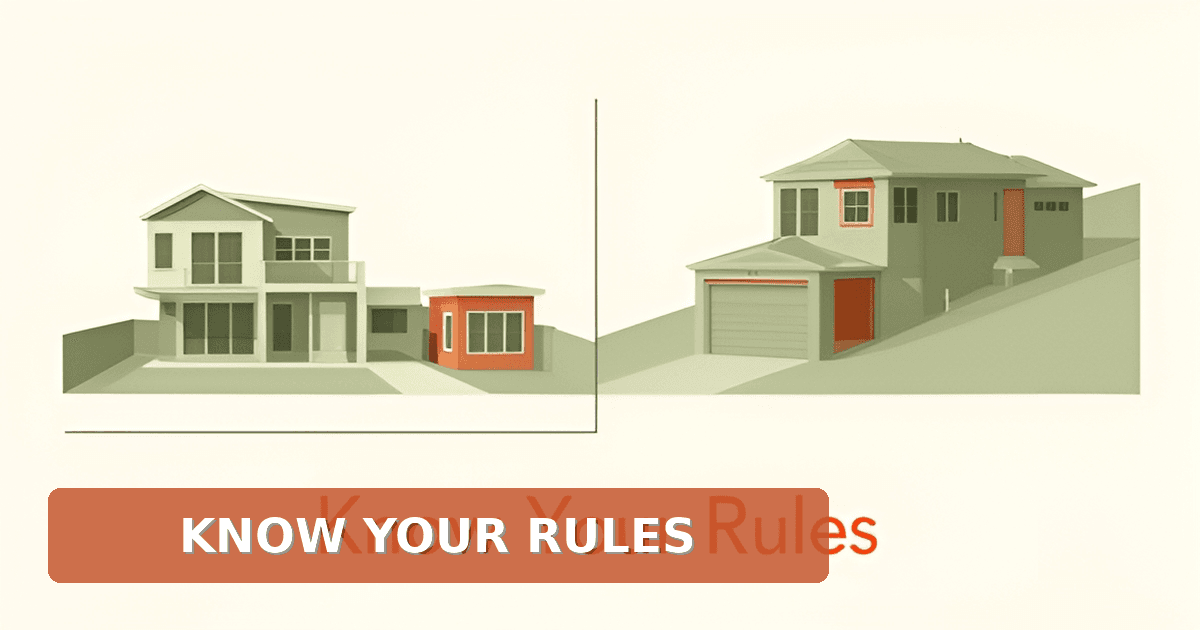
Pasadena ADU Builder vs Altadena: Different Jurisdictions, Different Rules
Key Facts
- Altadena is unincorporated LA County land, so county rules — not a city council — govern your ADU according to post-fire guidance.
- Pasadena now allows up to three units per single-family lot under its 2026 ordinance, a major change from the old one-ADU limit per CALI ADU.
- Pasadena caps detached ADUs at 18 feet and two stories, while LA County allows up to 25 feet under county standards.
- Altadena lots require 4-foot side and rear setbacks plus 6 feet of separation from the main house under LA County rules.
- Inside Altadena's Very High Fire Hazard Severity Zone, one uncovered parking space is required, needing 8.5 by 18 feet with 26 feet of clear backup per county standards.
- LA County offers a free Standard ADU Plans Program of pre-approved designs to speed up review — an advantage Pasadena doesn't match says LA County Planning.
- Both Pasadena and LA County must approve or deny ADU permits within 60 days through ministerial review with no public hearing under state law.
The Invisible Line That Changes Your ADU Rules
Two neighbors can stand on opposite sides of the same street in the San Gabriel Valley and face completely different ADU rules. Altadena sits on unincorporated Los Angeles County land, so the county — not a city council — sets and enforces the ADU rules there. Pasadena, just a few miles south, is its own incorporated city with a municipal ordinance all its own.
That invisible jurisdictional line matters more than most homeowners realize. A "Pasadena ADU builder" search returns plenty of contractors, but advice built around Pasadena's code can quietly mislead Altadena lot owners. The two rulebooks differ on the details that shape your project:
- Height limits: Pasadena caps detached ADUs at 18 feet and two stories, while LA County sources describe allowances up to 25 feet — a difference that determines whether a two-story design is even permittable.
- Setbacks: Altadena lots answer to the county's 4-foot side/rear setbacks and a 6-foot separation from the main house.
- Parking: Pasadena waives parking within a half-mile of any transit stop, but unincorporated areas inside a Very High Fire Hazard Severity Zone — which includes much of Altadena — carry their own parking requirements with specific exemptions.
- Pre-approved plans: LA County offers a free Standard ADU Plans Program catalog designed to speed up county review, an advantage Altadena homeowners have that Pasadena doesn't.
The timing makes generic advice especially dangerous right now. Pasadena rewrote its ADU ordinance in 2026 — Ordinance No. 7464 took effect April 18, 2026, and Ordinance No. 7471 followed on July 25, 2026 — after the state found its prior limits unlawful. Any Pasadena ADU advice written before April 2026 understates what you can build, and most homeowners still assume the old one-ADU-per-lot limit when the city now allows up to three units per single-family lot. Meanwhile, LA County Planning is actively updating its own ADU ordinance, so county-side rules may shift as well.
For Altadena homeowners, the stakes are compounded by post-fire conditions. Since the 2025 Eaton Fire, ADUs in Altadena have become a recovery tool — temporary housing during reconstruction, space for displaced family, and rental income to offset rebuilding costs. That demand has also drawn contractors promising quick builds and cut-rate ADUs, which is why verifying a builder's license through CSLB (as with Altadena-based JMB Builders LLC, #1103479) matters before signing anything.
At Altadena ADU Builder, we focus exclusively on unincorporated LA County rules — not Pasadena's — because that's the rulebook your lot actually answers to. Given that both ordinances are in flux, we recommend verifying current standards directly with LA County Planning before committing to a design.
Not sure whether your lot falls under county rules or city rules? Request a free ADU feasibility consultation — you'll get a cost-quiz concept render grounded in the regulations that actually apply to your address.
Pasadena vs. Altadena: A Side-by-Side Rule Comparison
Cross the invisible line between Pasadena and Altadena and the ADU rulebook changes completely — same street grid, same housing crisis, entirely different permitting realities. Altadena sits on unincorporated Los Angeles County land, so the county sets and enforces ADU rules instead of a city council, while Pasadena answers to its own municipal ordinance, recently rewritten through Ordinance No. 7464 and No. 7471.
The differences start with what you can build. Pasadena now permits up to three units on a single-family lot — one new-construction ADU, one conversion ADU, and one JADU — a major expansion most homeowners still don't realize, since the old ordinance allowed only one. LA County, by contrast, guarantees at least one 800 sqft ADU under California law, with detached ADUs also capped at 1,200 sqft.
Height is where the two jurisdictions truly diverge, and it shapes design rather than feasibility:
- Pasadena caps detached ADUs at 18 ft / 2 stories, with 16 ft in hillside and historic districts — meaning two-story plans "cannot be permitted as drawn" under the standard cap.
- LA County allows up to 25 ft, or per your Community Standards District, whichever is less — though other county-focused sources cite a 16 ft base height rising to 18 ft near transit.
- LA County requires 4 ft side/rear setbacks plus 6 ft separation from the main house; Pasadena requires 4 ft side/rear setbacks.
Parking rules split sharply too. Pasadena waives parking within a half-mile of any transit stop — any bus stop qualifies, not just Metro stations. Altadena's rules hinge on fire zones: outside a Very High Fire Hazard Severity Zone, no parking is required, but inside one, an uncovered space is mandated with several exemptions, including detached ADUs of 800 sqft or less under 16 ft.
One caution for Altadena homeowners: the county height figures conflict across sources — 25 ft versus 16 ft base — and LA County Planning is actively amending its ADU ordinance. Verify current rules directly with LA County Planning at (213) 974-6411 before finalizing any design. The county also offers a free Standard ADU Plans Program with pre-approved plans designed to speed review, an advantage Pasadena doesn't match.
That verification step is exactly where Altadena ADU Builder fits in — helping homeowners confirm which rules apply to their lot before money is spent on plans that won't permit. Both jurisdictions do share California's 60-day ministerial review requirement, so once your application is right, approval moves without public hearings.
Not sure which rulebook governs your lot? Get a free ADU feasibility consultation with a custom cost-quiz concept render — real costs, real permits, real builders.
Altadena's Home-Turf Advantages — and Post-Fire Realities
Altadena homeowners actually hold a few cards Pasadena residents don't. Because Altadena sits in unincorporated LA County, the county — not a city council — sets the ADU rules, and county rules are generally considered more ADU-friendly than city-level regulations. There's no minimum lot size required to add an ADU, and California law guarantees every lot can build at least one 800-square-foot unit.
The county also offers something Pasadena can't: a free Standard ADU Plans Program, a public catalog of pre-approved plans designed to speed up county review and approval. For homeowners watching every dollar during a rebuild, skipping custom design fees is a meaningful head start.
That said, Altadena's advantages come with real conditions, especially in the fire zones. If your lot falls within a Very High Fire Hazard Severity Zone, parking rules tighten: one uncovered off-street space may be required, though exemptions exist for detached ADUs of 800 square feet or less with limited height, or within a half-mile of transit. Fire-resistant materials and smarter site planning are now considered essential design inputs, not upgrades.
The post-2025 fire context has also changed what an ADU means for many Altadena families. Post-fire guidance describes ADUs serving as temporary residences during reconstruction, housing for displaced relatives, and rental income to offset rebuilding costs. A UCLA Latino Policy and Politics Institute study underscores the stakes: Altadena is largely working-class, making ADUs a genuine financial stability and anti-displacement tool — not just a lifestyle add-on.
One caution deserves its own paragraph. Since the Eaton Fire, Altadena has seen a rise in contractors offering quick builds and cut-rate ADUs that promise more than they deliver. Before signing anything, verify a contractor's license through CSLB, ask for documented local work, and be skeptical of anyone promising guaranteed permits or timelines — no honest builder can promise those, particularly while the county ordinance is actively being amended. At Altadena ADU Builder, we only feature licensed contractors like JMB Builders LLC (CSLB #1103479), an Altadena-based general contractor whose ADU and Eaton Fire rebuild work is documented publicly.
- Confirm whether your lot falls in a VHFHSZ — it changes your parking and design requirements.
- Check the county's free pre-approved plan catalog before paying for custom drawings.
- Verify any contractor's CSLB license number independently.
- Confirm current rules with LA County Planning directly, since the ordinance is mid-update.
If you want to know what your specific Altadena lot allows — and what it would realistically cost — get a free ADU feasibility consultation with a cost-quiz concept render. Real costs, real permits, real builders.
What Your Builder Must Know in Each Jurisdiction
The same backyard, two blocks apart, can be governed by entirely different rulebooks — and a builder who doesn't know which side of the line your lot falls on can waste months of design work. Here's what actually changes in practice.
Height is the first design fork. In Pasadena, detached ADUs cap at 18 feet and two stories, which means a two-story plan drafted for another jurisdiction cannot be permitted as drawn — the height shapes the design before anything else. In unincorporated Altadena, LA County standards allow detached ADUs up to 25 feet (or less if a Community Standards District applies), though some county guidance cites a 16-foot base limit with 18 feet near transit — a discrepancy worth confirming directly with LA County Planning before finalizing plans.
Fire-zone rules reshape Altadena site plans. Altadena sits largely within the Very High Fire Hazard Severity Zone, where county ADU standards require one uncovered parking space unless an exemption applies — and that space needs 8.5 by 18 feet with 26 feet of clear backup. That maneuvering room can determine where the ADU sits on the lot. Outside the fire zone, no ADU parking is required at all.
The 60-day clock runs in both jurisdictions. State law mandates ministerial review — no public hearing — with Pasadena and LA County both required to approve or deny within 60 days. The county process includes one round of corrections, so a complete, jurisdiction-correct submittal matters.
What a builder working both sides of the line must verify before drawing anything:
- Which ordinance applies — Pasadena's Ordinances 7464 and 7471, or LA County's ADU ordinance (currently being amended)
- The height cap for your specific lot — 18 ft in Pasadena, 16–25 ft depending on the county source and any CSD overlay
- Whether the lot sits in the VHFHSZ, triggering the parking space requirement
- Setbacks — 4 ft side/rear in both, but the county adds a 6 ft separation from the main house
Vetting the builder matters as much as the rules. Post-fire, Altadena has seen a rise in contractors promising quick builds that overdeliver on claims and underdeliver on permits. Always verify the license on the CSLB site — for example, JMB Builders LLC holds CSLB #1103479, and its ADU and Eaton Fire rebuild work is documented on jmb-builders.com. Altadena ADU Builder's free feasibility consultation checks your jurisdiction, lot constraints, and real costs before you commit to a plan — no guarantees, just the correct rulebook for your address.
Your Next Step: Confirm Your Rules, Then Confirm Your Budget
One phone call to the wrong planning department can cost you weeks of design work on rules that never applied to your lot. That's why the smartest first move for any Altadena homeowner is confirming which jurisdiction — and which rulebook — actually governs your parcel before you spend a dollar on plans.
Start with verification, not assumptions. Altadena sits in unincorporated Los Angeles County, so LA County Planning sets and enforces your ADU rules — you can reach the department at (213) 974-6411 or [email protected]. And because the County is actively updating its ADU ordinance, yesterday's answer may not be today's rule. Confirm the current standards in writing before finalizing any design.
Here's a practical verification checklist:
- Confirm your parcel is unincorporated LA County, not an adjacent city like Pasadena with its own ordinance.
- Ask about detached ADU height — published sources conflict, citing either 25 ft or a 16 ft base with 18 ft near transit.
- Verify whether your property falls in a Very High Fire Hazard Severity Zone, which can trigger a required parking space.
- Check whether your neighborhood's Community Standards District imposes stricter limits than county baselines.
- Ask about the County's free pre-approved Standard ADU Plans Program, designed to speed up review and approval.
Once your rules are confirmed, the next question is budget — and it should be a site-specific one, not a generic estimate. Even within a single jurisdiction, setbacks (4 ft sides and rear, 6 ft from the main house under county standards), fire-zone parking, and slope can swing your number significantly. A feasibility read grounded in your actual parcel beats any countywide average.
That's exactly what our free ADU feasibility consultation at Altadena ADU Builder is built for. You'll answer a short cost quiz and receive a concept render of what your lot could actually support — real costs, real permits, real builders, no permit or timeline guarantees dressed up as promises. It's the fastest way to move from "I think I can build" to a defensible plan.
One caution before you hire anyone: post-fire Altadena has seen a rise in contractors offering quick builds and cut-rate ADUs that promise more than they deliver, according to post-2025 fire guidance from Maxable. Verify licensure through CSLB — our featured builder, JMB Builders LLC (CSLB #1103479), is an Altadena-based licensed general contractor whose work is documented on jmb-builders.com, and that placement is paid and disclosed. Whatever builder you choose, check the license number yourself.
Confirm the rules. Confirm the budget. Then build with confidence.
Frequently Asked Questions
Do I need a Pasadena ADU builder for my Altadena property?
How tall can I build a detached ADU in Altadena?
How many ADUs can I build on my lot in the Pasadena area?
Do I have to add a parking space for my ADU in Altadena?
How can I speed up ADU permitting in Altadena?
How do I avoid getting scammed by an ADU contractor after the Eaton Fire?
One Street, Two Rulebooks: Build on the Right Side of the Line
The invisible line between Pasadena and Altadena doesn't just change your mailing address — it changes your height caps, setbacks, parking requirements, and even which planning department answers the phone. Pasadena rewrote its ADU ordinance twice in 2026, while LA County's rules are actively being amended, which means generic internet advice is quietly steering homeowners wrong on both sides of the line. For Altadena lots, the practical takeaways are clear: you answer to LA County Planning, not a city council; your fire-zone status may shape parking and design; the county's free pre-approved plans can save real money; and post-fire conditions demand a licensed, verifiable builder — check every CSLB number yourself before signing anything. The smartest sequence is simple: confirm your jurisdiction and current rules first, then confirm a site-specific budget, then build. Altadena ADU Builder's free ADU feasibility consultation does exactly that — a short cost quiz and a concept render grounded in the rules that actually apply to your address, as documented by LA County Planning. Real costs, real permits, real builders — no guarantees dressed up as promises.