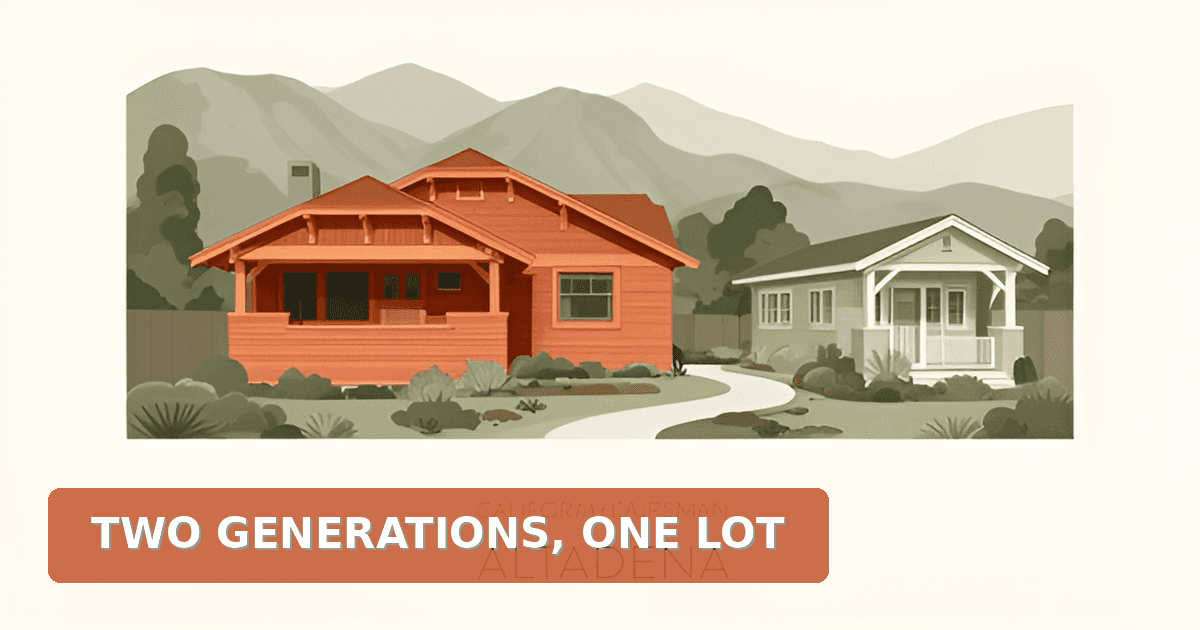
Multigenerational Living ADU: Costs and Layouts That Work in Altadena
Key Facts
- 66.7 million U.S. adults — more than 1 in 4 Americans — now live in multigenerational households, and 72% plan to stay according to recent research.
- California ADU permits surged 1,421% — from under 1,300 in 2016 to over 23,000 in 2021 — ADU cost statistics show.
- One builder estimates 70% of his ADU work serves multigenerational families per accessory dwelling research.
- Altadena's unincorporated LA County status lets a single-family lot hold a JADU, an attached ADU, and a detached ADU — local ADU guidance confirms.
- ADUs at or below 750 square feet are exempt from impact fees under LA County rules according to Altadena guidance.
- Attached ADUs average $245,000 versus $350,000 for detached — roughly 20–30% less — cost data shows.
- Plumbing and electrical consumed about $60,000 — 23% of the entire budget — on one real 550 sq ft LA ADU a builder of 100+ LA County ADUs documents.
Why Altadena Families Are Building ADUs for Multiple Generations
If your aging parents can't safely manage the stairs anymore, your adult son just moved back home, and assisted living costs more per year than most Altadena mortgages, you're not alone — you're part of the largest shift in American household design in decades. An estimated 66.7 million U.S. adults now live in multigenerational households — more than 1 in 4 Americans — and 72% of them plan to keep living that way long-term.
The math driving this is unforgiving. Assisted living and in-home care costs climb every year, while Altadena's housing market offers few affordable options for either generation. As Sheri Koones, author of ADUs: The Perfect Housing, puts it, a backyard unit is "a way for many older people to avoid having to go into an expensive assisted living or other facility as they age" (NAR reports).
Families also discover the arrangement pays off in ways a spreadsheet misses. Research on multigenerational ADU projects found that families considered them worthwhile even without a clear short-term return — avoided rent for boomerang kids, reduced childcare costs, and sidestepped long-term care expenses all add up quietly.
The trend isn't hypothetical for builders, either. One ADU builder estimates that 70% of his ADU work serves multigenerational families, and Altadena-specific guidance confirms the same locally: the most common use cases here are multigenerational living, caregiver suites, and private space for adult children (local ADU guidance).
What makes the ADU the default answer in Altadena specifically:
- California ADU permits surged 1,421% — from under 1,300 in 2016 to over 23,000 in 2021 — after state reforms removed owner-occupancy requirements, parking mandates, and lot-size minimums (ADU cost statistics).
- Altadena's unincorporated LA County status allows a single-family lot to hold a JADU, an attached ADU, and a detached ADU — rare flexibility for housing three generations on one property (county planning guidance).
- State policy changes now let families build true "multigenerational compounds" where grandparents, parents, and grandchildren share one property (The Washington Post).
The path that felt impossible five years ago is now the most practical option on the table. The question for most Altadena families is no longer whether to build — it's which layout fits the lot, the budget, and the generations who'll live in it.
Four Altadena Layout Paths — and What Each Actually Costs
Because Altadena sits in unincorporated LA County, a single-family lot can legally support up to three separate units — a junior ADU, an attached ADU, and a detached ADU — giving families more layout options than most California cities allow, according to Altadena-specific ADU guidance.
Each path carries a very different price tag, so think in ranges rather than single numbers.
- Garage conversion ($60K–$245K+): The most affordable route. National figures put garage and basement conversions at $60,000–$120,000, while LA-area conversions run $140,000–$245,000+. Garage conversions also follow a streamlined county path and are generally exempt from setback rules.
- Junior ADU, up to 500 sq ft ($100K–$200K): A JADU carved from existing space within the main home suits aging parents who want proximity. California benchmarks price 500 sq ft builds at $100,000–$200,000, and JADUs are capped at 500 sq ft by state law.
- Attached ADU ($150K–$360K): Attached units average $245,000 versus $350,000 for detached — roughly 20–30% less — because they share walls, foundations, and utilities. A 600 sq ft one-bedroom with separate living space runs $90,000–$180,000 and is noted as well suited to multigenerational housing.
- Detached ADU ($180K–$420K): Maximum privacy for a caregiver suite or adult children. LA detached builds range from $180,000 to $420,000, with two-story models starting at $280,000 even on footprints as small as 448 sq ft.
Why the wide ranges? Kitchens and bathrooms drive per-square-foot cost. On one real 550 sq ft Westwood project totaling $259,000 (~$471/sq ft), plumbing and electrical alone consumed roughly $60,000 — about 23% of the entire budget, as documented by a builder of 100+ LA County ADUs. A full kitchen plus an accessible bath pushes a small unit's cost per square foot far above a larger, simpler layout.
One Altadena-specific lever matters when choosing size: ADUs at or below 750 sq ft are exempt from impact fees. For a family weighing a compact caregiver unit against a larger two- or three-bedroom layout, staying under that threshold can meaningfully change the math.
Before committing to any layout, flag the Altadena constraints that can reshape both permit path and budget: Very High Fire Hazard Severity Zone parcels may require one off-street parking space, Oak Tree Permits and historic-district standards can affect approval, and Eaton Fire recovery may influence timing and cost. No builder can guarantee a permit outcome or timeline — which is exactly why we recommend validating feasibility on your specific lot first.
At Altadena ADU Builder, our free feasibility consultation includes a cost-quiz concept render so you can see which of these four paths fits your lot — and your budget — before falling in love with a floor plan. Featured builder JMB Builders LLC (CSLB #1103479) is disclosed as paid placement.
Designing for Two Generations: Privacy, Universal Design, and the 750 Sq Ft Sweet Spot
The most successful multigenerational ADUs aren't the biggest ones — they're the ones designed so two generations can share a property without sharing a thermostat, a kitchen schedule, or a front door. Builder Sam Hagerman estimates that roughly 70% of his ADU work serves multigenerational families, and the layouts that endure share a few non-negotiable principles.
Privacy starts with architecture. A separate entrance — ideally one that doesn't route your mother-in-law through your mudroom — does more for household harmony than any amount of square footage. One in-law famously demanded "Two Kitchens, Please!" in a story that has become shorthand for the autonomy principle: separate cooking space prevents the daily friction that erodes multigenerational arrangements. Even a compact kitchenette with a real stove gives the second household genuine independence.
Universal design is the second pillar. Because U.S. housing stock is largely unprepared for aging in place, features that support aging parents should go in on day one:
- Barrier-free, curbless showers with room for a future bench or caregiver
- Easy-grip lever hardware and rocker switches instead of knobs
- Countertop-height microwaves and appliances that don't require bending or reaching
- Wider doorways and a floor plan that could later accommodate mobility aids
Architect Diana Melichar's advice applies directly here: plan for how the space will be used as circumstances change, because flexibility is what makes the unit viable for a decade, not just a year.
Comfort matters too. A two-zone HVAC system — roughly a $2,500 upgrade per one LA County builder — lets a 72-year-old keep her bedroom at 74 degrees while the main house sits at 68. It's a small line item that pays for itself in daily goodwill.
Then there's Altadena's concrete budget lever: ADUs at or below 750 sq ft are exempt from impact fees under LA County rules, per local Altadena guidance. That threshold forces a useful decision point. A compact 600 sq ft one-bedroom with separate living space — well-suited to a caregiver suite or aging parent — runs roughly $90,000–$180,000 nationally, while a 1,200 sq ft two-to-three-bedroom family layout climbs to $180,000–$360,000 before any added fees.
Altadena ADU Builder helps families weigh exactly this trade-off in a free feasibility consultation, pairing a cost quiz with a concept render so the 750 sq ft question gets answered with your actual lot and budget in mind — not a generic rule of thumb.
Altadena-Specific Rules That Shape Your Build Before You Pick a Floor Plan
Most homeowners sketch floor plans first and discover the rules second. In Altadena, that order can cost you a redesign — the county's requirements shape what you can build long before you choose between a JADU and a detached unit.
The good news is that Altadena's unincorporated LA County status is unusually generous. A single-family lot here can support one JADU plus one attached ADU plus one detached ADU — a three-unit allowance that few jurisdictions match, according to Altadena-specific ADU guidance. That flexibility is worth confirming against your specific parcel before committing to a layout.
Several local constraints deserve attention first:
- Fire-zone parking: Parcels in the Very High Fire Hazard Severity Zone may be required to provide one off-street parking space, which affects where a unit can sit on tight lots.
- Oak Tree Permits: Protected oak trees can constrain building placement and grading, requiring a separate permit path.
- Historic-district standards may apply to some Altadena properties, adding design review to the approval process.
- Eaton Fire recovery continues to shape timing, cost, and the permit path for many local projects.
There's also a budget lever hiding in the size threshold. ADUs at or below 750 square feet are exempt from impact fees, while state law protects units of at least 800 square feet with 4-foot side and rear setbacks. That line between 750 and 800 square feet is often the difference between a compact caregiver suite and a full two-bedroom layout for adult children — and it should be a deliberate choice, not an accident of drafting.
One resource can shortcut the design phase entirely: LA County's free Standard ADU Plans Program offers preapproved plan catalogs, and preapproved detached plans are supposed to be decided within 30 days. Completeness determinations come due within 15 business days under state law. That said, no timeline or approval outcome can be guaranteed — fire-zone conditions, oak trees, and recovery-related backlogs all introduce variables that no guide can promise away.
This is exactly why Altadena ADU Builder starts every engagement with a free feasibility consultation, including a cost-quiz concept render, before any floor plan discussion. Builders working in Altadena — including featured builder JMB Builders LLC (CSLB #1103479), who handles Eaton Fire rebuilds alongside ADU construction — tend to agree on one point: resolve the lot's constraints first, then fall in love with a layout.
How to Start: Budgeting in Ranges and Getting a Feasibility Read on Your Lot
Budgeting for a multigenerational ADU starts with accepting an uncomfortable truth: there is no single number. Statewide, the median ADU costs about $150,000 (roughly $250 per square foot), but LA-area detached builds can run anywhere from $180,000 to $420,000, and garage conversions span a much wider band than most homeowners expect — from $60,000–$120,000 nationally to $140,000–$245,000+ in LA. The most useful approach, as Altadena-specific guidance puts it, is to think in ranges, not one universal number.
Start with the range that matches your layout path:
- Garage conversion: the most affordable path, often $60,000–$120,000, with a streamlined LA County review process.
- Attached ADU: averages $245,000 versus $350,000 for detached — roughly 20–30% less by sharing walls, foundations, and utilities.
- Detached ADU: maximum privacy for aging parents or adult children, typically $180,000–$420,000 in the LA area.
- JADU: capped at 500 square feet within the main home, the lowest-cost route to proximity.
Before you fall in love with a floor plan, focus on the lot. Altadena's unincorporated LA County status is unusually generous — a single-family lot can support one JADU, one attached ADU, and one detached ADU — but constraints like Very High Fire Hazard Severity Zone parking requirements, Oak Tree Permits, and historic-district standards can shape both your permit path and your budget. A feasibility read on your lot should also confirm setbacks, utility access, and whether your build lands under the 750-square-foot impact-fee exemption, one of the most concrete budget levers available locally.
Then weigh the full value picture, not just construction spend. Families often find multigenerational ADUs worthwhile even when short-term ROI looks thin, because the hidden returns are real: avoided rent for boomerang kids, reduced childcare costs, and elder care at home instead of an expensive assisted-living facility. Add potential rental income — the median new-ADU rent statewide is $2,000 per month — and the math often shifts decisively.
The single biggest mistake homeowners make, according to a builder of 100+ LA County ADUs, is starting without understanding where the money actually goes. Plumbing and electrical alone ran about $60,000 — roughly 23% of the budget — on one real 550-square-foot LA project.
That's why Altadena ADU Builder offers a free ADU feasibility consultation: answer a short cost quiz, and you'll receive a concept render and a realistic budget range for your specific lot — no guarantees, just clarity. For construction, we feature JMB Builders LLC (CSLB #1103479), an Altadena-based licensed general contractor whose ADU and custom-home work is documented at jmb-builders.com.
Frequently Asked Questions
How much does a multigenerational ADU actually cost in Altadena?
Can I fit three generations on one Altadena lot?
What's the 750 square foot rule I keep hearing about?
Is an ADU really cheaper than assisted living for aging parents?
What design features matter most when building for aging parents?
What Altadena-specific rules could derail my ADU plans?
One Lot, Three Generations, One Clear Next Step
The math that once made multigenerational living feel impossible has flipped: with more than 1 in 4 American adults now living in multigenerational households, Altadena's rare three-unit allowance — a JADU, an attached ADU, and a detached ADU on a single lot — makes it one of the best-positioned communities in California to actually build for it. The practical takeaways are simple: budget in ranges ($60K garage conversions to $420K detached builds), design for privacy and aging in place from day one, and check your lot's constraints — fire-zone rules, oak trees, the 750 sq ft impact-fee threshold — before falling in love with a floor plan. Your next step costs nothing: take Altadena ADU Builder's free feasibility consultation and cost quiz to get a concept render and a realistic budget range for your specific lot. No guarantees — just the clarity you need to decide which layout fits the generations who'll call it home.