LA County Setbacks for ADUs: Rear Yard Rules in Unincorporated Areas
Key Facts
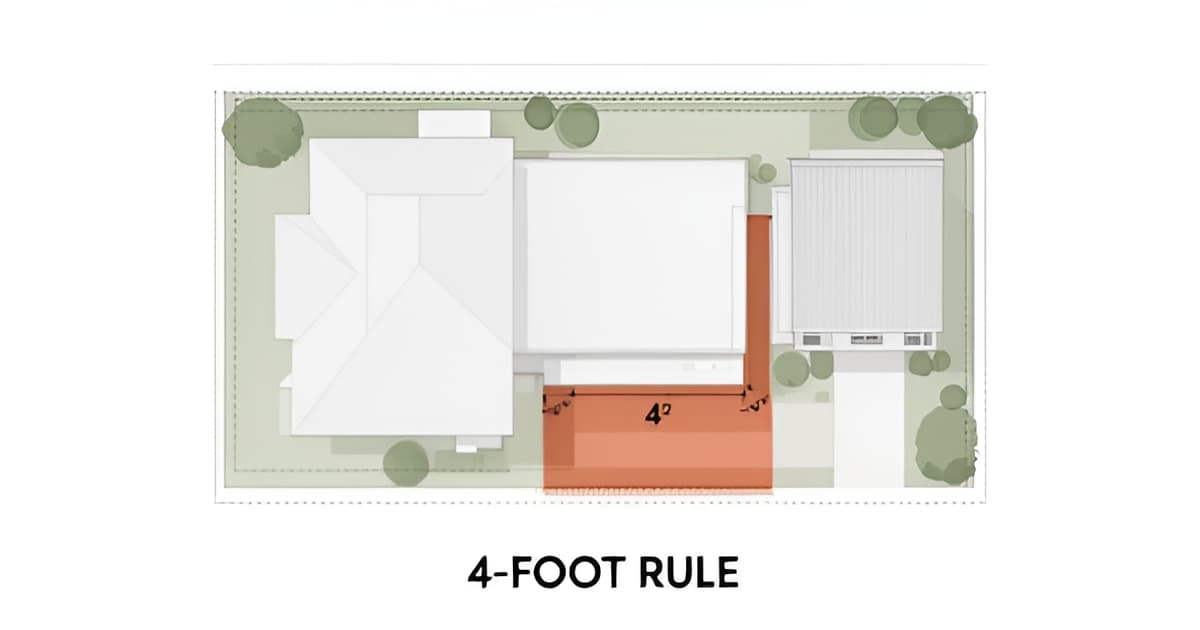
- Unincorporated LA County requires just 4-foot side and rear setbacks for new ADUs under Title 22, per county code analyses.
- Conversions and same-footprint rebuilds need zero setbacks — even if the old garage sits directly on the property line, per code-anchored county summaries.
- A detached ADU of 800 square feet or less with 4-foot setbacks is approved without other local standards, even in fire hazard zones, per county code analyses.
- Eaves and projections may come no closer than 2.5 feet to the lot line — a detail that sinks permits, per county code summaries.
- Roughly 1 million people live in unincorporated LA County, where county Title 22 — not City of LA rules — governs ADUs, per county ADU tracking.
- LA County ADUs hit a record 10,200 completions in 2025 — about 37% of the county's new housing, per Smart Cities Dive.
- The County approved $3.8 million in state funding for ADU grants to 35–50 unincorporated homeowners, with an Eaton Fire focus, per Smart Cities Dive.
Why Setback Rules Confuse Altadena Homeowners (And Why Jurisdiction Is Everything)
Google "ADU setbacks California" and you'll get a tidy answer — usually 4 feet from the side and rear property lines. That answer is technically correct for Altadena, but for the wrong reason, and mixing up the reasoning is where homeowners get into trouble.
Altadena is unincorporated, which means LA County's Title 22 governs your ADU — not the City of LA's municipal code. The City of Los Angeles has its own ADU rules under LAMC, administered by LADBS, and LA County contains 87 incorporated cities, each with its own ADU code. A blog post summarizing "LA ADU rules" could be describing any of them. Roughly 1 million people live in unincorporated LA County, and Altadena homeowners are among them — so generic state summaries and City of LA guides can quietly mislead.
Before planning anything, confirm your parcel's status using the County's Z-NET tool. An Altadena address doesn't guarantee an unincorporated parcel, and the setback rules in this article apply only where Title 22 does.
Why the confusion is risky right now:
- The county ordinance is actively changing — Title 22 Sec. 22.140.640 was last amended by Ord. 2025-0029, effective August 28, 2025, and further amendments are pending.
- HCD's December 1, 2025 findings letter ordered the County to amend its ordinance — including allowing up to eight ADUs on multifamily lots — changes the County had not yet made as of source verification.
- LA County Planning states it is actively updating the ADU Ordinance as state housing law evolves, with a draft ordinance in progress.
There's also a live state-versus-county tension. The County attaches an "only if nowhere else" condition to front-setback encroachments — a condition the State has told it to delete. Where Title 22 conflicts with state ADU law, state law controls.
This is why Altadena ADU Builder keeps every recommendation Altadena-specific: your parcel's jurisdiction, fire zone status, and easements determine what's actually buildable. A free ADU feasibility consultation — including a cost-quiz concept render — is the fastest way to confirm which rules apply to your lot before you spend money on plans.
The Three Setback Tiers: 4 Feet, Zero Feet, and the 800 Sq Ft Carve-Out
Most Altadena homeowners assume a backyard ADU needs to sit well away from the property line — but unincorporated LA County actually sorts setback rules into three distinct tiers, and knowing which one applies to your project can be the difference between a straightforward permit and a redesign.
If you're building a new detached ADU or expanding an existing structure, Title 22 Sec. 22.140.640 requires a 4-foot setback from both the side and rear property lines (G.1.c.iii), matching the state-law minimum under California Government Code. As one county ADU guide puts it, most new ADUs in LA County need only four feet from the side and rear lines — no more. State law backs this up: jurisdictions cannot impose larger setbacks on new construction up to 800 square feet, a protection ADU legal trackers call one of the most important in current housing law.
Here's where Altadena homeowners — especially those rebuilding after the Eaton Fire — catch a significant break. ADUs created by converting an existing structure, or rebuilding in the same footprint, require no setbacks at all (G.1.c.ii), even if the original garage or accessory building sits directly on the property line. Conversions also carry no size or height cap, and may add up to 150 square feet for ingress and egress, per code-anchored county summaries.
A detached ADU of 800 square feet or less, with 4-foot side and rear setbacks, is approved without other local standards — even in fire hazard zones (H.1.a.ii). State law reinforces this: no floor-area, lot-coverage, or lot-size rule may block an 800 sq ft unit meeting the 4-foot setback, per county code analyses.
A few practical edge conditions to keep in mind:
- Eaves and similar projections may come no closer than 2.5 feet to the lot line.
- Walls closer than 4 feet to the lot line may require fire-rated construction — check with Building & Safety.
- ADUs are exempt from Title 22 step-back rules (G.1.c.iii), a county-specific carve-out from upper-floor dimensional standards.
- Utility, drainage, or access easements override setback minimums regardless of tier.
One caution: the stepback exemption rests on a single code summary, so verify it with LA County Planning before finalizing plans. Which tier applies to your lot depends on what's already there — existing footprints, easements, and fire zone status all shift the answer. Altadena ADU Builder's free feasibility consultation maps your specific lot against these three tiers, and JMB Builders LLC (CSLB #1103479), our featured Altadena builder, handles same-footprint rebuilds and new detached ADUs under these rules regularly. Confirm current rules before you design — the ordinance is actively being amended, and setback feasibility is the first thing that determines what's actually buildable.
Edge Cases That Decide Your Build: Eaves, Fire-Rated Walls, Front Yards, and Easements
The 4-foot setback line on your site plan is where most Altadena builds get decided — but the details that actually sink permits live at the edges: eaves, fire ratings, front yards, and easements.
Eaves and fire-rated walls are the first surprises. Even if your ADU wall sits exactly 4 feet from the lot line, eaves and similar projections may come no closer than 2.5 feet to the property line under the county's rules, per county code summaries. And a wall placed closer than 4 feet is a different animal entirely — Building & Safety may require fire-rated construction, which changes your framing, your budget, and sometimes your whole layout. Designing the roof before confirming the eave line is a common and costly mistake.
Front yards are the other flashpoint. Unincorporated LA County allows ADUs of 800 square feet or less to encroach into the front setback, but the county attaches a condition: only if no other ground-level build location exists. According to state-county conflict tracking, HCD has ordered the County to delete that "nowhere else" requirement — meaning a narrow or hillside lot where the front yard is the only viable pad may be more buildable than the current county text suggests. Since the ordinance is actively being amended, verify the current language with LA County Planning before you commit to a front-of-lot design.
A few other edge conditions that quietly decide builds:
- Attached ADUs follow the main house's setbacks, not the 4-foot rule — so an attached unit inherits whatever the house already complies with, per state ADU analyses.
- Utility, drainage, or access easements override setback minimums — an easement strip can render an otherwise legal pad unbuildable.
- ADUs over 800 sq ft lose the state-exempt carve-out and may need to comply with underlying zoning setbacks of 5, 10, or more feet.
- Very high fire hazard severity zones can impose additional requirements, though a state-exempt 800-sq-ft unit with 4-foot setbacks is still approved without other local standards, even in fire zones.
The over-800-sq-ft trap deserves emphasis. The county's uniform cap is 1,200 sq ft, but crossing 800 means giving up the strongest protection in current ADU law — the exemption that overrides local standards — and stepping back into full zoning compliance. For many Altadena lots, that trade-off between square footage and permitting simplicity is the single biggest design decision.
These are exactly the site-specific questions Altadena ADU Builder works through in a free feasibility consultation, which includes a cost-quiz concept render tailored to your lot — and, when a build follows, JMB Builders LLC (CSLB #1103479), an Altadena-based licensed general contractor experienced with Eaton Fire rebuilds, can carry the design through construction.
Your Setback Feasibility Checklist: Verify Before You Design
Before you sketch a single wall, confirm that the setback rules you're designing around actually apply to your lot. The fastest way to lose months is to design to the wrong jurisdiction's code — and in Altadena, that mistake is surprisingly common.
Start with jurisdiction. These rules apply only to unincorporated LA County, not the City of LA or the county's 87 incorporated cities, each of which has its own ADU codes. Use the County's Z-NET tool to confirm your parcel's status before anything else. Roughly a million people live in unincorporated areas, and Altadena homeowners who assume City of LA rules apply often design around the wrong dimensional standards entirely.
Next, walk the lot. Measure your side and rear property lines against the baseline rules — new detached ADUs need a 4-foot side and rear setback under Title 22 Sec. 22.140.640, while conversions of existing structures or same-footprint rebuilds require no setback at all, even if the structure sits on the property line. Note any easements for utilities, drainage, or access, since those override setback minimums. Don't forget eaves: projections may come no closer than 2.5 feet to the lot line.
Then check your fire hazard zone status. Here's the good news for Altadena homeowners rebuilding after the Eaton Fire: a detached ADU of 800 sq ft or less with 4-foot side and rear setbacks is approved without other local standards — including in fire hazard zones. That carve-out means lot coverage, floor-area, and open-space rules cannot block an appropriately sized unit.
Finally, verify current rules with LA County Planning directly. The ordinance is actively changing — Title 22 was last amended by Ord. 2025-0029 (effective August 28, 2025), HCD's December 1, 2025 findings letter ordered further amendments the County had not yet made, and a draft ordinance is available on the County's ADU Ordinance Amendment page. Rules that were accurate last quarter may not be accurate when you submit.
One more item worth your time: the County Board of Supervisors approved $3.8 million in state funding for ADU grants to 35–50 unincorporated homeowners, with an Eaton Fire focus. If you're rebuilding, that funding could meaningfully offset costs — Supervisor Kathryn Barger noted ADUs "can help house displaced family members, provide rental income to offset rebuilding costs and offer long-term stability."
Your setback picture — lot lines, easements, fire zone status, and conversion eligibility — determines what's actually buildable on your specific lot. At Altadena ADU Builder, our free feasibility consultation includes a concept render based on our cost quiz, so you can see how the 4-foot rule (or a zero-setback conversion) translates to your backyard before you invest in design work. For construction, our featured builder is JMB Builders LLC (CSLB #1103479), an Altadena-based licensed general contractor handling ADUs and Eaton Fire rebuilds.
Frequently Asked Questions
How far back from the property line does my ADU have to sit in Altadena?
Do Altadena ADU rules follow the City of Los Angeles code?
Can I build an ADU in a fire hazard zone after the Eaton Fire?
What happens if I want an ADU bigger than 800 square feet?
Can I put an ADU in my front yard if my lot is small?
Are the ADU setback rules in LA County changing?
Your Backyard, Your Rules: Turning Setback Math into a Buildable Plan
Altadena's setback rules come down to three tiers: 4 feet from side and rear lines for new detached ADUs, zero setbacks for conversions and same-footprint rebuilds, and the powerful 800-square-foot carve-out that overrides local standards — even in fire hazard zones. The catch is jurisdiction: Title 22 governs unincorporated LA County, not the City of LA codes that dominate most online guides, and with the ordinance actively being amended, last quarter's rules may not survive your permit submission. That's why the real work happens on your specific lot — property lines, easements, eave clearances, and fire zone status all quietly decide what's buildable. If you're rebuilding after the Eaton Fire, note that the County approved $3.8 million in state ADU grant funding for unincorporated homeowners. Your next step: confirm your parcel on Z-NET, then book a free ADU feasibility consultation with Altadena ADU Builder — you'll get a cost-quiz concept render showing exactly how these rules play out on your land before you spend a dollar on plans.