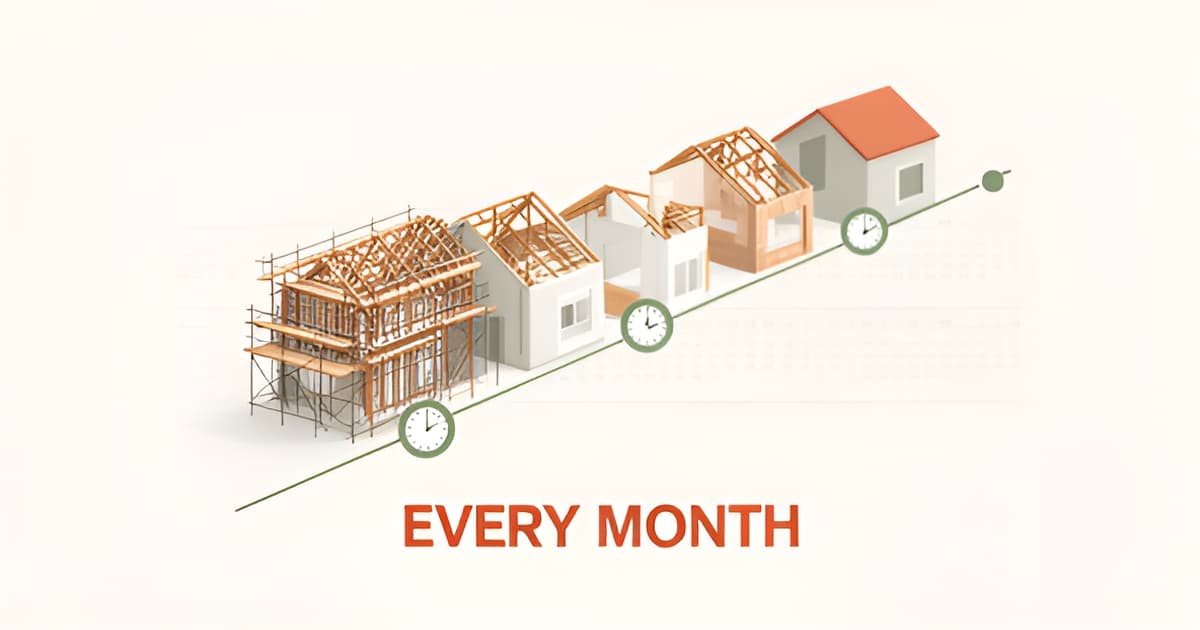
Home Building Timeline in Altadena: Every Phase, Every Month
Key Facts
- The average US home takes 8.8 months from authorization to completion, but custom homes run 11.7–14.3 months, per Census Bureau data.
- California's Pacific division averages 10.3 months permit-to-completion, well above the 8.8-month national average, NAHB analysis shows.
- West Coast home timelines of 14–24 months are driven by permitting, with CEQA review adding 3–12 months in California, regional analysis finds.
- Mid-construction design changes add 2–8 weeks and increase costs 15–25% beyond original contract pricing, industry research quantifies.
- Custom cabinetry takes 10–20 weeks and imported tile up to 24 weeks to arrive, so late selections stall the finish phase, 2026 lead-time data warns.
- Experienced builders report delays happen almost always in pre-construction, not the build itself, according to builder experience.
- Homes over 6,000 square feet take 16.3 months to build versus 9 months for homes under 4,000, Census data shows.
How Long Does Building in Altadena Really Take? The Honest Numbers
Ask three different people how long it takes to build a home in Altadena and you'll get three wildly different answers — from "about a year" to "plan on two." Here are the numbers behind the noise, and why the honest answer depends on what you're building and where.
The most credible benchmark comes from U.S. Census Bureau Survey of Construction data, which puts the national average at 8.8 months from authorization to completion in 2025 — 1.4 months for authorization plus 7.4 months of construction, per NAHB analysis of the data. But that figure includes tract homes built for sale, which take just 7.4 months. Custom homes — the category that applies to nearly everything built in Altadena — run longer: 11.7 months when contractor-built and 14.3 months when owner-built.
California makes things even more interesting. The Pacific division, which includes California, averages 10.3 months permit-to-completion, well above the national average. And total West Coast timelines of 14–24 months are driven primarily by permitting rather than construction, according to regional construction analysis. In California specifically, CEQA environmental review can add 3–12 months, and permit processing alone runs 16–32 weeks in backlogged urban markets like Los Angeles.
Why the West Coast penalty is permitting-driven:
- CEQA environmental review adds 3–12 months in California
- Permit processing runs 16–32 weeks on the West Coast
- Backlogged urban markets like LA can see permits take 6+ months
- Seismic and environmental review requirements add review cycles absent in other regions
Here's the part most timeline articles won't tell you: no Altadena-specific timeline data exists. None of the major construction data sources track LA County unincorporated permitting timelines, and no published figures cover Eaton Fire rebuild processes or debris-removal timelines for fire-affected lots. Any builder or website quoting you an exact "Altadena timeline" is extrapolating from regional averages — not measuring local reality.
That's why we don't offer timeline guarantees at Altadena ADU Builder. What we do offer is something more useful: a free feasibility consultation that reads your specific lot, your project type, and current LA County conditions, and gives you a realistic range — not a sales number. The most controllable schedule decisions, like finalizing design selections before groundbreaking, happen in the earliest weeks, and a feasibility read is where that discipline starts.
The Five Phases, Month by Month: From First Sketch to Certificate of Occupancy
Every home follows the same arc from first sketch to certificate of occupancy, but the months inside that arc vary more than most homeowners expect. Here's how the five phases typically break down — and where the calendar actually gets predictable.
Phase 1: Pre-construction and design typically runs 4–8 weeks for design alone, with permits adding 3–6 weeks in streamlined jurisdictions, per one builder's step-by-step breakdown. This is also where schedules slip most: experienced builders report that delays happen "almost always in pre-construction, not in the build," driven by plan modifications, design iteration, and permitting timing. Finalizing selections early is the single most controllable fix.
Phase 2: Permits. On the West Coast, permit processing runs 16–32 weeks, and California's CEQA environmental review can add 3–12 months, according to regional timeline research. No published data covers LA County unincorporated timelines specifically, so Altadena homeowners should treat these as context, not local estimates — a local feasibility review is the only way to get jurisdiction-specific answers.
Phase 3: Site prep and foundation is comparatively quick: 2–4 weeks in fast scenarios, stretching to 1–2 months on complex lots. Foundation curing and inspections consume similar time regardless of home size, which is why bigger homes don't scale linearly.
Phase 4: Framing and rough-ins brings visible progress fast. Framing runs 3–5 weeks, with mechanical rough-ins (plumbing, electrical, HVAC) adding 3–4 weeks. Rough-in inspections must pass before insulation goes in.
Phase 5: Finishes and closeout is typically the longest single phase. Interior finishes run 4–10 weeks, followed by a punch list and final walkthrough of 2–4 weeks before the certificate of occupancy issues.
- Insulation and drywall: 2–6 weeks — the schedule's turning point
- Interior and exterior finishes: 4–10 weeks
- Punch list and final inspections: 2–4 weeks
- Certificate of occupancy: the finish line
The milestone worth memorizing: drywall. As one builder puts it, once drywall is hung, "the schedule gets very clean" and a confident close-out date becomes possible. Before that point, flexibility matters more than precision.
Inspections deserve a reframe, too. Every milestone gets inspected by the local jurisdiction before the next stage begins — that's a feature, not a delay. Skipping or rushing a stage creates problems later, which is why quality-focused builders argue a builder who builds it right the first time beats one who promises a faster finish. Altadena ADU Builder's guidance follows the same logic: realistic windows up front, no guarantees, and early decisions that keep the calendar honest.
Where Altadena Timelines Actually Slip: Pre-Construction, Not Construction
Most homeowners brace for delays during construction — the rain, the framing crew, the inspections. The data says they're watching the wrong window. According to builder experience, timeline slippage happens "almost always in pre-construction, not in the build," driven by plan modifications, design iteration, and permitting timing — everything that occurs before a shovel hits the ground.
The costs of getting this wrong are concrete. Industry analysis quantifies mid-construction design changes at 2–8 weeks of added time and 15–25% cost increases beyond original contract pricing. Plan modifications alone add roughly 8 weeks, and permit delays can stretch a project by 1–6 months — with permitting called "the single most unpredictable timeline variable in 2026," ranging from 2 weeks in streamlined suburbs to 6+ months in backlogged markets like LA.
California adds its own layer. West Coast data shows CEQA environmental review can add 3–12 months to a project, and West Coast permit processing runs 16–32 weeks. That's why total West Coast timelines of 14–24 months are driven primarily by permitting and environmental review — not by construction itself.
Then there's the materials problem. The same 2026 lead-time data shows why selections must be locked early:
- Specialty windows: 12–16 weeks
- Custom cabinetry: 10–20 weeks
- Imported tile: 12–24 weeks
- Professional-grade appliances: 8–16 weeks
Wait too long on cabinet decisions and your finish phase stalls while the crew waits on a truck. Material shortages alone add 4–12 weeks when orders aren't placed early — often more than the weather delays everyone worries about.
The fix is unglamorous but proven: finalize selections before permits clear, keep a single decision document, and make multiple design selection appointments rather than one marathon session, per builder recommendations. Experienced builders lock selections and plan submissions early precisely to prevent drift from long-lead materials.
This is also why Altadena ADU Builder frames its free ADU feasibility consultation as a pre-construction step, not a sales pitch — the cheapest schedule you'll ever protect is the one you plan before groundbreaking. Local builders like JMB Builders LLC, an Altadena-based licensed contractor (CSLB #1103479) working on custom homes and Eaton Fire rebuilds, apply the same logic: front-load the decisions, and the build itself mostly takes care of timing. No builder can guarantee a permit date or a completion date — but the homeowners who control pre-construction almost never need one.
Your Controllable Move: Lock Decisions Early and Get a Local Feasibility Read
Most schedule slippage happens before a shovel hits the ground — plan modifications, design iteration, and permitting, not the build itself, according to builder experience. That means the most powerful timeline lever you control is making decisions early and making them final.
Mid-construction changes carry a real price: design changes made after construction starts add 2–8 weeks and increase costs 15–25% beyond original contract pricing, per industry timeline research. Locking selections and plan submissions before groundbreaking is how experienced builders prevent drift from long-lead materials and trade availability.
Here is a practical discipline that works:
- Keep a single decision document — one place where every selection, change, and open question lives, a practice recommended in step-by-step building guides.
- Schedule weekly calls with your project manager so decisions surface before they block a crew.
- Order long-lead materials at the permit stage, not after approval — specialty windows run 12–16 weeks and custom cabinetry 10–20 weeks out.
- Spread design selections across multiple appointments rather than one marathon session.
Ordering early matters most in California, where permitting alone can run 16–32 weeks on the West Coast. If you wait for the permit to order windows, you can stack months of material lead time on top of months of review time.
One caveat deserves honesty: no national benchmark captures your lot. Altadena sits in LA County unincorporated territory, and post-Eaton Fire rebuild lots carry conditions — debris removal status, fire-specific review, lot conditions — that no Census Bureau average or builder blog can account for. The 10.3-month Pacific division average is context, not a promise for your property.
That is why an early feasibility read matters more than any timeline chart. Altadena ADU Builder offers a free ADU feasibility consultation with a cost-quiz concept render designed to surface exactly these local constraints before you commit to a design. Our featured local builder, JMB Builders LLC (CSLB #1103479) — an Altadena-based licensed general contractor whose custom home, ADU, and Eaton Fire rebuild work is documented at jmb-builders.com — is featured through paid placement, disclosed here for transparency. No consultation or builder can guarantee a permit date or a completion month. What early planning does guarantee is that the decisions that slow projects down get made while they are still cheap to change.
Frequently Asked Questions
How long does it actually take to build a home in Altadena?
Why do California builds take longer than the national average?
Where do home building timelines usually slip — construction or before it starts?
When should I order materials like windows and cabinets for my build?
At what point in the build does the schedule become predictable?
Can a builder guarantee my permit date or completion month in Altadena?
Your Timeline Is Won Before Groundbreaking
The honest answer to "how long does building in Altadena take?" is a range, not a promise: custom homes run 11.7–14.3 months nationally, the Pacific division averages 10.3 months permit-to-completion, and California permitting — not construction — is what stretches West Coast projects to 14–24 months. The most useful takeaway from the data is that schedules slip almost always in pre-construction, not in the build. Mid-construction design changes add 2–8 weeks and 15–25% in cost, per industry timeline research, while locking selections early and ordering long-lead materials at the permit stage keeps the calendar honest. Your practical moves: keep a single decision document, hold weekly project-manager calls, and treat drywall as the milestone when a confident completion date finally becomes possible. No national average captures your lot — especially post-Eaton Fire lots with debris-removal and review conditions no benchmark accounts for. That's why Altadena ADU Builder offers a free ADU feasibility consultation with a cost-quiz concept render: a realistic range for your specific property, not a sales number. Start there, and make your cheapest decisions first.