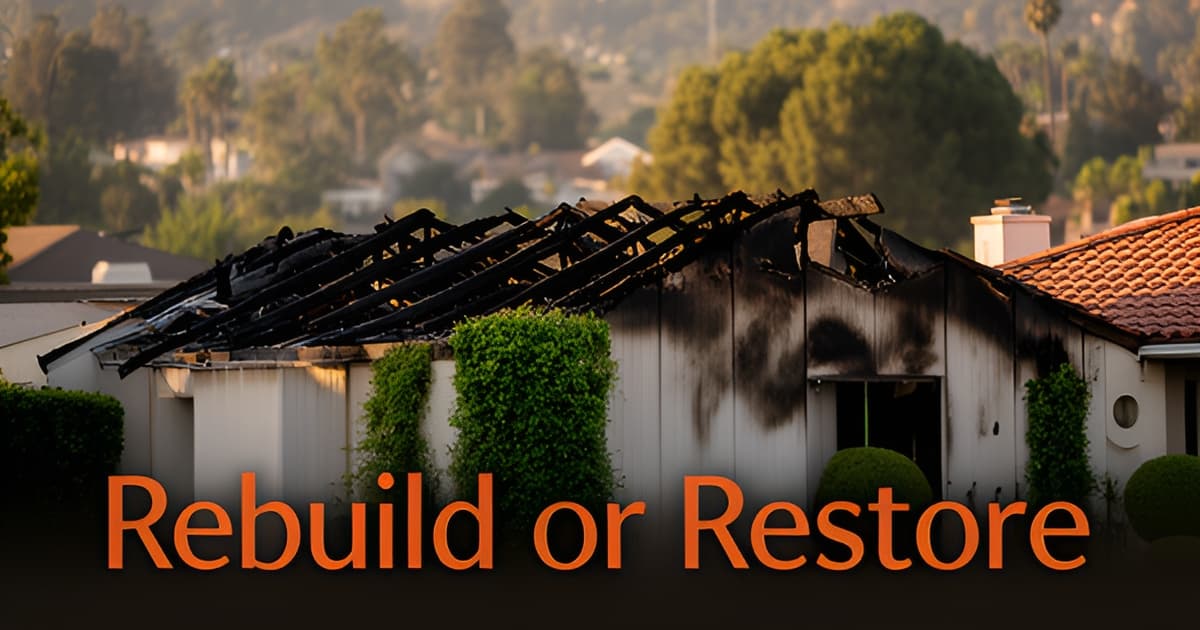
Historic Home Renovation in Pasadena and Altadena: Restore or Rebuild Decisions
Key Facts
- Only 23 of roughly 6,000 significantly damaged Altadena homes had completed rebuilding as of December 2025, recovery tracking data shows.
- Rebuilding costs about $500 per square foot in Altadena — a 1,500 sq ft home runs $750,000 against average insurance coverage of $607,000.
- Six out of 10 intact, remediated Altadena homes tested after the Eaton Fire remained uninhabitable due to elevated lead and asbestos.
- LA County's like-for-like rebuild pathway lets fire-affected homeowners expand up to 10% or 200 square feet beyond the original footprint.
- The Mills Act locks qualified historic properties into a rolling 10-year contract with a restricted value that can be considerably lower than market value.
- The National Trust for Historic Preservation notes strict period restorations are rare — most owners choose rehabilitation, keeping modern systems while preserving character.
- Pasadena's Historic Preservation Commission can recommend relocating a significant historic structure rather than allowing its demolition.
The Restore-or-Rebuild Crossroads: What Pasadena and Altadena Homeowners Face
For owners of Pasadena's Craftsman bungalows and Spanish Revival homes, the restore-or-rebuild question has never been more urgent — or more complicated. The Eaton Fire, which began January 7, 2025, destroyed 9,413 structures and left Altadena homeowners weighing decisions that blend history, money, and health in equal measure.
The numbers tell a sobering story. As of December 2025, only 23 of roughly 6,000 significantly damaged Altadena residential properties had completed rebuilding, according to a Catalyst California recovery tracking report. Just 43% of owners had applied for or received permits. The financial math explains the hesitation: rebuild costs benchmark around $500 per square foot, meaning a 1,500-square-foot replacement runs about $750,000 — while average insurance coverage in Altadena was $607,000. That leaves a shortfall of more than $140,000 before temporary housing costs even enter the picture.
Contamination adds another layer of uncertainty. Of 50 intact, remediated homes tested by Eaton Fire Residents United, 6 out of 10 remained uninhabitable due to elevated lead and asbestos. Even homes that survived the fire may require environmental testing before any restoration work begins.
For homeowners facing this crossroads, three key factors shape the decision:
- Regulatory pathway: LA County's like-for-like rebuild rules allow up to 10% or 200 square feet of added size — whichever is greater — beyond the original footprint, but larger changes trigger current Title 22 standards, including a 20-foot front setback.
- Financial incentives: The Mills Act can lower property taxes considerably for owners who restore qualified historic properties, and a federal 20% Historic Rehabilitation Tax Credit rewards certified rehabilitation work.
- Designation status: In Pasadena, major alterations or demolition of a historic resource require a Certificate of Appropriateness, and the Historic Preservation Commission may recommend relocation rather than demolition.
Here's the counterintuitive good news: experts consistently favor rehabilitation over strict restoration. As the National Trust for Historic Preservation notes, strict period restorations are rare — most owners retain modern systems while preserving historic character. Original windows and old-growth lumber are often more durable than modern replacements, and the goal isn't a museum but a livable home.
For intact or repairable homes, Altadena's deep restoration ecosystem — documented in Pasadena Heritage's referral list of Craftsman and Spanish Revival specialists — supports the rehabilitation path. And for owners thinking beyond the original structure, an ADU feasibility review can clarify how a like-for-like rebuild's size flexibility might accommodate a backyard unit. At Altadena ADU Builder, we offer a free feasibility consultation with a cost-quiz concept render to help you see what's possible on your lot before committing to a path.
If you're ready to explore your options, request a free ADU feasibility consultation and get a concept render of what your property could support.
Check Your Status First: How Historic Designation Rules Shape Your Options
Before you pick up a hammer or call a demolition crew, one question changes everything: does your home carry a historic designation? In Pasadena and unincorporated Altadena, the answer determines which rulebook — and which rebuild pathway — applies to your property.
If your home is a designated historic resource in Pasadena, any major alteration or demolition requires a Certificate of Appropriateness reviewed by the city's Historic Preservation Commission. The Commission can recommend that a significant structure be relocated rather than demolished, and the city's program explicitly promotes rehabilitation and adaptive use over teardowns, per the City of Pasadena's historic preservation office.
Unincorporated Altadena operates under LA County rules, which take a different approach. The County's Eaton Fire recovery program offers a "like-for-like" rebuild pathway: your replacement structure must match the original in size, location, and land use — with flexibility to expand up to 10% or 200 square feet beyond the original footprint, whichever is greater. Exceed those limits and your project is treated as new development under current Title 22 standards, including Altadena's minimum 20-foot front yard setback.
Do this before spending money on plans or contractors:
- Search the California Historical Resources Inventory Database (CHRID) and Pasadena's "Map My Neighborhood" tool for your address
- Call Pasadena Planning at (626) 744-4009 to confirm historic status and required permits
- Review LA County's fire-recovery resources, which flag Altadena's County landmarks, a pending historic district, and state and nationally listed properties
Designation status matters financially, too. A historic designation can unlock the Mills Act, which contracts with the County Assessor to restrict your property's assessed value — often considerably lower than market value — in exchange for preservation commitments.
The stakes are real. As of December 2025, only 23 of roughly 6,000 significantly damaged Altadena residential properties had completed rebuilding, and just 43% of owners had applied for or received permits, according to Catalyst California's rebuild tracking. Knowing your designation status up front prevents costly plan revisions and keeps every option — restore, rehabilitate, or like-for-like rebuild — genuinely on the table.
If you're weighing a rebuild or addition in Altadena and want to understand how the like-for-like rules interact with ADU planning on your lot, Altadena ADU Builder offers a free ADU feasibility consultation with a cost-quiz concept render. Our featured builder, JMB Builders LLC (CSLB #1103479), is an Altadena-based licensed contractor experienced with Eaton Fire rebuilds — a paid placement we disclose openly.
The Money Math: Mills Act Tax Relief, Federal Credits, and the Insurance Gap
The restore-vs-rebuild decision often comes down to a spreadsheet, and the numbers tell a sharper story than sentiment does. For intact historic homes, the tax code stacks the deck in favor of preservation; for fire-damaged ones, the math can be sobering before a single board is ordered.
Start with the upside. Under the Mills Act, enacted in 1972, owners who restore and preserve qualified historic properties sign a rolling 10-year contract that reassesses the property at a restricted value — one that "can be considerably lower" than market value, generating meaningful annual property tax savings. Layer on the federal Historic Rehabilitation Tax Credit, a 20% income tax credit for rehabilitating certified historic structures, and the restoration path gains two durable financial tailwinds that rebuilding simply doesn't offer.
Now the other side of the ledger. Tracking data from Altadena's recovery puts rebuild costs at roughly $500 per square foot. For a 1,500 square foot home, that's about $750,000 — against average insurance coverage of $607,000. That's a shortfall of more than $140,000 before you account for temporary housing, which the same research notes insurance often fails to cover. It helps explain why, as of December 2025, only 23 of nearly 6,000 significantly damaged Altadena residential properties had completed rebuilding.
- Mills Act contracts: rolling 10-year agreements with restricted property values typically well below market assessments
- Federal credit: 20% income tax credit for certified historic rehabilitation work
- Rebuild benchmark: ~$500 per square foot in current Altadena conditions
- Average coverage: $607,000 — leaving a $140,000+ gap on a 1,500 sq ft rebuild
There's also a structural constraint worth pricing in. LA County's like-for-like rebuild pathway allows expansion of only 10% or 200 square feet — whichever is greater — beyond the original footprint, height, or size. Anything larger triggers current Title 22 standards, including a 20-foot front yard setback under the Altadena Community Standards District. For homeowners weighing whether a rebuilt home can also make room for an ADU, those limits shape what's feasible — something we factor into every feasibility consultation we run for Altadena property owners.
The practical takeaway: run both scenarios before committing. Restoration preserves Mills Act savings and often costs less than the insurance gap implies; rebuilding means budgeting realistically for the shortfall. Whichever way you lean, getting a clear-eyed cost picture — including what an ADU addition could contribute long-term — is the first step, and our free feasibility consultation with a concept render is built for exactly that comparison.
Rehabilitate, Don't Museum-Restore: The Approach Experts Recommend
Your 1920s Craftsman doesn't need to become a museum exhibit to be worth saving — and the experts are nearly unanimous on that point. The National Trust for Historic Preservation calls strict period restorations "rare" for homes, noting that most owners choose rehabilitation: preserving the character-defining features while keeping modern plumbing, electrical, and HVAC systems.
The distinction matters for your budget and your daily life. "The key to a quality rehabilitation is how well it accommodates modern technologies and living styles," the National Trust explains — meaning you can keep the quarter-sawn oak built-ins and clinker-brick fireplace while adding a contemporary kitchen or, for that matter, planning an ADU on the lot. As restoration contractors put it, the goal isn't "creating a museum, but about protecting the special elements of your home while making it functional for your family."
That repair-first philosophy has a counterintuitive payoff: the original materials often outlast what replaces them. Old-growth lumber and original wood windows, properly maintained, frequently prove more durable than modern substitutes. That's why preservation experts advise repairing rather than swapping out historic fabric whenever possible.
A few hard rules protect that investment:
- Never sandblast or use aggressive chemicals on historic wood, brick, or stone — the damage is irreversible.
- Don't discard original materials during demolition or cleanup; salvage them for repair and reuse.
- Don't mix architectural periods when adding on; new work should match scale and materials but remain distinguishable from the original.
For Altadena homeowners, one step comes before any of this: environmental testing is mandatory before restoring a fire-adjacent home. The Eaton Fire data is sobering. Of 50 intact, remediated homes tested by residents' groups, 6 out of 10 remained uninhabitable due to elevated lead or asbestos, according to rebuilding tracking research. Lead contamination touched even undamaged properties — 58% of undamaged single-family homes in Altadena sit in high-lead grid areas.
The good news is that this region supports the rehabilitation approach exceptionally well. Pasadena Heritage maintains an annually updated referral list of preservation specialists, including Altadena firms with decades of Craftsman experience — though the organization wisely advises verifying licenses and insurance and getting multiple estimates. At Altadena ADU Builder, we'd add one more piece of due diligence: confirm your home's historic status with the city or county before finalizing any scope, since it shapes both permits and potential Mills Act tax savings.
Your Action Plan: Vetting Builders, Permits, and Next Steps
The difference between a smooth historic renovation and a stalled, budget-busting ordeal usually comes down to preparation. Before you sign anything, follow a disciplined vetting process that confirms your home's status, your builder's credentials, and your regulatory pathway.
Step one: confirm your historic status before touching anything. Pasadena homeowners can check designation status through the California Historical Resources Inventory Database and the "Map My Neighborhood" tool, or call the City's Design & Historic Preservation section at (626) 744-4009, per the City of Pasadena. This determines whether a Certificate of Appropriateness applies and whether Mills Act tax relief is on the table — the LA County Assessor notes the program's restricted value can be considerably lower than market value for qualified historic properties.
Step two: vet builders the way preservationists do. Pasadena Heritage's referral list is the local gold standard, connecting homeowners with Craftsman and Spanish Revival specialists — including Altadena's own Grueter Construction, with 35+ years restoring bungalows "while providing them with 21st century functionality." But Pasadena Heritage itself cautions: verify current licenses and insurance, and always get more than one estimate. As builder guidance puts it, choosing the wrong partner "can lead to irreversible damage."
Your vetting checklist should include:
- A proven portfolio of historic or period-home work, with client references you actually call
- Working knowledge of local preservation law — Certificates of Appropriateness in Pasadena, like-for-like rules in unincorporated Altadena
- Access to specialized craftspeople for plaster repair, custom millwork, and glass restoration
- An active CSLB license and current insurance, verified independently
Step three: know your flexibility. LA County's like-for-like rebuild pathway allows fire-affected Altadena homeowners to expand up to 10% or 200 square feet beyond the original footprint — whichever is greater — while keeping the original placement and scale. That modest allowance, paired with an ADU on a qualifying lot, can meaningfully expand livability without triggering full new-development review under current Title 22 standards.
Set budget expectations honestly: rebuild tracking data benchmarks Altadena rebuild costs around $500 per square foot, against average insurance coverage of $607,000 — a shortfall exceeding $140,000 for a 1,500-square-foot home. Multiple detailed estimates aren't optional; they're essential.
One disclosed local option: JMB Builders LLC (CSLB #1103479), an Altadena-based licensed general contractor featured through paid placement on this guide, builds custom homes, ADUs, and whole-home remodels, including Eaton Fire rebuilds. If you're weighing whether an ADU fits your lot and budget, Altadena ADU Builder offers a free ADU feasibility consultation with a cost-quiz concept render — a low-stakes first step before committing to any builder.
Frequently Asked Questions
Should I restore my fire-damaged historic home or tear it down and rebuild?
How much does it actually cost to rebuild in Altadena after the Eaton Fire?
Do I need a permit or approval to renovate my historic Craftsman home in Pasadena?
What are the like-for-like rebuild rules in Altadena, and how much can I expand my home?
Is it worth restoring a historic home for the tax breaks?
My home survived the Eaton Fire — do I still need environmental testing before renovating?
Your Home's Next Chapter Starts With a Phone Call
The restore-or-rebuild decision comes down to three things you now know how to check: your home's historic designation, your environmental test results, and your honest budget math. Confirm status with Pasadena Planning or LA County before spending a dollar on plans. If your home is intact or repairable, rehabilitation — not museum-grade restoration — is the expert-backed path, and it preserves access to Mills Act tax savings that a teardown forfeits. If you're rebuilding after the Eaton Fire, the like-for-like pathway offers modest size flexibility, but budget for the real numbers: at roughly $500 per square foot, a 1,500-square-foot rebuild runs about $750,000 against average insurance coverage of $607,000, a shortfall of more than $140,000 that has kept all but 23 of nearly 6,000 damaged Altadena properties from completing rebuilding. Wherever you land, an ADU can shape the long-term value of either path. Altadena ADU Builder offers a free ADU feasibility consultation with a cost-quiz concept render — a low-stakes way to see what your lot could support before you commit.