Full Gut Renovation Cost in Los Angeles: What You Get at Each Price
Key Facts
- A complete gut renovation in LA County runs $425,000–$650,000+, with down-to-studs work reaching $600K–$1.5M, per 2026 contractor benchmarks.
- Electrical, plumbing, and HVAC systems consume about 20% of a whole-home renovation budget — and none of it is visible when finished, per design-build project data.
- California's energy code adds $30,000–$55,000 in compliance costs to mid-tier whole-home projects, according to LA cost data.
- Actual LA renovation costs can vary 20–40% from initial estimates, so contractors advise a 10–15% contingency buffer, per LA County benchmarks.
- Beverly Hills and Santa Monica renovations carry a 35–40% premium, while Pasadena-area projects run 15–20% above baseline, per regional cost data.
- LA garage conversions cost $58,000–$196,000 — often delivering more usable space per dollar than a full gut renovation, per Sweeten's LA cost guide.
- Most homeowners who assume they need a down-to-studs gut find a reconfiguration delivers 90% of the outcome, per design-build practitioners.
Why Gut Renovation Estimates in LA Vary by $500,000 (and Why That's Normal
Search "gut renovation cost" and you'll find national figures around $100,000–$200,000. Then you get quotes in Los Angeles and the numbers start at $425,000 — sometimes $650,000 or more. Neither figure is wrong, and that's exactly the problem.
The gap exists because the two numbers describe different projects. National databases like HomeGuide put full gut renovations at $100,000–$200,000, or $60–$150 per square foot. But LA-specific contractors report $425,000–$650,000+ for a complete gut, and down-to-studs work in 2026 ranges from $600K to $1.5M, per A to Z Construction's 2026 guide. Those aren't errors — they reflect different scope definitions, home sizes, and LA cost premiums stacked on top of each other.
Three forces drive the divergence:
- Scope definitions vary wildly. One contractor's "gut" means new paint and fixtures; another's means stripping to studs, replacing every system, and reconfiguring walls. Multiple LA sources converge on a tier structure — cosmetic refresh, mid-level remodel, down-to-studs gut, premium custom — but most headline numbers don't tell you which tier they're describing.
- Home size multiplies everything. A $100–$250/sq ft gut renovation on a 1,200 sq ft bungalow is a different project than the same rate applied to 4,000 sq ft. High-end LA full-home engagements on 3,000–6,000 sq ft homes run $1M–$3M.
- Regional premiums apply even within LA County. Pasadena-area projects carry a +15–20% multiplier, while Beverly Hills and Santa Monica run +35–40%. The same scope costs materially different amounts depending on your zip code.
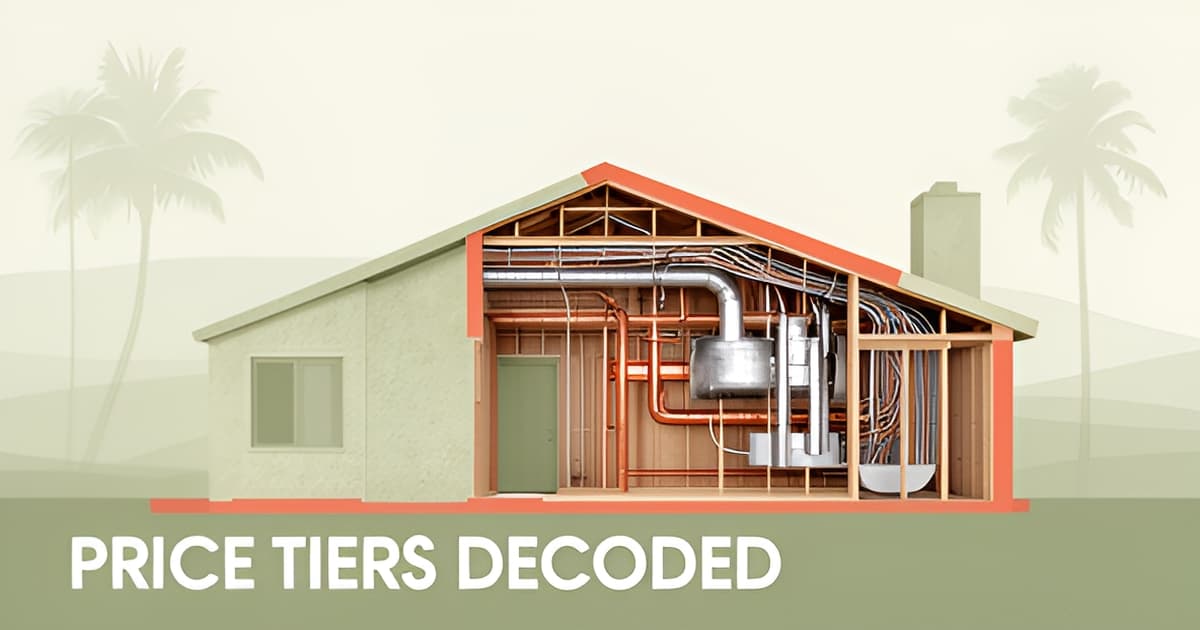
There's also an invisible layer most estimates bury: electrical, plumbing, and HVAC systems routinely consume roughly 20% of a whole-home budget, and none of it is visible when the work is finished. Much of LA's housing stock was built between 1950 and 1985, and pre-1970s homes often hide knob-and-tube wiring, original lath, and undersized electrical service behind every wall. California's energy code adds another $30,000–$55,000 on mid-tier whole-home projects, since heat-pump HVAC and water heaters are now the default spec.
This is why a single "average" number is useless. The only reliable way to read renovation pricing is to match the number to a defined scope tier — what's being stripped, what's being replaced, and what finish level you're buying. In the breakdown below, we map each price tier to exactly what you get, so you can compare quotes on equal footing.
For Altadena homeowners, the calculus often includes a parallel question: whether part of the budget is better spent on a garage conversion or detached ADU (typically $58,000–$196,000 for conversions) rather than expanding the main house. Altadena ADU Builder helps you run that comparison — request a free ADU feasibility consultation with a cost-quiz concept render to see what your property supports before committing to a full gut.
The Four Price Tiers: Cosmetic Refresh to Down-to-Studs Gut
The most expensive mistake in LA renovation isn't hidden damage — it's buying more scope than your house actually needs. Multiple LA cost sources converge on the same four-tier structure, and understanding where your project falls can save you hundreds of thousands of dollars.
| Tier | LA Cost Range | What It Buys | Timeline |
|---|---|---|---|
| Cosmetic Refresh | $75,000–$150,000 | Paint, flooring, fixtures, surface kitchen/bath updates — no structural or systems work | 4–7 months |
| Mid-Level Remodel | $150,000–$275,000 | New kitchen and baths, select-room upgrades, targeted systems fixes | 6–10 months |
| Major Remodel | $275,000–$425,000 | Most rooms, structural wall removal, new flooring, electrical, plumbing, and HVAC | 9–14 months |
| Complete Gut | $425,000–$650,000+ (down-to-studs: $600K–$1.5M) | Everything stripped to studs, full systems replacement, layout changes, new windows | 9–14+ months |
These tiers come from LA County cost benchmarks and 2026 contractor pricing guides, which independently describe the same progression from surface work to full down-to-studs rebuilds inside the existing shell.
Per-square-foot benchmarks follow the same logic: cosmetic refreshes run roughly $50–$100/sq ft, mid-range renovations $200–$400/sq ft, and down-to-studs work $500–$900/sq ft. One design-build firm cautions that any per-foot figure is "a starting assumption rather than a measurement" — useful for sanity-checking a bid, not for setting a budget.
The jump between tiers isn't finishes — it's systems. According to whole-home cost data, electrical, plumbing, and HVAC routinely consume about a fifth of a whole-home budget, and none of it is visible when the work is finished. A same-size house needing a panel upgrade, repipe, and HVAC replacement "adds tens of thousands before anything visible changes."
Down-to-studs jobs also trigger mandatory energy-code work that lighter tiers escape:
- Heat-pump HVAC: $18K–$32K (vs. $10K–$15K gas like-for-like)
- Heat-pump water heater: $4.5K–$7.5K
- Envelope insulation: $3.5K–$8K, mandatory once walls open
- Code-compliant windows: $1,200–$1,800 each
On a mid-tier whole-home, energy compliance typically lands at $30,000–$55,000 — a line item many homeowners never see coming.
Here's the finding worth taping to your fridge: "Most homeowners come in assuming down-to-studs and discover a reconfiguration gets them 90% of the outcome." That's the consistent experience reported by design-build practitioners working across LA's older housing stock.
The exception is genuinely old homes. On pre-1970s houses — common throughout Altadena and the foothills — patching 1920s-era systems room-by-room can cost more over ten years than replacing them once. In those cases, the gut isn't over-scoping; it's the honest path. For everyone else, a well-planned mid-level or major remodel delivers nearly all of the visual and functional transformation at a fraction of the cost and months less disruption.
If you're weighing a major remodel against adding living space instead, a garage conversion or detached ADU often delivers more usable square footage per dollar — a comparison worth running before you commit to a tier.
The Invisible 20%: Systems, Old Housing Stock, and California Energy Code
The most expensive parts of a gut renovation are the ones you'll never see. Electrical, plumbing, and HVAC routinely consume a fifth of the whole-home budget — and none of it is visible when the crew packs up, according to one design-build firm's project data.
This is where LA budgets blow up. Pre-1970s housing across the city carries "surprises behind every wall — knob-and-tube, original lath, undersized service," as one LA contractor guide puts it. Much of the Valley and Westside stock dates to 1950–1985, which is why hidden surprises are so common here. Altadena's older homes fit squarely into this risk profile.
Systems condition — not square footage — is the decisive cost driver. A same-size house needing a panel upgrade, a galvanized repipe, and HVAC replacement "adds tens of thousands before anything visible changes," per the same project data. A house that looks identical to its neighbor can carry a materially different renovation bill purely because of what's inside the walls.
Then there's California's energy code, which layers mandatory costs onto any down-to-studs job. On a mid-tier LA whole-home project, energy-compliance work typically lands between $30,000 and $55,000, because heat-pump HVAC and heat-pump water heaters are now the default spec:
- Heat-pump HVAC: $18K–$32K, versus $10K–$15K for a like-for-like gas system that code now discourages
- Heat-pump water heater: $4.5K–$7.5K, with rebates recovering $1.5K–$3K
- Envelope insulation: $3.5K–$8K, mandatory once walls are open on a full gut
- Code-compliant windows: $1,200–$1,800 each
California has also banned running new gas lines to new construction — a real consideration for resale-minded renovations, as Sweeten's LA cost guide notes.
For Altadena homeowners weighing a full gut against patching an older system room by room, the honest math is sobering. On LA's oldest stock, down-to-studs replacement is often the honest path — patching 1920s systems piecemeal can cost more over ten years than replacing them once. That's why local firms like JMB Builders LLC, an Altadena-based licensed general contractor handling whole-home remodels and Eaton Fire rebuilds, approach older homes with systems-first scoping rather than finish-first budgeting.
The practical takeaway: budget the invisible layer before you fall in love with tile. If you're also weighing whether a gut renovation or a backyard ADU makes more sense for your property, Altadena ADU Builder offers a free ADU feasibility consultation with a cost-quiz concept render to help you compare the two paths.
Budgeting Without Getting Burned: Contingency, Estimates, and Red Flags
Here's the uncomfortable truth about renovation budgets: the number on your estimate is a starting point, not a final cost. Actual costs in Los Angeles can vary 20–40% from initial estimates, and the contractors who publish real project data admit the gap is structural, not bad luck.
That's why a contingency line isn't optional. Plan a 10–15% buffer on top of every estimate. As one LA contractor put it plainly: "Some of our projects come in under contingency. None come in under budget." The biggest source of remodel pain, they note, isn't unexpected problems — it's homeowners who didn't plan for any. On a $425,000–$650,000 complete gut, that buffer alone represents $40,000–$100,000 you should never assume you'll get back.
Reading an estimate correctly is the other half of the discipline. A good estimate is itemized, written, and explicit about what's included and what's not — and what's missing tells you as much as what's listed. Watch for these red flags:
- Single round numbers with no breakdown ($150,000 for "whole house")
- Verbal-only estimates that leave nothing in writing
- Omitted permit costs — this is illegal, but it happens
- "Fixed price guaranteed" claims that sound safe but rarely hold
- Cash discounts offered outside the contract
Permits deserve their own line item because they're substantial and scope-dependent. Typical LA permit costs run $750–$2,500, with express permits for kitchen and bath work at $500–$1,000; major projects can start at $5,000 and climb to $20,000 in cities like Santa Monica, according to LA contractor data. On down-to-studs work, expect fees at the higher end and plan check timelines of 10–16 weeks.
Finally, know where to spend and where to save. Spend on cabinets, plumbing rough-in and waterproofing, lighting, layout changes, and the contractor himself — these are the elements you can't cheaply undo. Save on decorative fixtures, tile patterns, paint, hardware, and interior doors, which are easy to upgrade later. High-end finishes can consume half a bathroom budget; a $2,000 faucet doesn't make the waterproofing behind it better.
The same logic applies at the property scale. If a gut renovation estimate is giving you pause, adding an ADU — which our team at Altadena ADU Builder helps homeowners evaluate through a free feasibility consultation with a cost-quiz concept render — may deliver more usable space per dollar than stripping your main house to the studs. Licensed builders like JMB Builders LLC (CSLB #1103479) handle both whole-home remodels and ADU construction, which makes comparing the two paths side-by-side straightforward before you commit to either.
Gut Renovation vs. Adding an ADU: Which Makes Sense for Your Altadena Property
Before you sign off on a down-to-studs budget, it's worth asking a harder question: is a gut renovation actually the best way to buy the living space your property needs? For many Altadena homeowners on generous lots, the honest answer is sometimes no — or at least, "not all of it."
A complete gut renovation in LA County runs $425,000 to $650,000+, and down-to-studs work can reach $600K to $1.5M on larger homes, according to 2026 LA contractor benchmarks. That money buys a transformed interior — but not a single additional square foot of living space.
Compare that with adding an ADU. Garage conversions in LA run $58,000 to $196,000, while ground-up detached ADUs typically land between $250K and $450K, with luxury builds reaching higher. For the cost of a full gut, you could often complete a substantial interior remodel and add a detached unit.
Here's the insight that changes the math for many homeowners: practitioner data from LA design-build firms shows most homeowners who assume they need a down-to-studs gut discover that a reconfiguration-level remodel delivers "90% of the outcome." The remaining budget can go toward an ADU instead.
The comparison looks like this:
- Full gut ($425K–$650K+): fully modernized existing footprint, new systems, no added square footage.
- Reconfiguration remodel ($300K–$700K): new kitchen and baths, layout changes, updated systems within the existing shell.
- Garage conversion ($58K–$196K): 400–800 sq ft of new rentable or family living space at the lowest cost per foot.
- Detached ADU ($250K–$450K): a fully independent dwelling — rental income, guest quarters, or a future downsizing option.
ADU-friendly state laws passed in 2016 and 2019 have made this path dramatically easier, and exterior upgrades plus garage conversions are among the fastest-rising categories in LA renovation planning.
The gut makes sense when your home's bones demand it — pre-1970s Altadena stock often hides knob-and-tube wiring and undersized electrical service, and on the oldest homes, replacing systems once can cost less than patching them room-by-room over a decade. The ADU path makes sense when your existing layout works but your household has outgrown it.
Many Altadena properties can support both. If you're weighing these options, Altadena ADU Builder offers a free ADU feasibility consultation that includes a cost-quiz concept render — a realistic look at what a backyard unit could cost and look like on your specific lot before you commit renovation dollars anywhere. No permit or timeline outcomes are guaranteed, but seeing the numbers side by side is the cheapest due diligence you'll ever do.
Frequently Asked Questions
How much does a full gut renovation cost in Los Angeles?
What's the difference between a cosmetic refresh, mid-level remodel, and down-to-studs gut?
Do I really need to gut my house to the studs?
What hidden costs should I budget for in an older LA home?
How much contingency should I add to my renovation budget?
Would an ADU or garage conversion be a better use of my budget than a gut renovation?
The Number That Matters Isn't the One on the Estimate
The real takeaway from LA's renovation pricing isn't a dollar figure — it's discipline. Match every quote to a defined scope tier, budget the invisible 20% for systems before you fall in love with finishes, add a 10–15% contingency, and remember that most homeowners discover a reconfiguration remodel delivers 90% of the outcome they assumed required a down-to-studs gut. That leaves room to ask the bigger question: is a full gut the smartest way to spend six figures on your Altadena property, or would a garage conversion or detached ADU deliver more usable space per dollar? Before you commit renovation dollars anywhere, run the comparison. Altadena ADU Builder offers a free ADU feasibility consultation that includes a cost-quiz concept render — a realistic look at what a backyard unit could cost and look like on your specific lot. No permit or timeline outcomes are guaranteed, but seeing the gut-renovation and ADU numbers side by side is the cheapest due diligence you'll ever do. Get your free feasibility consultation and make your next six-figure decision with both paths on the table.