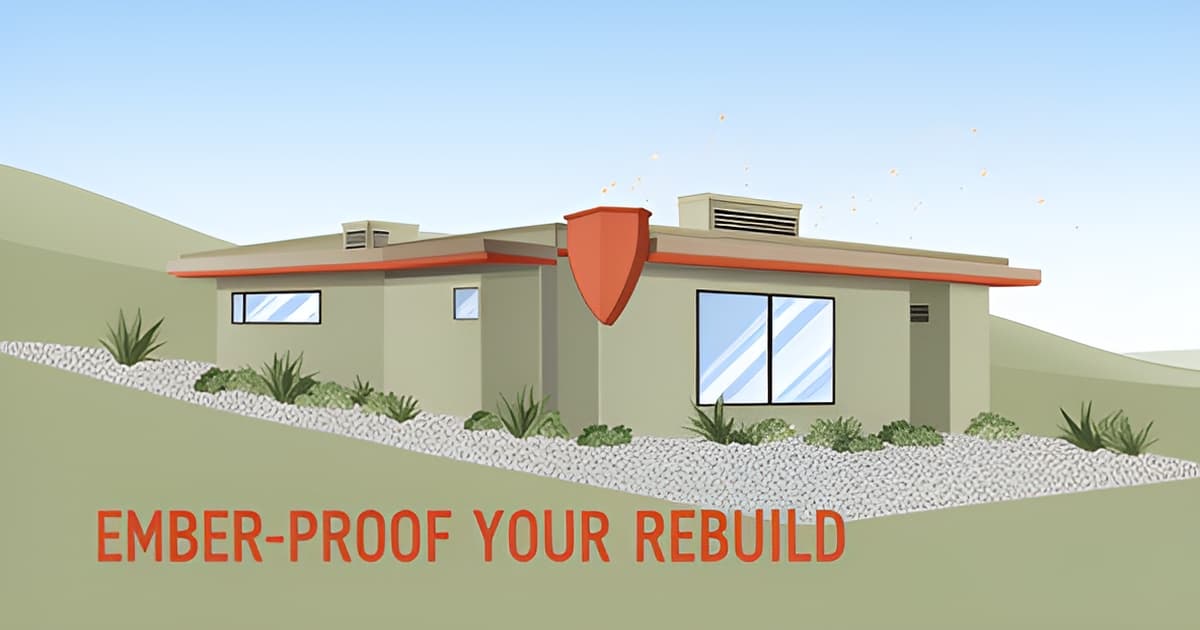
Fire-Resistant Home Rebuild: WUI Requirements in LA County
Key Facts
- Wind-carried embers travel more than a mile ahead of the fire front and destroy most homes through vents and eaves, per fire engineering research.
- Chapter 7A-compliant construction adds only ~$30,000 to a 2,000 sq ft rebuild — under 10% of typical cost, per Headwaters Economics.
- Homes combining hardening with defensible space survived the LA fires at nearly 50%, versus just 20% with no mitigation, a 2026 CDI study found.
- 40% of destroyed LA homes — roughly 4,900 — fall outside state-mapped Chapter 7A zones and receive no insurance-funded code upgrades, per Headwaters Economics.
- Removing vegetation within 5 feet of a structure alone is associated with a 17% reduction in structure loss, research shows.
- Every $1 spent rebuilding wildfire-resistant could save $210 in avoided future losses, Headwaters Economics estimates.
- Tempered glass is roughly four times stronger than regular glass, resisting the radiant heat that shatters windows, per rebuilding analysis.
Why Embers — Not Flames — Decide Whether Your Altadena Home Survives
When the Eaton Fire swept through Altadena in January 2025, it destroyed thousands of homes — and in most cases, the flames never touched them. According to fire engineering research, wind-carried embers travel more than a mile ahead of the fire front, and they enter homes through the quietest openings: attic vents, eaves, and gaps around doors and windows.
This is the ignition mechanism most homeowners don't understand. UC Cooperative Extension fire scientist Yana Valachovic identifies embers entering through vents or lodging on flammable roofs as the most crucial ignition pathway in wind-driven fires like Eaton, per independent reporting. A house can sit far from the fire line and still burn from the inside out.
The evidence from Altadena and Pacific Palisades is striking. Homes built after California's 2008 fire code update "fared much better," and Valachovic observed that some post-2008 structures "defended themselves on their own." A 2026 CDI study found that homes combining hardening with defensible space survived at nearly 50%, versus 20% for homes with no mitigation.
The critical weak points are small and inexpensive to fix:
- Attic and crawl-space vents — the #1 ember entry point, addressable with 1/8-inch metal mesh or ASTM E2886-rated vents
- Open eaves and unsealed soffits, where embers lodge and smolder
- The first five feet around the structure — clearing vegetation here alone is associated with a 17% reduction in structure loss
- Single-pane windows, which fail long before dual-pane tempered glass
Here is what makes this manageable: ember resistance is a design decision, not a budget crisis. A Headwaters Economics and IBHS analysis found Chapter 7A-compliant construction adds roughly $30,000 to a 2,000 sq ft rebuild — under 10% more than typical construction — and basic vent and deck retrofits start at around $2,000.
That framing matters for every Eaton Fire rebuild in Altadena. The question is not whether fire-resistant construction is affordable. The question is what your specific parcel requires — and 40% of destroyed LA homes fall outside state-mapped Chapter 7A zones, receiving no insurance-funded code upgrades, per Headwaters Economics.
At Altadena ADU Builder, we see this play out in rebuild and ADU consultations across unincorporated LA County: homeowners assume code will force hardening, only to learn their parcel isn't mapped. Verifying your WUI status with the county before design begins is the first step — and the smartest rebuilds treat vents, roofing, glazing, and defensible space as one coordinated system from day one.
What Chapter 7A Requires — and What It Costs (Less Than You Think)
Embers, not flames, destroy most homes in wind-driven fires — and California's Chapter 7A is written specifically to keep those embers out. If your rebuild parcel sits in a mapped Fire Hazard Severity Zone, here's what the code actually demands, and why the price tag is smaller than the rumors suggest.
Chapter 7A boils down to five practical upgrades: Class A roofing, ember-resistant vents meeting ASTM E2886, dual-pane windows with at least one tempered pane, ignition-resistant siding, and covered exterior vent openings. Tempered glass matters because it carries roughly four times the strength of regular glass, resisting the radiant heat that shatters windows and lets embers inside.
The essentials, in plain terms:
- Class A roof — the non-negotiable first line of defense
- Ember-resistant vents — 1/8-inch or finer metal mesh on attic and crawl-space openings
- Dual-pane tempered glazing in windows and doors
- Ignition-resistant cladding such as fiber cement or stucco
- A 5-foot noncombustible "Zone 0" around the structure
Now the cost question. A Headwaters Economics analysis puts the Chapter 7A premium at roughly $30,000 on a 2,000 sq ft rebuild — under 10% of typical construction cost. IBHS research goes further, finding wildfire-resistant homes cost "roughly the same" as typical construction.
Better still, California law can erase that premium. Under Ins. Code § 10103, full replacement policies must include Law and Ordinance Coverage for code upgrades up to 10% of dwelling coverage — meaning many homeowners in mapped areas pay $0 out of pocket to rebuild to code.
One critical catch: only about 60% of the 11,500 homes destroyed in the LA fires sit inside mapped Chapter 7A zones. The other 40% — roughly 4,900 homes — receive no insurance-funded upgrades at all. Before designing anything, verify your parcel's WUI status with the county building department. At Altadena ADU Builder, we encourage homeowners to settle this question early, since mapping status shapes both budget and design decisions — whether you're rebuilding a main home or planning a fire-hardened backyard ADU.
Fire Hardening Is a System: Design Decisions That Must Happen Together
The most expensive mistake in a fire-zone rebuild isn't a material choice — it's treating fire hardening as a shopping list. A noncombustible roof over combustible wall framing isn't a complete solution; it's a partial one, and partial upgrades often don't outperform unprotected homes at all, according to fire-resistant design research.
That's why these decisions belong at schematic design, not mid-construction. Roof profile, vent placement, window specification, cladding, and eave details all interact, and changing any one of them after framing starts costs real money. For Altadena homeowners planning a rebuild or an ADU, this is where a feasibility conversation pays for itself — the package costs roughly the same whether you specify it early or scramble to retrofit it later.
The highest-impact moves are also the least discussed. Per design analysis of the 2025 LA fires, the most effective measures include:
- Sealing soffits and eliminating open eaves, where embers accumulate and enter
- Simplifying rooflines to reduce ember-trapping complexity, with Class A roofing
- Noncombustible cladding such as fiber cement or stucco — one inch of stucco resists flame for at least an hour
- Dual-pane windows with at least one tempered pane, which offers roughly 3–4 times the heat resistance of standard annealed glass
- Ember-resistant vents with 1/8-inch metal mesh meeting ASTM E2886
The proof that this system approach works is standing in the burn scars. Architect Greg Chasen's passive house in Pacific Palisades — no eaves, concrete walls, sealed attic, tempered double-pane windows — survived with a burning car parked beside it. In Lahaina in 2023, FEMA documented the so-called "Miracle House," which survived on a Class A metal roof and noncombustible perimeter hardscaping alone.
The broader data backs up these individual stories. UC Cooperative Extension fire scientist Yana Valachovic found that homes built to California's post-2008 WUI code "performed exceedingly well" in the Palisades and Eaton fires — some, she noted, "defended themselves on their own." A 2026 California Department of Insurance study found homes combining hardening with defensible space survived at nearly 50%, versus 20% for homes with no mitigation.
For an ADU or garage conversion in Altadena, the same logic applies at a smaller footprint: specify the roof, glazing, vents, and cladding as a coordinated package in your concept render, before permits are filed. At Altadena ADU Builder, our free feasibility consultation and cost quiz are designed to surface these decisions while they're still cheap to make — and JMB Builders LLC (CSLB #1103479), our featured local builder, is actively building Eaton Fire rebuilds in the community.
Planning a rebuild or backyard ADU in Altadena? Get a free ADU feasibility consultation — including a cost-quiz concept render that builds fire-hardening into the design from day one.
Beyond Code: Zone 0, Defensible Space, and the $5,000 Upgrades Worth Making
Chapter 7A gets your home to code — but the homes that survived the Eaton Fire at the highest rates went further. A 2026 study found hardened homes with defensible space survived at nearly 50%, versus just 20% for homes with no mitigation.
California law already requires the foundation of that protection. Under Public Resources Code 4291, CAL FIRE's three-zone system mandates defensible space in 100 feet around wildfire-prone structures: a 0–5 foot noncombustible zone, a 5–30 foot managed zone (mow annual grasses to 4 inches or less), and a 30–100 foot extended zone. Embers travel more than a mile ahead of the fire front, so what sits against your walls matters as much as what your walls are made of.
Going beyond code costs surprisingly little. The IBHS Wildfire Prepared Home™ add-ons — upgrades beyond Chapter 7A — run up to about $5,000 per home, according to Headwaters Economics. Worth specifying in any rebuild or ADU plan:
- Noncombustible metal gutters and downspouts, where embers love to lodge
- Enclosed under-deck areas, which otherwise trap heat and burning debris
- Noncombustible fencing and landscaping within 5 feet of the structure
- Removing vegetation within 5 feet alone — associated with a 17% reduction in structure loss
The math is hard to argue with. Removing flammable material from Zone 0 can cost nothing but labor, and basic retrofits start around $2,000. Set against the survival gap between hardened and unhardened homes, $5,000 is cheap insurance.
One caveat: hardening your own lot isn't enough. Radiant heat from a burning neighbor's structure can ignite even a well-built home — as NFPA's Michele Steinberg put it, "You can build the perfect house, but if a neighbor doesn't, you will still have risk." Neighborhoods in Boulder County that coordinated defensible space saw lower destruction rates in the 2021 Marshall Fire. In Altadena's dense lots, that argues for talking defensible space with neighbors — and for treating any accessory dwelling unit as part of the same fire strategy. An ADU adds structure square footage close to the primary home, so its roofing, vents, glazing, and surrounding Zone 0 should be designed together with the main house, not as an afterthought.
If you're weighing a rebuild alongside a backyard ADU, Altadena ADU Builder's free feasibility consultation includes a cost-quiz concept render so you can see how the two structures sit on your lot — and where the noncombustible zone between them should go. Featured builder JMB Builders LLC (CSLB #1103479), an Altadena general contractor doing Eaton Fire rebuilds, brings this same zone-by-zone thinking to whole-property plans.
Your Altadena Rebuild Roadmap: Verify, Design, Build
Rebuilding after the Eaton Fire means making dozens of decisions in quick succession — and the ones that matter most happen before a single stud goes up. The sequence below keeps you from designing a home that fails inspection or, worse, designing one that burns.
Step 1: Verify your parcel's WUI mapping status first. Only about 60% of the 11,500 homes destroyed in the 2025 LA fires fall within state-mapped Chapter 7A zones, and Headwaters Economics research shows the remaining 40% receive no insurance-funded code upgrades. Before you hire a designer, confirm with LA County whether your Altadena parcel sits in a mapped fire hazard severity zone — it determines both your building requirements and your insurance eligibility.
Step 2: Review your Law and Ordinance Coverage with your carrier. California Insurance Code § 10103 requires full replacement policies to include code-upgrade coverage up to 10% of dwelling coverage, meaning many homeowners in mapped areas pay nothing out of pocket for Chapter 7A compliance. One caution from the rebuild community: payouts can be slow, with one Palisades homeowner reporting theirs took a year and a day, and there's no framework guaranteeing insurability for building above code. Know your numbers before you commit to a spec.
Step 3: Bring fire hardening into schematic design — not construction. Fire resistance is a coordinated system, not a shopping list of materials; partial upgrades often don't outperform unprotected homes because roof, vents, glazing, and cladding must work together. Work with a licensed builder experienced in Eaton Fire rebuilds who specifies the full package from day one:
- Class A roofing and ember-resistant vents meeting ASTM E2886 with 1/8-inch metal mesh
- Dual-pane windows with at least one tempered pane — roughly four times less likely to break in fire
- Noncombustible cladding, sealed eaves, and simplified rooflines
- A five-foot noncombustible Zone 0 around the structure
Step 4: Fold the same specs into any ADU or garage conversion. A hardened main home next to a vulnerable converted garage undermines the whole system — embers travel more than a mile ahead of a fire front, and radiant heat from a burning accessory structure can ignite the main house. Applying the same specs to an ADU costs little: Chapter 7A construction adds roughly $30,000 to a 2,000 sq ft rebuild, under 10% of typical construction cost.
Altadena ADU Builder offers a free ADU feasibility consultation that includes a cost-quiz concept render, so you can see real costs, permits, and hardened-spec options for your specific parcel before committing. JMB Builders LLC (CSLB #1103479), an Altadena-based licensed general contractor building custom homes, ADUs, and Eaton Fire rebuilds, is a featured, disclosed paid placement on this guide.
Frequently Asked Questions
How much more does it actually cost to rebuild my Altadena home to fire code?
Why did so many homes in Altadena burn even when the flames never reached them?
What exactly does Chapter 7A require for a rebuild in a fire hazard zone?
Do I really need to harden my ADU too, or just the main house?
My neighbor's house burned and mine didn't get mapped — will insurance cover my code upgrades?
Is fire-resistant construction worth it if my neighbors don't do the same?
Build Once, Build Right: Your Altadena Rebuild Starts With One Question
The Eaton Fire taught Altadena a hard lesson: embers decide which homes survive, and the homes that defended themselves best were designed as a system — Class A roofing, ember-resistant vents, tempered glass, noncombustible cladding, and a five-foot Zone 0 — all specified before framing began. The cost of doing it right is smaller than most homeowners fear: roughly $30,000 on a 2,000 sq ft rebuild, under 10% more than typical construction, with Law and Ordinance Coverage potentially covering the full upgrade for homes in mapped Chapter 7A zones. Your next steps are simple: verify your parcel's WUI mapping status with LA County, review your policy's code-upgrade coverage, and bring fire hardening into schematic design — including any ADU or garage conversion, which should meet the same specs as your main home. Altadena ADU Builder's free feasibility consultation, with a cost-quiz concept render, helps you see exactly how these decisions fit your parcel and budget. The homes that stood through the Eaton Fire made these choices early. Yours can too — start with one conversation.