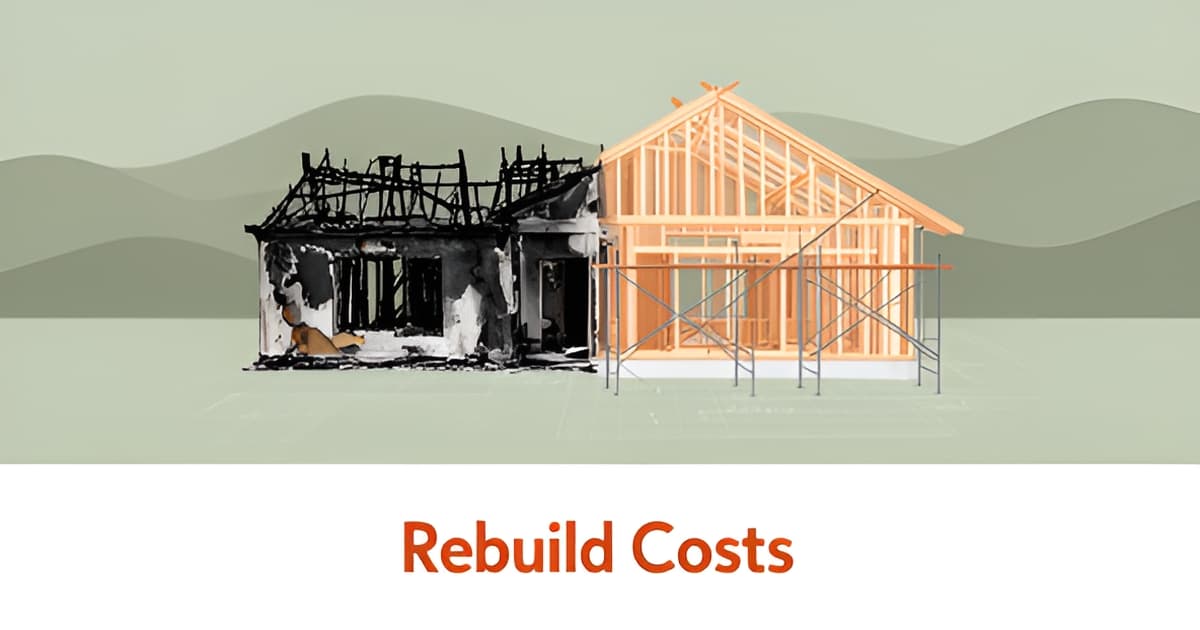
Fire Damage Reconstruction in Altadena: What the Process Costs
Key Facts
- Eaton Fire survivors face an average $300,000–$500,000 gap between insurance payouts and actual rebuild costs, per a survey of 2,000+ survivors.
- 69% of total-loss homeowners in the LA fires lacked enough insurance to rebuild, with an average underinsurance gap of $247 per square foot, United Policyholders found.
- Full rebuilds in LA wildfire zones run $450–$800+ per square foot — and pre-construction and carrying costs add another 25–40% to the stated build price, industry analysis shows.
- Only 150 homes had been rebuilt in the Eaton burn scar as of mid-August, while roughly two-thirds of Altadena owners hadn't applied for permits nine months post-fire, the LA Times reports.
- Building to the IBHS Wildfire Prepared Home Plus standard adds just 3% to a $500,000 build while extending home lifespan from 30–50 years to 100+, per IBHS cost analysis.
- Altadena survivors can tap zero-interest loans averaging $260,000 from Altadena Land Initiatives and Greenline grants up to $250,000, with no income requirements.
- Partial fire restoration averages $4–$7 per square foot nationally — a fraction of full rebuild costs — though LA-area costs likely run higher.
The Real Cost Gap: Insurance vs. Rebuild Reality in Altadena
The check that hasn't cleared yet is the one nobody warned you about: the gap between what your insurer pays and what it actually costs to rebuild in Altadena. A July survey of more than 2,000 Eaton and Palisades fire survivors by the Department of Angels found an average shortfall of roughly $500,000 between insurance payouts and actual rebuild costs — even after accounting for insurer payments. Joy Chen of the Eaton Fire Survivors Network puts the average gap closer to $300,000, which she calls "a huge hurdle."
The underinsurance problem is structural, not anecdotal. A United Policyholders one-year survey found that 69% of total-loss homeowners in the LA fires lacked enough insurance to rebuild, with an average underinsurance gap of $247 per square foot. Meanwhile, 82% of Eaton victims were uncertain they could cover costs insurance wouldn't pay.
The second trap is mistaking a construction bid for a project budget. Full rebuilds in LA wildfire zones run $450–$800+ per square foot, so a $600/sf bid on a 2,000-square-foot home looks like $1.2 million. It isn't. As industry analysis bluntly puts it: that's a $1.2M construction cost — not a $1.2M total project cost. Pre-construction and carrying costs add 25–40% to the stated build cost, and they arrive before a single stud goes up.
The hidden layers include:
- Demolition and site remediation: 5–15% of project cost, or $10,000–$50,000+ privately
- Design, engineering, and permitting: 10–15% of the total
- Contingency: 10–20%, which post-disaster projects routinely consume
- Contractor queues of 6–18 months just to break ground after a disaster
The financial strain compounds from there. Roughly half of surveyed survivors have depleted significant savings, just under half have taken on debt, and half have run out of — or will run out within a year — of insurance money for temporary housing. 70% of insured survivors report insurance delays, denials, or underpayments actively derailing recovery.
This is why Altadena ADU Builder tells homeowners to price the actual rebuild first, then reconcile it against coverage — never the reverse. Local licensed contractors like JMB Builders LLC (CSLB #1103479), an Altadena firm documented as building Eaton Fire rebuilds, can quote real local numbers rather than national averages. The number that matters is the total project cost, and in the Eaton burn scar, that number is almost always bigger than the check.
Full Rebuild vs. Partial Restoration: Two Very Different Price Tags
Two Altadena homeowners can stand on nearly identical lots after the Eaton Fire and face completely different financial realities. One is looking at a full rebuild; the other is dealing with smoke damage and an interior gutting. The price difference between those two scopes isn't a matter of degree — it's a matter of magnitude.
For homes that survived but were damaged, restoration benchmarks look almost modest. National averages put fire restoration at $4–$7 per square foot, with a typical total project cost around $27,175. Smoke damage removal runs $200–$1,200 per room, water damage cleanup $1,300–$5,700, and removal of damaged personal items $50–$125 per pound. Keep in mind these are national figures — LA-area costs likely run higher.
Full rebuilds are another universe entirely. In LA wildfire zones, high-end and wildfire-resilient construction runs $450–$650 per square foot, with some Palisades homeowners reporting bids as high as $800/sf. For a 2,000-square-foot home in Altadena, that means $1M–$1.6M+ for construction alone — and per-square-foot bids don't tell the whole story.
The full project cost breaks down roughly like this:
- Demolition and site remediation: 5–15% of the budget
- Design, engineering, and permitting: 10–15%
- Core construction: 50–60%
- Interior finishes: 15–25% (a $75–$150/sf swing between standard and premium packages)
- Contingency: 10–20%
On top of all that, pre-construction and carrying costs add another 25–40% to the stated build price. A $600/sf bid on a 2,000-square-foot home is a $1.2M construction cost — not a $1.2M total project cost.
This is why the repair, rebuild, or sell decision is so fraught for partial-loss homeowners. Elisa Nixon's home was badly smoke-damaged and needs an interior gutting. Taylor Feltner, whose Pasadena home sits at the edge of Altadena, has described wavering between repairing and leaving, with every insurance fight "reliving the trauma of that night." Some partial-loss owners sold rather than endure months of contamination concerns, construction dust, and noise — and some now regret it. In certain situations, buying a replacement home may genuinely cost less than rebuilding.
The insurance math complicates everything. Surveys of Eaton Fire survivors put the average shortfall between insurance payouts and actual rebuild costs at $300,000–$500,000, and 69% of total-loss homeowners lacked enough coverage to rebuild. If you're weighing a partial restoration against a full rebuild, price the actual scope first — then reconcile it against your coverage.
For Altadena homeowners exploring whether to rebuild, add space, or build an ADU on a fire-damaged lot, Altadena ADU Builder offers a free feasibility consultation with a cost-quiz concept render. Licensed local contractors like JMB Builders LLC (CSLB #1103479), whose Eaton Fire rebuild work is documented at jmb-builders.com, can scope both full rebuilds and partial-loss repairs — and getting multiple licensed, bonded, insured estimates remains the single best defense against underpricing either path.
Financing the Gap: Loans, Grants, and Programs for Eaton Fire Survivors
Even a full insurance payout rarely covers an Eaton Fire rebuild. Survivors face an average gap of roughly $300,000–$500,000 between what insurers pay and what rebuilding actually costs, depending on which survey you trust — one July survey of 2,000+ survivors put the shortfall at $500,000, while the Eaton Fire Survivors Network estimates closer to $300,000 on average.
The financial strain is real and measurable. Roughly half of survivors have depleted significant savings, just under half have taken on new debt, and half have run out of — or will run out within a year — of insurance money for temporary housing, per the Department of Angels survey. That pressure is exactly what a new wave of funding programs aims to relieve.
Three programs now target the gap directly:
- Altadena Land Initiatives Corporation — Backed by Cathay Bank, this survivor-led nonprofit offers zero-interest loans averaging $260,000 with no income requirements, plus 70+ pre-approved construction plans with vetted builders. Co-founder Ursula Hyman notes the group has capital for about 25 homes against a goal of 100 this year.
- Greenline Housing Foundation grants — Up to $250,000 for Eaton Fire survivors, with no income limits and no repayment obligation.
- State Disaster Rebuilding Assistance Program — A $100 million program approved by Governor Newsom, though it was not yet accepting applications as of the latest reporting.
These tools matter because the gap is structural, not temporary. A United Policyholders one-year survey found 69% of total-loss homeowners in the LA fires lacked enough insurance to rebuild, with an average underinsurance gap of $247 per square foot. With rebuilds in LA wildfire zones running $450–$800 per square foot, even generous settlements fall short.
If you're weighing how a rebuilt lot could also house family displaced by the fire, Altadena ADU Builder offers a free ADU feasibility consultation with a cost-quiz concept render — a practical first step before committing scarce funds. Local contractors like JMB Builders LLC (CSLB #1103479), an Altadena-based builder documented on jmb-builders.com as taking on Eaton Fire rebuilds, can help translate these funding dollars into shovel-ready plans.
One caution: donor fatigue is already emerging, and program capital is finite. If a zero-interest loan or grant fits your situation, applying early beats waiting for the state program to open.
Building Back Fire-Resilient Without Breaking the Budget
Many Altadena homeowners rebuilding after the Eaton Fire assume that building fire-resilient means building expensive. The numbers say otherwise — and the gap between perception and reality is costing families both protection and peace of mind.
According to IBHS cost analysis, upgrading from a code-minimum build to the IBHS Wildfire Prepared Home Plus standard adds only about 3% to a $500,000 construction budget. That modest premium extends a home's expected lifespan from 30–50 years to 100+ years — a rare case where a small spend buys a disproportionate return. Basic compliance with California's Chapter 7A wildfire-zone building code is similarly manageable: roughly $13,070 on a 1,750-square-foot home.
Budget-tier upgrades deliver much of the same protection for even less. As local reporting on Altadena's rebuilding conversation notes, ember-resistant vents, double-pane windows, and concrete-look exteriors fit what one expert called a "Volvo-level" budget. You don't need exotic materials to make a home dramatically harder to ignite.
Altadena's own first rebuilt home proves the point. The 2,160-square-foot house on East Loma Alta Drive — the first to receive a certificate of occupancy after the Eaton Fire — uses fireproof design, no attic vents, and cement roof tiles. None of these are luxury features; they're practical choices any rebuild can incorporate.
Resilient construction can also pay you back through insurance. Under California's "Safer from Wildfires" framework, the state Department of Insurance requires insurers to offer discounts for mitigation actions, meaning hardened homes can lower premiums over time.
When scoping a rebuild, the highest-value resilient additions include:
- Ember-resistant vent screening — one of the cheapest, highest-impact upgrades
- Double-pane, tempered-glass windows that resist radiant heat
- Cement or tile roofing instead of combustible shingles
- Chapter 7A-compliant exterior materials, already required in Altadena's wildfire zone
Local contractors with active Eaton Fire rebuild experience — such as JMB Builders LLC (CSLB #1103479), an Altadena-based licensed general builder documented on jmb-builders.com — can price these upgrades early, when they cost least. Here at Altadena ADU Builder, we see the same principle apply to backyard ADUs: fire-resilient design decisions made before framing start are far cheaper than retrofits after.
The takeaway: resilience is a line item, not a luxury. On a half-million-dollar build, we're talking about a few percentage points — not a second mortgage.
Your Action Plan: Timelines, Contractor Queues, and Next Steps
Knowing the numbers is one thing; knowing what to do next is what separates the homeowners who are moving from those still stuck at the kitchen table with an insurance letter. The rebuild math in Altadena is unforgiving, but the sequence of your decisions matters almost as much as the dollars.
Start by setting realistic expectations on time. Full rebuilds typically run 12–24+ months from groundbreaking to completion, and that clock doesn't include the wait to break ground. According to industry analysis of post-disaster construction, homeowners who delay engaging a contractor can face a 6–18 month queue just to begin construction. UCLA's Ziman Center estimates it could take three years to see considerable building, five for large-scale activity, and up to a decade for the full community rebuild.
The queue is real, but so is the hesitation. Roughly two-thirds of Altadena property owners had not yet applied for building permits nearly nine months after the fire, per the LA Times. Waiting doesn't shorten the line — it just moves you further back in it.
Your practical sequence should look like this:
- Price the actual rebuild first, then reconcile against coverage. A $600/sf bid on a 2,000-sf home is a $1.2M construction cost — not a $1.2M total project cost, since pre-construction and carrying costs add 25–40%.
- Get multiple bids from licensed, bonded, insured contractors with documented fire-rebuild experience — verify the CSLB license number directly.
- Lock your design decisions early. Changing structural or systems choices after framing starts can trigger $20,000–$50,000+ in rework.
- Layer in financing: zero-interest loans averaging $260,000 from Altadena Land Initiatives and Greenline grants up to $250,000 exist specifically to close the insurance gap.
One decision worth making during design — not after — is whether your rebuilt lot can support an ADU. Altadena ADU Builder offers a free ADU feasibility consultation with a cost-quiz concept render, which helps you price the full potential of your property before permits are filed. Local builders like JMB Builders LLC (CSLB #1103479), which documents its Eaton Fire rebuild work on jmb-builders.com, plan for this from day one. Rebuilding once is hard enough; designing the lot so you never have to redo it is the cheapest decision you'll make.
Frequently Asked Questions
How much does it actually cost to rebuild a home after the Eaton Fire in Altadena?
Will my insurance cover the full cost of rebuilding?
Is it cheaper to repair smoke damage or rebuild completely?
What financing is available if my insurance doesn't cover the full rebuild?
How long will it take to rebuild my home?
Does building fire-resilient cost a lot more?
The Number That Matters: Your Total Project Cost
Rebuilding in Altadena isn't just expensive — it's full of numbers that don't tell the whole story. The average gap between insurance payouts and actual rebuild costs runs $300,000–$500,000, and 69% of total-loss homeowners in the LA fires lacked enough coverage to rebuild. A per-square-foot bid is a construction cost, not a project cost, once pre-construction and carrying expenses add 25–40%. The good news: zero-interest loans, grants up to $250,000, and fire-resilient upgrades costing only ~3% more can shrink that gap. Your sequence matters as much as your dollars — price the full scope first, reconcile it against coverage, get multiple licensed bids, and lock design decisions early. If you're weighing whether a rebuilt lot could also house displaced family, Altadena ADU Builder offers a free ADU feasibility consultation with a cost-quiz concept render — a no-pressure first step toward understanding what your property could actually become.