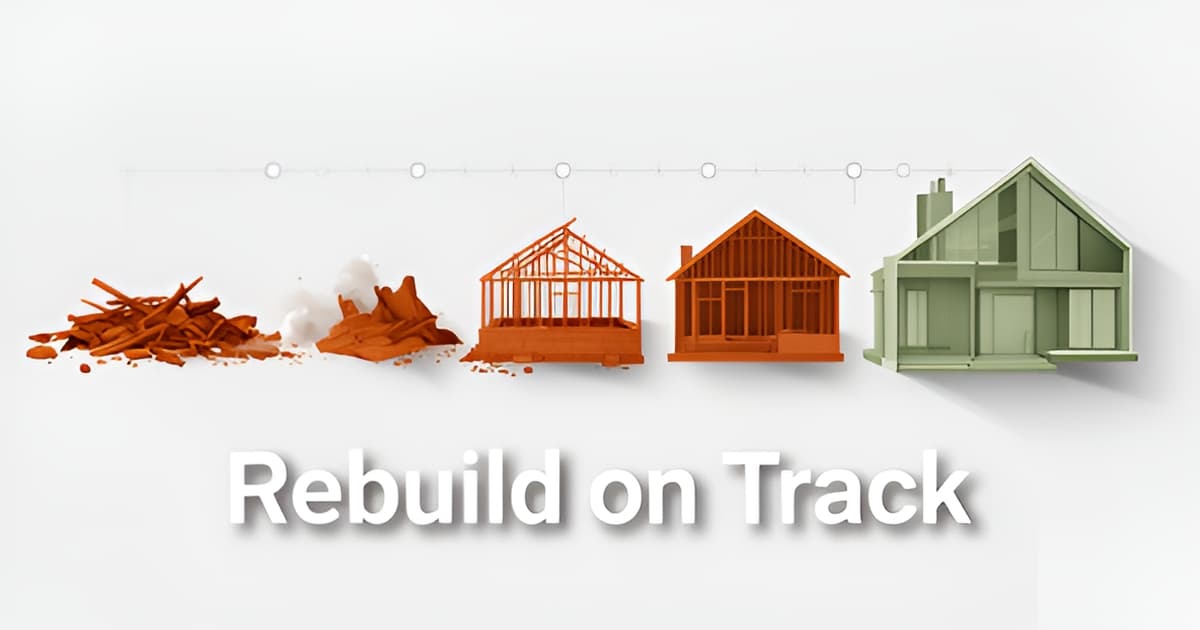
Eaton Fire Home Rebuild Timeline: Months From Permit to Move-In
Key Facts
- One year after the Eaton Fire, only 23 of nearly 6,000 significantly damaged Altadena homes had completed rebuilding, per Catalyst California's tracker.
- Roughly 70% of damaged homes in the Eaton Fire burn scar remain in rebuilding limbo, UCLA researchers report.
- Only 43% of significantly damaged property owners have applied for or received permits, rebuild tracking data shows.
- Debris removal plus environmental testing takes 3–12 months and must finish before any permit is issued, per LA Times analysis.
- A realistic full rebuild runs 18–30 months from design start to move-in, and 10–12 month promises are a red flag, warns architect Daniel Ziese.
- A 1,500 sq ft rebuild at $500/sq ft costs $750,000 versus Altadena's average insurance coverage of $607,000, leaving a $140,000+ gap.
- Eaton Fire area like-for-like rebuilds may grow by up to 10% or 200 square feet, whichever is greater, LA County allows.
The Real Rebuild Pace in Altadena — One Year Later
One year after the Eaton Fire, the numbers tell a harder story than most homeowners expect. As of December 2025, only 23 of nearly 6,000 significantly damaged residential properties in Altadena had completed rebuilding, according to tracking data from Catalyst California.
The limbo extends far beyond finished homes. Roughly 70% of damaged homes in the burn scar remain in what UCLA researchers call "rebuilding limbo" — and only 43% of significantly damaged property owners have even applied for or received permits. More than half of owner-occupied properties have no permit application on file at all.
These numbers matter because they expose the gap between promises and reality. Some contractors and consultants still advertise 10–12 month rebuilds, but practicing architects now flag those promises as a red flag. The realistic range for a full rebuild is 18–30 months from design start to move-in, with county-wide outcomes spanning 12–36 months depending on preparation, insurance, and site conditions.
Even the fast track is narrow. Homeowners with complete documents and clear plans might finish in 12 to 18 months — but as one recovery timeline analysis notes, that outcome is the exception. Most people are still working through insurance disputes or debris cleanup before design even begins.
Why is progress so slow? The bottlenecks compound:
- Debris removal (Phases 1 and 2) must be completed before any permit is issued, and debris removal plus environmental testing alone can take 3–12 months
- Incomplete plan sets that trigger multiple review cycles are the single biggest source of permitting delays
- Insurance shortfalls — a 1,500 sq ft rebuild at $500/sq ft costs about $750,000, versus Altadena's average coverage of $607,000
- Contractors are booking months ahead, and long-lead WUI materials like windows, doors, and Class A roofing require early pre-ordering
The lesson from year one is clear: accurate timeline planning is your first defense against costly surprises. Homeowners who budget for 18–30 months, engage a builder early, and resolve insurance gaps before design tend to move faster — not slower. At Altadena ADU Builder, we recommend treating any rebuild or ADU project the same way: get a realistic feasibility picture first, including costs and site constraints, before committing to a schedule. Licensed local builders like JMB Builders LLC (CSLB #1103479), who handle Eaton Fire rebuilds, can help pressure-test your assumptions in an early consultation.
If someone quotes you a 10–12 month move-in today, ask what their plan assumes. The data says most of Altadena isn't there yet — and the homeowners who plan honestly are the ones who avoid the most expensive delays.
The Four-Phase County Timeline: Debris Removal to Certificate of Occupancy
Rebuilding after the Eaton Fire is not one project — it's four, and each one has to finish before the next can truly begin. LA County's official sequence runs from site clearance through plan submission, permits, construction with milestone inspections, and finally the Certificate of Occupancy that lets you move home.
Debris removal gates everything. You can submit your rebuild application anytime, but LA County requires both Phase 1 (EPA household hazardous waste removal) and Phase 2 (fire debris removal via the free Army Corps program or an owner-paid contractor) to be complete before any permit is issued. Realistically, debris removal plus environmental testing takes 3–12 months — a window many homeowners underestimate.
Once the lot is cleared, planning and design typically runs 3–6 months. This is where post-fire site conditions — soil stability, drainage, retaining conditions — must be addressed before plans can be finalized. Permitting then takes anywhere from 10 days to 3 months, though custom builds can take a year or longer.
The county's expedited track for like-for-like rebuilds can compress permitting to 10–15 business days, and Eaton Fire area replacement structures may grow by up to 10% or 200 square feet, whichever is greater. But treat like-for-like as a helpful starting point — not an automatic shortcut. Most homes still need plan updates to meet current WUI and energy standards, and incomplete plan sets remain the single biggest cause of multiple review cycles.
Construction itself is the longest phase: 12 to 24+ months, followed by several weeks of final inspections before the Certificate of Occupancy is issued. That's why realistic end-to-end expectations run 18–30 months from design start to move-in — and why promises of 10–12 months are, in one practicing architect's words, a red flag.
Key durations to plan around:
- Debris removal and environmental testing: 3–12 months, and a hard prerequisite before permits
- Planning and design: 3–6 months, including site condition assessment
- Permitting: 10 days–3 months; like-for-like review in 10–15 business days
- Construction: 12–24+ months, with milestone inspections throughout
- Final inspections and Certificate of Occupancy: several weeks
The pace on the ground confirms these ranges: as of December 2025, only 23 of nearly 6,000 significantly damaged residential properties had completed rebuilding. Altadena ADU Builder's guidance to local homeowners reflects this reality — no one can guarantee a timeline, but understanding the sequence helps you make decisions early, when contractors are booking months ahead and long-lead WUI materials like windows, vents, and Class A roofing need to be pre-ordered. If you're weighing whether your rebuild could include an ADU, a free ADU feasibility consultation with a concept render based on your lot can help you plan the whole site — not just the house — from day one.
The Five Delay Drivers You Can Actually Control
Most Eaton Fire rebuild delays aren't caused by the county — they're caused by preventable planning gaps. Here are the five schedule killers you can actually do something about, starting with the one architects call the single biggest source of lost time.
1. Incomplete plan sets. According to practicing architect Daniel Ziese, incomplete plan sets that trigger multiple review cycles are the #1 controllable delay right now. Expect at least one revision cycle even with good plans, so budget that time in rather than treating it as a setback.
2. Insurance shortfalls. The math is sobering: a 1,500-square-foot home at $500 per square foot costs $750,000 to rebuild, while average Altadena insurance coverage was $607,000 in 2023 — a gap of $140,000 or more before temporary housing costs, which policies typically don't cover alongside construction. Resolve your coverage numbers before finalizing the design, or you'll redesign mid-project.
3. Contractor scarcity. Builders are booking months ahead, and early engagement improves both pricing accuracy and schedule reliability. On pricing, Altadena Rebuild Coalition's Matthew Trotter offers a useful screen: "$200 a square foot, that's a red flag. If they say $1,000 — also a red flag."
4. Long-lead WUI materials. Fire-resistant components must be pre-ordered early because they take months to arrive:
- Windows and doors rated for wildland-urban interface codes
- Vents and exterior ventilation openings
- Class A roofing and non-combustible siding
Remember that like-for-like rebuilds still require current Building, Fire, and Health and Safety Code compliance, though LA County allows a floor-area increase of up to 10% or 200 square feet, whichever is greater. Defensible space requirements apply in high fire hazard zones regardless.
5. Post-fire site issues. Of 50 intact, remediated homes tested by residents' groups, six in ten remained uninhabitable due to elevated lead or asbestos. Soil stability, drainage, and retaining conditions must be resolved before design can be finalized — which is why a site assessment early in the process protects your timeline.
Here at Altadena ADU Builder, we advise homeowners to sequence these five items before permit submission, not after the first correction notice. A free ADU feasibility consultation can also help you test whether the 10%/200 sq ft expansion allowance covers a backyard unit, using a cost-quiz concept render to ground the decision in real numbers rather than guesswork.
Your Month-by-Month Action Plan to Stay on the Fast Track
The 12–18 month fast track exists, but it's the exception, not the rule. Architect James Hughes puts it plainly: homeowners who know exactly what they want and have documents ready "might finish in 12 to 18 months" — while most people remain stuck in insurance or cleanup, and only 23 of nearly 6,000 significantly damaged Altadena properties had completed rebuilding as of December 2025, according to Catalyst California's rebuild tracker. The difference between the two outcomes comes down to sequencing decisions made in the first few months.
Here's how well-prepared homeowners compress the timeline:
- Complete debris removal early. Phases 1 and 2 must be finished before the county issues any permit, and debris removal plus environmental testing can take 3–12 months on its own.
- Lock your insurance documentation before design begins. Insurance doesn't cover temporary housing and construction simultaneously, and rebuild costs of $400–$800 per square foot routinely exceed policy limits.
- Engage a licensed builder during design, not after. Contractors are booking months ahead in affected areas, and early engagement improves both pricing accuracy and schedule reliability.
- Pre-order long-lead WUI materials during permitting — windows, doors, vents, Class A roofing, and non-combustible siding all carry extended lead times.
- Prepare complete plan sets. Incomplete plans that trigger multiple review cycles are the single biggest source of delays, per guidance from Ziese Architecture.
Start feasibility conversations before your plans are final. Post-fire site conditions — soil stability, drainage, retaining walls — must be resolved before design can be finalized, and a builder who understands Eaton Fire rebuilds can flag WUI code requirements and like-for-like constraints (replacement structures may grow by up to 10% or 200 square feet, whichever is greater) before they become expensive revisions.
For Altadena homeowners considering adding an ADU to their rebuild, early feasibility matters even more, since ADU-specific timelines aren't well documented. JMB Builders LLC (CSLB #1103479), an Altadena-based licensed general contractor that builds custom homes, ADUs, and Eaton Fire rebuilds, offers a free ADU feasibility consultation with a cost-quiz concept render — a low-commitment way to pressure-test your budget and site assumptions early. It's one of the local builders covered in Altadena ADU Builder's independent guides, where the placement is disclosed.
One caution: treat any promise of a 10–12 month rebuild as a red flag. A realistic full rebuild runs 18–30 months from design start to move-in, and even the county's expedited like-for-like permitting — as fast as 10–15 business days — only accelerates one phase of a much longer process. No builder, guide, or consultant can guarantee permits or timelines; the only controllable variable is how prepared you are when your turn in line arrives.
Frequently Asked Questions
How long does it realistically take to rebuild a home after the Eaton Fire?
Why have so few Altadena homes actually been rebuilt a year after the fire?
Do I have to finish debris removal before I can get a rebuild permit?
What is the like-for-like rebuild shortcut, and how much faster is it?
What causes the biggest delays in an Eaton Fire rebuild, and what can I control?
How can I get my Eaton Fire rebuild done on the fastest possible timeline?
Your Timeline Is Only as Good as Your First Three Months
The numbers one year after the Eaton Fire are sobering: only 23 of nearly 6,000 significantly damaged properties had completed rebuilding as of December 2025. The homeowners moving fastest aren't lucky — they finished debris removal early, resolved insurance gaps before design, submitted complete plans, and pre-ordered long-lead WUI materials while their permits were still under review. Plan for 18–30 months from design start to move-in, treat any 10–12 month promise as a red flag, and expect at least one plan revision cycle along the way. If you're rebuilding and wondering whether your lot could also support an ADU — especially within the county's 10%/200 sq ft expansion allowance — the time to find out is now, before your plans are final. Altadena ADU Builder's free ADU feasibility consultation, with a cost-quiz concept render grounded in your actual lot and budget, is a low-commitment way to pressure-test your assumptions early. No one can guarantee a timeline — but planning honestly is the single best way to avoid the most expensive delays.