Down to the Studs Remodel: Costs, Permits, and Timeline
Key Facts
- A down-to-the-studs remodel runs 9–18 months total, with permitting alone consuming 2–4 months in California markets, per Bay Area design-build data.
- Full gut renovations cost $100,000–$200,000+ nationally at $60–$150 per square foot, according to HomeGuide's cost data.
- Older homes need 15–25% contingency budgets because knob-and-tube wiring, galvanized plumbing, and asbestos are routine discoveries, contractor breakdowns show.
- Removing a load-bearing wall adds $8,000–$15,000 once engineer fees and beam fabrication are included, per renovation cost research.
- Temporary housing during a gut remodel runs $3,000–$6,000+ monthly, adding $24,000–$72,000 over a typical build, Bay Area project data finds.
- Permits and fees consume 10–15% of full renovation budgets — $10,000–$30,000 — San Diego construction analysis reports.
- Homeowner indecision on finishes is the single most underestimated cause of remodel delays, industry timeline research warns.
What a Full Gut Remodel Really Means — and Why the Walls Hide Surprises
Behind the drywall of nearly every older Altadena home sits a decision the homeowner never planned for — and a bill they never budgeted. That's the defining reality of a down-to-the-studs remodel.
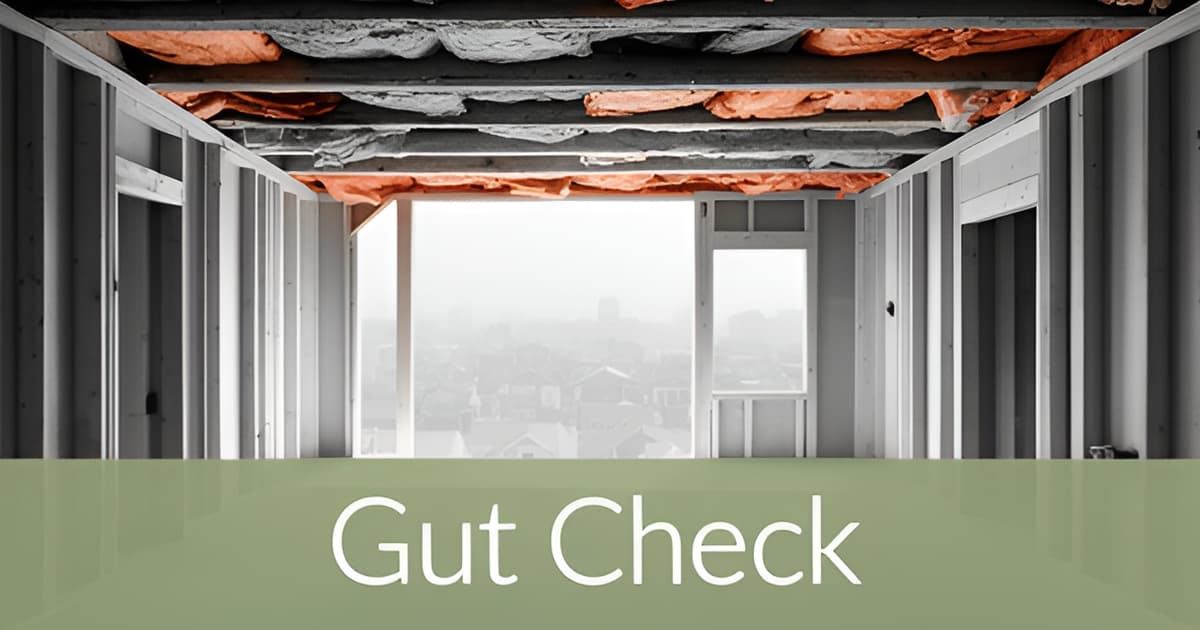
A true gut renovation strips the home to its structural bones: walls opened or removed, plumbing replaced, electrical brought to current code, HVAC upgraded, then everything rebuilt from the framing out. Stud-level scope goes beyond even that, adding complete demolition, a full rewire and panel upgrade, full plumbing replacement, new insulation and drywall, and complete kitchen and bath rebuilds, according to contractor breakdowns of renovation scope. This is why stud-level work sits firmly at the top tier of residential renovation — nothing above it except teardown and new construction.
Here's the catch, and it matters enormously in a community like Altadena, where much of the housing stock predates 1978: hidden conditions behind the walls are the rule, not the exception. As one remodeling timeline guide puts it, finding something unexpected is more common than finding nothing at all.
Pre-1978 homes frequently reveal a familiar roster of problems once the drywall comes off:
- Knob-and-tube wiring buried in walls and attics
- Galvanized or cast-iron plumbing at or past end of life
- Asbestos requiring licensed abatement before other trades can proceed
- Lead paint, which mandates EPA RRP-certified contractors
- Undersized 60–100 amp electrical panels where modern life demands 200
These discoveries carry real costs. Asbestos removal alone adds $1,200–$2,800, and lead and asbestos testing runs $300–$500 before remediation even begins. As one contractor bluntly notes, "the moment a wall is open, you will find something that needs fixing."
This is why honest contractors refuse to quote a firm fixed price on an older home. Research consistently recommends a 15–25% contingency budget for pre-1985 or century-old houses, versus 10–15% for newer builds. As one builder observed, the contractors who tell you this upfront are the ones worth trusting — the ones quoting firm prices with no contingency on a century-old house are the ones to avoid.
There's a silver lining for Altadena homeowners weighing a gut remodel. With the structure exposed, seismic retrofitting becomes far more cost-effective, and full lead and asbestos abatement is cheaper done all at once than room by room. Local firms like JMB Builders LLC (CSLB #1103479), which handles whole-home remodels and Eaton Fire rebuilds in the area, work in exactly this exposed-wall window where those upgrades pay off most.
The Permit Cascade: What Stud-Level Scope Triggers in LA County
Opening the walls in a gut remodel doesn't just reveal framing — it reveals paperwork. Once your scope touches structure, plumbing, or electrical, a single renovation idea cascades into a stack of separate approvals, each with its own fees, inspections, and review cycles.
The base building permit is only the starting point. Major structural projects and full system replacements typically require separate trade permits for electrical, plumbing, and mechanical work, layered on top of the base permit. Nationally, building permits for a full remodel run $200–$3,000, though some markets report $1,000–$5,000 for typical remodels, and permits and fees can consume 10–15% of an entire renovation budget.
Structure triggers its own chain. If your plans involve removing a load-bearing wall — common in open-concept layouts — most jurisdictions expect a structural engineer's sign-off, which adds roughly $500–$1,500 before a beam is ever fabricated. And because the engineer's calculations become part of your permit set, this step sits upstream of approval, not after it.
Age triggers another branch entirely. Homes built before 1978 likely contain lead paint, requiring EPA RRP-certified contractors, while pre-1980s homes may harbor asbestos that must be abated by licensed specialists before other trades can proceed. Testing typically costs $300–$500, with asbestos removal adding $1,200–$2,800 to the budget.
A few practical realities shape how this cascade plays out:
- Incomplete permit submissions go to the back of the queue — a single missing detail can reset your place in line.
- Inspection timelines, not permit fees, are often the real schedule driver; approval waits can stretch months in some California jurisdictions.
- A single comprehensive permit for a gut remodel usually avoids the multiple review cycles that phased remodels trigger.
- Seismic retrofitting is most cost-effective during a gut renovation, when the structure is already exposed — a genuine California opportunity worth discussing with your designer early.
For Altadena homeowners — many working with pre-1978 housing stock or rebuilding after the Eaton Fire — these triggers compound quickly, and no two projects follow the same path. We can't guarantee any permit outcome or timeline, and no honest builder should. What a feasibility review can do is map your specific scope against these requirements before you commit. Altadena ADU Builder offers a free ADU feasibility consultation with a cost-quiz concept render, and JMB Builders LLC (CSLB #1103479), our featured builder, brings whole-home remodel and fire-rebuild experience documented at jmb-builders.com.
The Real Numbers: Cost Ranges and What Drives Them
Ask five contractors what a down-to-the-studs remodel costs and you'll get five different answers — because the honest answer depends entirely on where you live and what's hiding behind your walls. The numbers below are regional benchmarks, not Altadena quotes, but they show exactly how wide the spread is.
Nationally, a full gut renovation runs $100,000–$200,000+, or $60–$150 per square foot, according to HomeGuide's cost data. California markets sit far higher: Bay Area gut renovations range $200–$400+ per square foot, and San Diego projects for a 2,000–3,000 sq ft home run $400,000–$600,000+.
Several line items drive most of that variation:
- Structural changes — removing a load-bearing wall adds $8,000–$15,000 once engineer fees and beam fabrication are included
- System replacements — electrical work runs $2,000–$9,000, a full replumb $2,500–$6,000, and HVAC $4,800–$12,400
- Permits and fees — typically 10–15% of the total budget, or $10,000–$30,000 on full renovations
- Labor — accounts for 50–60% of renovation budgets
- Temporary housing — since the home is uninhabitable, expect $3,000–$6,000+ per month, adding $24,000–$72,000 over a typical build
Older homes amplify every one of these numbers. Pre-1978 homes frequently reveal knob-and-tube wiring, galvanized plumbing, asbestos, and 60–100 amp panels that need upgrading to 200 amps. That's why contractors recommend 15–25% contingency budgets for pre-1985 or century-old homes, versus 10–15% for newer stock.
The gut-versus-phased decision also carries a price tag. Phased remodeling costs 10–15% more in total due to repeated mobilization, though some of that is offset by avoiding temporary housing costs. And in some cases, remodeling stops making sense: when a home has foundation damage or fully outdated systems, new construction can be cheaper — HomeGuide puts tear-down rebuilds at $350,000–$800,000 versus $100,000–$200,000 for renovation.
For Altadena homeowners — especially those weighing a gut remodel alongside an ADU or garage conversion in the wake of the Eaton Fire — these trade-offs materially change both budget and permitting path. Altadena ADU Builder offers a free feasibility consultation with a cost-quiz concept render to help you pressure-test scope before committing. JMB Builders LLC (CSLB #1103479), an Altadena-based licensed general contractor with whole-home remodel and Eaton Fire rebuild experience, is one featured builder worth comparing.
The takeaway: anchor your budget to your region's per-square-foot reality, add contingency for what the walls are hiding, and get scope-specific numbers before you commit to a figure.
The Timeline: 9–18 Months from First Drawing to Final Inspection
Most people planning a gut remodel dramatically underestimate one thing: how long the whole journey takes. Between design, permitting, and construction, a down-to-the-studs project typically spans 9–18 months from first drawing to final inspection — and no contractor can honestly promise you the low end.
Expect roughly 2–4 months of permitting and pre-construction before a single wall comes down. Bay Area design-build firms report this range for permit approval alone, and incomplete submissions go to the back of the queue, so a thorough first submission matters more than a fast one. Planning, design, and permitting can consume nearly a quarter of the total timeline, according to Watershed Built's project data.
Once construction begins, the phases stack up like this:
- Design and discovery — 4–8 weeks of drawings, measurements, and scope decisions
- Demolition — just 1–2 weeks to strip the home to its studs
- Framing, plumbing, electrical, and HVAC — 4–8 weeks of systems work
- Insulation and drywall — 1–3 weeks
- Finishes, then final fixtures and punch list — 4–8 weeks plus 1–3 weeks
That adds up to 6–12+ months of active construction on top of permitting. Older or structurally complex homes run longer — contractors experienced with century-old homes cite 9–18 months, because "finding something unexpected behind the walls is more the rule than the exception." Much of Altadena's pre-1978 housing stock fits this profile, which is why contingency planning matters as much as scheduling.
Here is the delay factor almost nobody budgets for: homeowner indecision on finishes. Industry sources consistently identify it as the single most underestimated cause of remodel delays. Tile, cabinets, and fixtures decisions stall crews, and a crew that stops for two weeks may not restart for four. Select every finish before demolition begins, and your timeline stays intact.
Remember, too, that the home is uninhabitable throughout construction — repeated utility shutoffs and lead-safe dust protocols make living there infeasible. Build temporary housing into your schedule, not just your budget. These are benchmarks from other markets, not Altadena-specific estimates; LA County unincorporated timelines vary by project scope, and no honest builder will guarantee dates. Altadena ADU Builder advises treating any firm timeline quote on an older home as a red flag rather than a promise.
Your Next Step: Budgeting in Layers and Getting a Scope-Specific Read
The difference between a gut remodel that stays on budget and one that spirals often comes down to how you structure the budget itself. Contractors who work on century-old homes recommend building your budget in priority layers: life-safety and structural work first, then the building envelope, then interior systems, then finishes (Carpenter Beach Construction).
This layering matters because structural and systems work typically consumes 20–30% of a full renovation budget — $20,000 to $100,000 on larger projects — before a single finish is chosen (Remade Home Construction). If you overspend on tile and cabinetry early, you'll be forced to compromise on the wiring and plumbing behind the walls.
Your contingency should scale with your home's age. While general guidance lands between 10–20%, sources converge on 15–25% for pre-1985 or century-old homes, where knob-and-tube wiring, galvanized plumbing, and undersized electrical panels are routine discoveries (Radford Building Company). One practitioner put it bluntly: contractors who quote a firm fixed price with no contingency on a century-old house are the ones to be cautious about.
Hazardous-materials testing is the cheapest insurance you can buy. Testing for lead paint and asbestos runs $300–$500, with remediation typically $1,000–$5,000+ (mysplitlevel.com). Finding these materials mid-demolition stalls every trade on site; testing before you finalize your scope lets you price abatement into the plan from day one.
A few questions to bring to any contractor conversation:
- What contingency percentage are you carrying, and what does it cover?
- Have you tested for lead and asbestos, and when?
- Which walls are load-bearing, and does the scope require a structural engineer?
- How will temporary housing costs — $3,000 to $6,000+ per month in California markets — fit into the total?
For Altadena homeowners weighing a gut remodel against alternatives — or considering whether a down-to-the-studs rebuild opens the door to adding an ADU on the property — Altadena ADU Builder offers a free feasibility consultation with a cost-quiz concept render to help you pressure-test your scope before committing. The featured builder in our guide, JMB Builders LLC (CSLB #1103479, paid placement), is an Altadena-based licensed general contractor with documented experience in whole-home remodels and Eaton Fire rebuilds.
No consultation can guarantee a permit timeline or final cost — nobody honest can in LA County unincorporated territory. But getting a scope-specific read before demolition starts is the closest thing to certainty this process offers.
Frequently Asked Questions
How much does a down-to-the-studs remodel actually cost?
How long does a full gut remodel take from start to finish?
Why do contractors keep telling me to budget a 15–25% contingency?
Do I need to move out during a gut renovation, and how much will that cost?
What permits does a gut remodel trigger in LA County?
Is it cheaper to gut remodel all at once or do it in phases?
Open the Walls with a Plan, Not a Prayer
A down-to-the-studs remodel is the most complete renovation a home can undergo — and the one where hidden conditions, layered permits, 15–25% contingencies, and 9–18 month timelines are simply part of the deal. The homeowners who come out ahead aren't the ones who found the cheapest quote; they're the ones who budgeted in priority layers, tested for lead and asbestos before demolition, selected every finish early, and asked hard questions about contingency before signing anything. And here's the opportunity hiding inside the demolition: with your structure exposed, a gut remodel is the most cost-effective moment to add square footage — including an ADU on the same property. Altadena ADU Builder helps you pressure-test that decision with a free feasibility consultation and cost-quiz concept render, so you can see how a gut remodel and an ADU compare on cost, permits, and timeline before committing to either. Every figure in this guide is a regional benchmark, not an Altadena quote — and no honest builder will promise otherwise. But a scope-specific read beats a guess every time. Featured builder JMB Builders LLC (CSLB #1103479, paid placement) brings documented whole-home remodel and Eaton Fire rebuild experience to the table. Start with the free feasibility consultation, and open your walls with a plan instead of surprises.