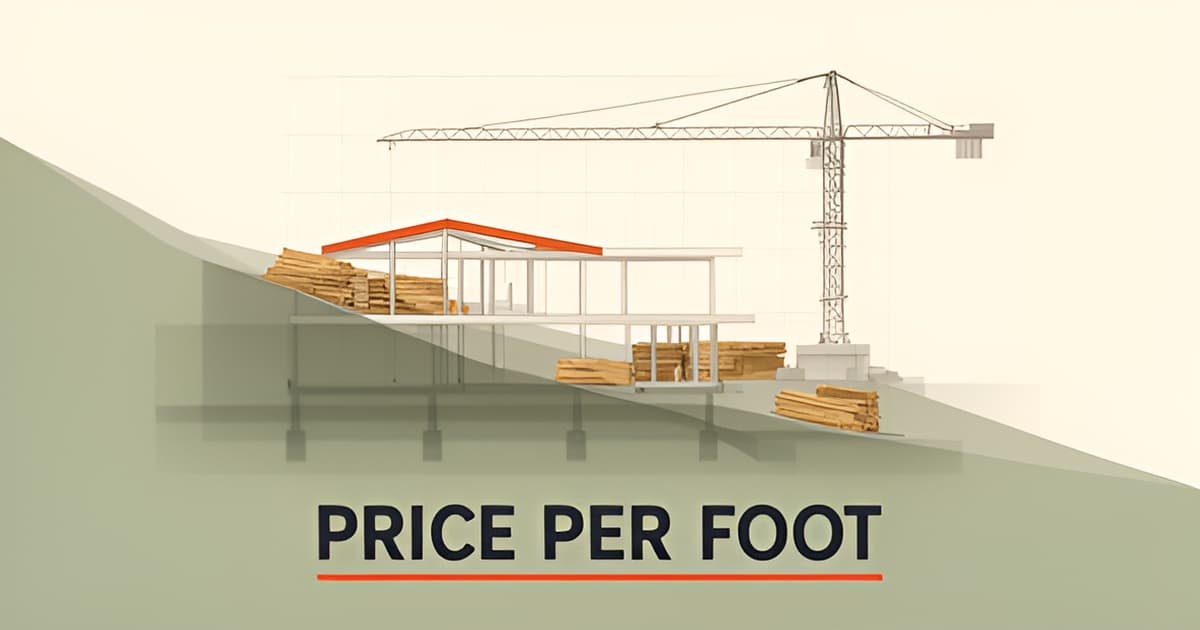
Custom Home Cost in Los Angeles: What Drives the Price Per Foot
Key Facts
- Two similar-sized LA homes can differ by $120 per square foot — site conditions, not square footage, decide the real number, according to one LA builder.
- LA construction costs jumped 6% in Q1 2025 alone, with residential building costs up 44% over five years, recent cost data shows.
- Hillside lots add a 15–30% construction premium for grading, retaining walls, and soil engineering, LA cost benchmarks confirm.
- A documented 2,500 sq ft LA home with high-end finishes cost $1.25 million — $500 per square foot — in a California case study.
- A Malibu fire-resistant rebuild hit $1,267 per square foot ($3.8M for 3,000 sq ft), case data shows.
- Total project costs routinely run 60–100% above construction budget once land, design, permits, and landscaping are counted, per a Bay Area cost framework.
- Changes during design cost hundreds of dollars; changes during construction cost thousands or tens of thousands, builders warn.
Why There's No Single Price Per Square Foot in LA
Every Los Angeles custom home budget starts with the same deceptively simple question — how much per square foot? — and that question is exactly why so many budgets go wrong. As one LA builder puts it, "there is no universal number that applies to every project" in one of the most complex construction markets in the country.
The real 2025 LA tiers span an enormous range. Current estimates place basic construction at $200–$300 per square foot, mid-range at $300–$450, and high-end luxury at $450–$650 or more. Averages hide more than they reveal.
Two real projects show why. A 2,500-square-foot LA home with high-end finishes cost $1.25 million — $500 per square foot — in a documented California case study. Meanwhile, a 2,400-square-foot Studio City custom home came in at $380 per square foot, with construction at $720K, permits and fees at $68K, design at $84K, and site improvements at $40K over 18 months.
Same city. Similar size. A $120-per-square-foot gap. The difference comes down to three drivers that shape every custom build:
- Site conditions — the biggest wildcard. Hillside lots add a 15–30% premium for grading, retaining walls, and soil engineering.
- Design complexity — large glass spans, multi-story volumes, and custom structural elements demand added engineering and materials.
- Finish level — premium finishes alone can account for $150–$300+ per square foot.
The market backdrop compounds the planning challenge. According to recent LA cost data, construction costs jumped 6% in Q1 2025 alone, and residential building costs have surged 44% over the past five years. A budget built on last year's per-foot figure may already be stale.
There's also a timing effect: longer builds mean more carrying cost and exposure to material inflation, with lumber up 20–30% and electrical components up 20–35% versus pre-2020 levels. That's why Altadena ADU Builder treats any per-foot number as a starting hypothesis, not a budget — the site-specific factors always decide the real number.
For Altadena homeowners weighing a custom home, ADU, or rebuild, the practical takeaway is simple: get a site-specific feasibility read before anchoring to any per-foot average. A free ADU feasibility consultation with a cost-quiz concept render — including a conversation with JMB Builders LLC (CSLB #1103479), the featured Altadena-based licensed general contractor — is the fastest way to replace a misleading average with a number that reflects your actual lot.
The Three Cost Drivers: Site Conditions, Design Complexity, and Finish Level
Two homes of identical size can differ by hundreds of dollars per square foot, and the reason is rarely the square footage itself. As one LA builder guide puts it, "beyond square footage, complexity is the key driver of cost" — and complexity lives in three places: your site, your design, and your finish level.
Site conditions are the biggest wildcard. Flat, accessible lots behave predictably; hillside and constrained lots do not, requiring grading, shoring, specialized foundations, and complex staging. LA cost data shows hillside construction adds a 15–30% premium, with soil reports and foundation work running $10K–$40K and seismic engineering adding another $15K–$50K. In Los Angeles, zoning overlays, hillside ordinances, and extended plan-check timelines compound these costs further.
Design complexity is the second lever. Large glass spans, open floor plans, multi-story volumes, and custom structural elements all require added engineering and materials. A modern hillside design leaning on steel and reinforced systems carries meaningfully higher seismic costs than a conventional single-story plan — a reality that hits twice in a market where construction costs already jumped 6% in Q1 2025 alone.
Finish level is where the per-foot tiers crystallize. Current Los Angeles pricing benchmarks break down as:
- Basic: $200–$300/sq ft — standard materials, straightforward layouts
- Mid-range: $300–$450/sq ft — upgraded finishes, some customization
- High-end: $450–$650+/sq ft — luxury materials, complex design integration
California case studies confirm the gradient: a Sacramento standard-finish build hit $400/sq ft, an LA high-end home $500/sq ft, and a Napa luxury build $600/sq ft. The extreme case — and the one most relevant to Altadena homeowners rebuilding after the Eaton Fire — is a Malibu fire-resistant rebuild that came in at $1,267/sq ft ($3.8M for 3,000 sq ft), driven by fire-rated materials and hardened construction methods that California now increasingly requires in wildfire zones.
For Altadena rebuilders weighing these same fire-resistant requirements, the lesson is that site and code conditions — not finish choices — set the floor under your budget. Altadena ADU Builder recommends getting a site-specific feasibility read before locking in a per-foot target, since your lot's conditions are the single most predictive cost factor. If you're considering an ADU as part of a rebuild plan, our free ADU feasibility consultation includes a cost-quiz concept render tailored to your property.
The Hidden Budget: Why Total Project Cost Runs 60–100% Above Construction Cost
If your budget says "$500 per square foot," your real number may be closer to $900. That's because per-foot construction figures exclude land, soft costs, site work, and contingency — and in expensive markets, these add-ons routinely push total project costs 60–100% above the construction budget. One Bay Area framework illustrates the math bluntly: a $2 million construction budget becomes a $3.5–4 million total project once land, design, permits, and landscaping are counted.
Los Angeles case data makes the same point. A Studio City custom home came in at $912,000 for 2,400 square feet — but the $720,000 construction price sat alongside $68,000 in permits and fees, $84,000 in architectural design, and $40,000 in site improvements, according to JDJ Consulting's 2025 LA cost analysis. The construction-only number told less than 80% of the story.
Here's what sits on top of the build itself in LA:
- Architecture and design — typically 8–15% of total cost, with plans running $5,000–$15,000 and engineering plus inspections another $5,000–$10,000
- Permits and fees — 5–10% of the project, or $10–$40 per square foot
- Site preparation — $15,000–$75,000, climbing sharply on hillside lots where grading, shoring, and soil engineering add a 15–30% premium
- Utility connections — $10,000–$50,000 before framing even begins
- Landscaping and outdoor living — $25,000–$150,000, and in Southern California, pools, hardscape, and retaining walls should be treated as core budget rather than optional upgrades
LA's regulatory environment compounds these costs. California-specific requirements like Title 24 energy codes, seismic reinforcement, and fire-resistant materials add real dollars, while hillside ordinances, environmental reviews, and extended plan-check timelines demand professional coordination and patience. For Altadena homeowners — particularly those navigating Eaton Fire rebuilds in LA County unincorporated territory — fire-resistant construction standards are now a central budget line, not a footnote. The extreme end of that spectrum: a Malibu fire-resistant rebuild documented at $1,267 per square foot.
Then there's contingency, where sources genuinely disagree. Some builders recommend 5–10% of the construction budget; others advise 15–20% for new builds. Given LA's volatility — construction costs jumped 6% in Q1 2025 alone, with residential costs up 44% over five years — we at Altadena ADU Builder suggest planning toward the higher end of that range rather than assuming the best case.
The takeaway: budget in layers, not in a single per-foot figure. Because site conditions are the biggest wildcard, a feasibility assessment specific to your lot — the kind of upfront evaluation that saved one Studio City project $15,000 in change orders — is the most reliable way to find your true number before committing. For Altadena homeowners weighing a custom build or ADU, a free feasibility consultation with a cost-quiz concept render is a low-risk first step; the featured builder, JMB Builders LLC (CSLB #1103479), documents its custom home and rebuild work at jmb-builders.com.
How to Budget Your Altadena Build Without Getting Burned
A budget that survives an Altadena build is less about the number you start with and more about how you protect it. With LA construction costs up 6% in Q1 2025 alone and residential building costs surging 44% over five years, sloppy budgeting gets expensive fast.
Start with bid validation. Get at least three contractor bids and compare them line by line — and be cautious of unusually low bids, which often lead to hidden costs later. A bid far below the local range (LA custom builds run roughly $200–$650+ per square foot depending on finish tier) usually signals omitted scope, not a bargain. For an Eaton Fire rebuild, verify the contractor has documented rebuild experience; the featured builder on this guide, JMB Builders LLC (CSLB #1103479), is an Altadena-based licensed general contractor whose rebuild work is documented at jmb-builders.com.
Next, lock your material assumptions early. Validate material pricing within 30–60 days of order placement — lumber is running 20–30% above pre-2020 levels and electrical components 20–35%, so stale quotes erode quietly.
Respect the cost-of-change principle: changes during design cost hundreds of dollars; changes during construction cost thousands or tens of thousands. Freeze your floor plan, glass spans, and finish selections before the foundation is poured.
- Compare at least three bids and reject suspiciously low ones.
- Re-verify material pricing within 30–60 days of ordering.
- Finalize all design decisions before construction begins.
- Plan utility connections during design, not mid-build.
- Hold a contingency of roughly 10–20% of the construction budget.
Utility planning deserves special emphasis. In one Studio City case study — a 2,400 sq ft home built for $912,000 ($380/sq ft) — early utility coordination saved $15,000 in change orders. Utility connections alone can run $10,000–$50,000 in LA, so confirming power, sewer, and water routing during design is one of the cheapest insurance policies available.
Finally, remember that costs vary block by block across LA County — the San Fernando Valley runs 10–15% below the city average while premium areas run 20–30% above — and no published figure accounts for your specific lot. Site conditions remain the most impactful and least predictable cost driver, which is why Altadena ADU Builder recommends a site-specific feasibility assessment before you commit to a budget. Our free ADU feasibility consultation includes a cost-quiz concept render so you can see what your lot can support before you spend design dollars.
Treat every figure here as a planning estimate, not a guarantee — the builders who avoid getting burned are the ones who validate everything twice.
Get a Site-Specific Cost Picture Before You Budget
A spreadsheet can only tell you what a home costs once you know what your lot will let you build. Site conditions are consistently identified as the most impactful and least predictable cost driver in Los Angeles custom construction, with hillside sites alone adding a 15–30% premium for grading, retaining walls, and soil engineering, according to LA cost data.
The numbers back this up. Seismic engineering runs $15K–$50K, soil reports and foundation work add $10K–$40K, and site preparation can reach $15K–$75K before a single wall goes up. As one custom builder's guide puts it, there is no universal per-foot number in LA — two similar-sized homes can vary dramatically based on the ground beneath them.
That's why the first step isn't a budget — it's a feasibility look at your specific property:
- Slope, access, and grading requirements that determine your hillside premium
- Soil conditions and foundation implications before design begins
- Utility connections, which can swing costs by $10K–$50K
- Regulatory overlays and plan-check realities specific to your parcel
Early site diligence pays for itself. In one documented Studio City build, early utility planning avoided roughly $15K in change orders — the kind of surprise that erases a contingency fund fast. And with LA construction costs up 6% in Q1 2025 alone, waiting to discover site problems during construction is the most expensive way to find them.
For Altadena homeowners — especially those navigating Eaton Fire rebuild decisions — this is where local knowledge matters. Our featured builder at Altadena ADU Builder is JMB Builders LLC (CSLB #1103479), an Altadena-based licensed general contractor with documented custom home, ADU, and whole-home remodel work, including Eaton Fire rebuilds, at jmb-builders.com. (Disclosure: this is a paid placement.)
JMB Builders offers a free ADU feasibility consultation that includes a cost-quiz concept render — a site-specific picture of what your lot can actually support before you commit to a budget. No permit approvals or timeline guarantees are implied; feasibility is about information, and information is what keeps your per-foot number from becoming a surprise.
Altadena's guide to building a backyard ADU — real costs, real permits, real builders.
Frequently Asked Questions
How much does it cost to build a custom home in Los Angeles per square foot?
Why did my neighbor's build cost so much less per square foot than the estimates I've seen?
Does the per-square-foot number include everything, like permits and design?
How much should I budget for permits, site prep, and utilities on top of construction?
How much contingency should I hold for an LA or Altadena build?
Are fire-resistant rebuild requirements going to blow up my Altadena budget?
Your Per-Foot Number Starts With Your Lot, Not a Spreadsheet
The lesson running through every figure in this guide is simple: there is no universal price per square foot in Los Angeles. Site conditions, design complexity, and finish level can push two similar-sized homes $120 or more apart per foot, and construction cost alone tells less than 80% of the total project story once permits, design, site work, and utilities are counted. With LA construction costs up 6% in Q1 2025 alone and residential building costs surging 44% over the past five years, a budget anchored to last year's average is already stale. The builders who avoid surprises are the ones who validate their lot first — because slope, soil, and utility access set the floor under every number that follows. For Altadena homeowners weighing a custom build, ADU, or Eaton Fire rebuild, Altadena ADU Builder recommends starting with a free ADU feasibility consultation, complete with a cost-quiz concept render from our featured builder, JMB Builders LLC (CSLB #1103479). Replace the average with your actual number — before you spend a dollar on design.