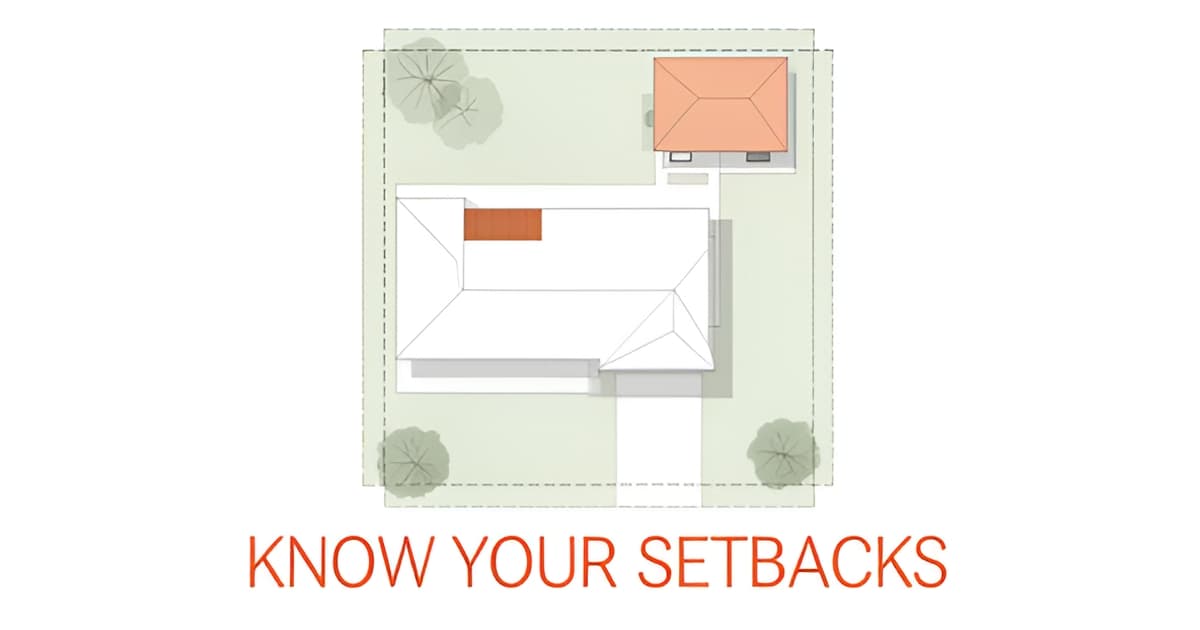
Altadena Property Setbacks: What LA County Requires From the Property Line
Key Facts
- Altadena doesn't follow standard LA County zoning — it uses its own Community Standards District.
- Primary dwellings need 25-foot rear setbacks under 20,000 sq ft — but 35 feet at or above that threshold, per the CSD guide.
- Detached ADUs need only 4-foot rear and side setbacks under state law, per Maxable's Altadena guide.
- Garage conversions within the existing footprint are exempt from setback requirements entirely.
- Like-for-like Eaton Fire rebuilds are exempt from current zoning, but new ADUs and additions must fully comply per LA County.
- Non-like-for-like rebuilds face a flat 20-foot minimum front setback, according to County recovery guidance.
- No structure may exceed 23 feet in height within 15 feet of any property line — including rear-yard ADUs, per the CSD summary guide.
Why Altadena Setback Rules Confuse Homeowners (It's Not Standard LA County Zoning)
If you've compared setback notes with a friend in Pasadena or pulled a generic "LA County zoning" checklist online, you've probably ended up with numbers that don't match your property. That's because Altadena doesn't follow the general LA County zoning code. As an unincorporated community, it operates under its own tailored rulebook — the Altadena Community Standards District (CSD) — and even that isn't the final word on front setbacks.
Here's the wrinkle that trips up most homeowners: for primary dwellings, front setbacks are governed by the Setback District Map, which supersedes the CSD. Your front yard requirement depends on where your parcel sits on that map — not on a single countywide number. A neighbor two blocks away could face entirely different front setback rules than you do.
The layers don't stop there. The applicable setback rules for your project shift based on several factors:
- Lot type — interior, corner, reverse corner, flag, and through lots each apply setbacks differently. Reverse corner side yards, for example, require 10 feet versus 5 feet for interior lots.
- Lot size — rear setbacks jump from 25 feet to 35 feet once a lot reaches 20,000 square feet, and shallow lots under 75 feet deep get a proportional formula instead.
- Structure type — a detached ADU typically needs only 4-foot rear and side setbacks under state law, while a primary dwelling follows the full CSD standards.
- Rebuild status — post-Eaton Fire, like-for-like rebuilds are exempt from current zoning requirements, but non-like-for-like rebuilds face a flat 20-foot minimum front yard setback, per LA County recovery guidance.
This layered system is exactly why generic ADU checklists and well-meaning neighbor advice so often mislead Altadena homeowners. A blogger quoting standard county rules won't mention the Setback District Map. A neighbor's experience with their garage conversion tells you nothing about your corner-lot ADU, where the CSD may impose additional front and side yard requirements. And since the Eaton Fire, two homeowners on the same street may be operating under completely different rules depending on their rebuild classification.
Even the fire-rebuild exemption has fine print: like-for-like protection applies only to the original rebuilt structure. Any addition — including a new ADU — must fully comply with current zoning, according to a detailed rebuilding guide.
The practical takeaway: before you commit to a design or take anyone's word on what fits in your yard, you need to know which setback regime actually governs your specific parcel. That's the first thing we sort out at Altadena ADU Builder — because in Altadena, the right answer depends entirely on your lot, your structure, and your rebuild status.
The Setback Numbers That Actually Apply: Primary Homes vs. ADUs vs. Fire Rebuilds
The number that governs your project depends on what you're building — and in Altadena, three very different rulebooks apply depending on whether you're constructing a primary home, an ADU, or rebuilding after the Eaton Fire.
Primary dwellings follow the Altadena CSD. According to a guide based on the County's official summary sheet, side setbacks equal 10% of the average lot width, with minimums of 5 feet for interior and corner side yards and 10 feet for reverse corner lots. Rear setbacks scale with lot size: 25 feet for lots under 20,000 square feet, and 35 feet at or above that threshold. Shallow lots get a proportional formula — the rear yard may equal 20% of average depth, but never less than 10 feet. Front setbacks are a separate matter entirely, governed by the Setback District Map, which supersedes the CSD.
ADUs are dramatically more permissive. State law allows newly constructed detached ADUs with just a 4-foot rear and side setback, and garage conversions within the existing footprint are exempt from setback requirements entirely. California also guarantees the right to build at least an 800-square-foot ADU even if local rules would otherwise prohibit it. The key caveats:
- The CSD may impose additional front and side yard requirements, especially on corner lots.
- No structure portion may exceed 23 feet in height within 15 feet of any property line — a real constraint for two-story ADU designs.
- LA County must approve or deny complete ADU applications within 60 days.
Fire rebuilds follow a two-track system. Per the official County recovery guidance, like-for-like rebuilds are exempt from current Zoning Code requirements, including setbacks — they only need to meet current Building, Fire, and Health and Safety Codes. Eaton Fire area homeowners can modify the original structure up to 10% or 200 square feet (whichever is greater) plus 10% in height while keeping that protection.
Non-like-for-like rebuilds face different math. The CSD's front yard setback requirements are waived, replaced by a flat 20-foot minimum front setback. And critically, "like-for-like" protects only the original structure — new ADUs, garages, and additions must fully comply with current zoning no matter what the main house qualifies for.
Because the applicable regime depends on your lot type, lot size, and rebuild status, a site-specific feasibility check matters more than any rule of thumb. Altadena ADU Builder offers a free feasibility consultation with a cost-quiz concept render to help you determine which setback numbers actually govern your parcel — and local builders like JMB Builders LLC (CSLB #1103479), which handles Eaton Fire rebuilds, work within these same constraints daily. The County itself recommends confirming specifics with your assigned land use planner, since rebuild requirements continue to evolve.
The Traps That Catch ADU Projects: Height, Corner Lots, and 'Grandfathered' Additions
The 4-foot setback sounds like a green light — until homeowners discover it's only one of several rules their ADU has to clear. Three constraints in particular catch Altadena projects off guard.
Height near property lines is the first trap. Under the Altadena Community Standards District, no portion of a structure may exceed 23 feet in height within 15 feet of any property line — and this applies to rear-yard ADUs too, according to a guide based on the County's official CSD summary sheet. A two-story detached ADU placed just 4 feet from the rear lot line can easily run into this cap, forcing design changes like pushing the unit deeper into the yard, reducing upper-floor area, or dropping to a single story.
The height limits themselves are murky. One ADU-focused source lists detached ADU heights at up to 16 feet, or 18 feet within a half-mile of transit or on multi-family property, with attached ADUs up to 25 feet (per Maxable's post-fire Altadena guide). Another states ADUs in most residential zones can reach 25 feet, varying by proximity to the property line or zoning overlays. That discrepancy matters: it can be the difference between a comfortable two-story unit and a plan that comes back from plan check with corrections. Verify the applicable limit for your parcel with LA County Regional Planning before committing to a design.
Corner lots carry extra requirements. The CSD may impose additional front and side yard requirements on corner lots — a critical caveat for homeowners planning around the 4-foot ADU baseline. Reverse corner lots face a 10-foot side setback for primary dwellings, versus 5 feet for interior lots, and ADU-specific corner rules can tighten further.
Finally, the rebuild trap. For Eaton Fire homeowners, like-for-like protection is narrower than many assume. Per LA County's official recovery guidance, like-for-like structures don't need to comply with current Zoning Code requirements — but that exemption covers only the original rebuilt structure. As one rebuilding guide puts it, "Like-for-Like does not mean 'everything is grandfathered.'" New ADUs, replacement garages, and additions must fully comply with today's setbacks, even when the main home qualifies for like-for-like treatment.
- 23-foot height cap within 15 feet of any property line, including rear-yard ADUs
- Unresolved detached ADU height limits: 16/18 feet in some sources, 25 feet in others
- Corner-lot CSD requirements that can override the 4-foot ADU baseline
- Like-for-like protection applies only to the original structure — new ADUs and additions must meet current setbacks
These constraints interact, which is why Altadena ADU Builder recommends a site-specific feasibility review before design begins. A free ADU feasibility consultation — including a concept render from our cost quiz — can surface height, corner-lot, and rebuild issues while they're still easy (and cheap) to fix. JMB Builders LLC (CSLB #1103479), an Altadena-based licensed general contractor featured on our site, regularly navigates these questions on local ADU and Eaton Fire rebuild projects.
Your Setback Action Plan: Verify Your Parcel Before You Design
Because Altadena sits in unincorporated LA County, the setback rules governing your parcel can differ from your neighbor's — and after the Eaton Fire, they can even differ depending on whether you're rebuilding like-for-like. Before you sketch a single floor plan, it pays to confirm exactly which regime applies to your lot.
Start with the basics: your lot type and size. Standard interior, corner, reverse corner, flag, and through lots each apply setbacks differently, and rear setbacks scale with lot size — 25 feet for lots under 20,000 square feet versus 35 feet for lots at or above that threshold, according to a visual guide based on the County's official CSD summary sheet. Shallow lots under 75 feet deep get a proportional rear-yard formula instead.
Next, check the Setback District Map and your Community Standards District (CSD) status. The Setback District Map supersedes the CSD for front setbacks, meaning your parcel's location on that map — not the general CSD text — determines your front yard requirement. The County itself advises homeowners to consult their assigned LA County land use planner for the most current information, since some zoning requirements may be modified for fire rebuilds, per the official LA County recovery guidance.
If you're rebuilding after the Eaton Fire, document your pre-fire home's size now. The County is taking a tolerant, flexible approach to documentation, reportedly accepting real estate listings, appraisal reports, and insurance records as evidence. This matters because like-for-like rebuilds are exempt from current Zoning Code setbacks, but any addition — including a new ADU — must fully comply with today's standards. Non-like-for-like rebuilds face a flat 20-foot minimum front yard setback.
Finally, if an ADU is on your radar, note the 60-day window: LA County must approve or deny a complete ADU application within 60 days. Keep in mind that incomplete or incorrect submissions are the most common source of delays, so a thorough feasibility review up front protects that timeline.
Your verification checklist:
- Confirm your lot type (interior, corner, reverse corner, flag, or through) and square footage
- Locate your parcel on the Setback District Map and verify CSD requirements with LA County Regional Planning
- Gather pre-fire documentation — listings, appraisals, insurance records — if rebuilding
- Distinguish which parts of your project qualify for like-for-like exemption and which must meet current setbacks
- Calendar the 60-day ADU permit decision deadline once your application is complete
At Altadena ADU Builder, our free ADU feasibility consultation — paired with a concept render from our cost quiz — is designed to tell you which setback regime governs your specific parcel before you invest in design work. We make no permit or timeline guarantees; zoning outcomes always rest with the County. If you want a second opinion on buildability, JMB Builders LLC (CSLB #1103479), an Altadena-based licensed contractor experienced in Eaton Fire rebuilds, is a featured builder on our site via paid placement, with its work documented at jmb-builders.com.
Frequently Asked Questions
What are the setback requirements for a house in Altadena?
How close to the property line can I build an ADU in Altadena?
Do I have to follow current setbacks if I'm rebuilding after the Eaton Fire?
Can I add an ADU to my like-for-like rebuild without meeting current zoning?
Why is my neighbor's setback different from mine when we're both in Altadena?
How tall can my ADU be if it's close to the property line?
Your Setback Answer Starts With Your Parcel — Not a Rule of Thumb
Altadena's setback rules can't be reduced to a single number, and that's the real lesson here. Your front setback comes from the Setback District Map, which supersedes the CSD. Your side and rear setbacks depend on lot type and size — reverse corner lots, for instance, require 10-foot side yards versus 5 feet for interior lots. If you're building an ADU, state law's 4-foot rear and side setback is a major advantage, but the 23-foot height cap within 15 feet of any property line and corner-lot CSD requirements can reshape your design. And if you're rebuilding after the Eaton Fire, the two-track system matters: like-for-like rebuilds are exempt from current zoning setbacks, per LA County's official recovery guidance, but any new ADU or addition must meet today's standards. Before you invest in design work, take our free ADU feasibility consultation with a cost-quiz concept render — we'll identify which setback regime actually governs your parcel, and confirm details with your assigned LA County land use planner. No permit guarantees, just clarity before you build.