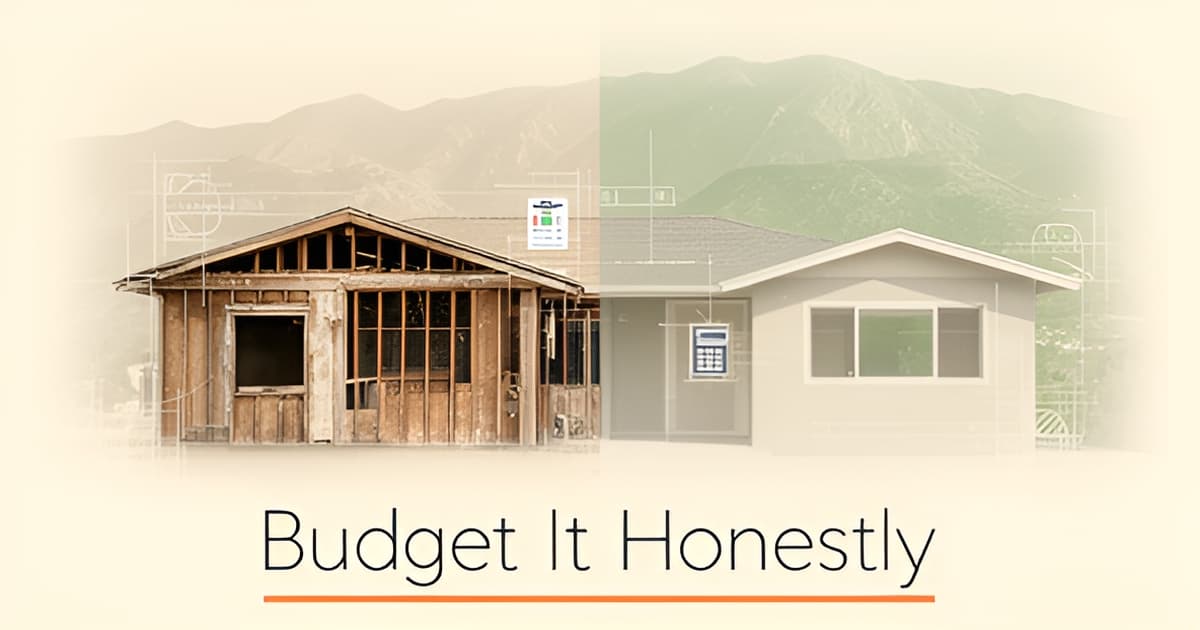
Altadena Home Renovation: Budgeting a 1920s–1960s House Honestly
Key Facts
- Basic rebuild work in Altadena runs $300–$400 per square foot, with high-end finishes exceeding $500, according to local contractor estimates.
- A 1,500-square-foot rebuild at $500 per square foot costs about $750,000 — over $140,000 more than Altadena's average 2023 insurance coverage of $607,000, per Catalyst California.
- Six in 10 intact, remediated homes tested after the Eaton Fire remained uninhabitable due to elevated lead or asbestos, testing by Eaton Fire Residents United found.
- Average permit approval for Altadena rebuilding takes about five months, with full projects stretching 12 to 24 months, Spectrum News reported.
- A soil compaction report is required if soil is disturbed deeper than 12 inches, and visible foundations must be tested before reuse, LA County guidance warns.
- Only 23 of nearly 6,000 significantly damaged Altadena properties had completed rebuilding as of December 2025, Catalyst California documented.
- The expedited 'like-for-like' permit path applies only if modifications stay within 10% or 200 square feet of the original footprint, per LA County rebuild rules.
Why Generic Per-Square-Foot Numbers Fail in Altadena
If you own an intact 1920s–1960s home in Altadena and you're budgeting a renovation with a national per-square-foot calculator, you're building your plan on a number that was never meant for your house, your parcel, or your permitting reality.
Altadena's actual construction market tells a different story. Basic rebuild work in the area runs an estimated $300–$400 per square foot, with high-end finishes exceeding $500 per square foot, according to local contractor estimates published after the Eaton Fire. Catalyst California uses an even starker benchmark: at $500 per square foot, replacing a 1,500-square-foot home costs roughly $750,000 — a figure that exposed a shortfall of more than $140,000 against the town's average insurance coverage of $607,000.
But here's the trap: even those headline figures understate what owners actually pay. As one analysis of Altadena's rebuild surge warns, "Do not use a generic per-square-foot rebuild number as the entire analysis. Site work, design, engineering, utility work, permits, insurance requirements, financing and finishes may sit outside a headline construction figure."
For owners of older, intact homes, the excluded costs stack up fast:
- Site and soil work — a compaction report is required if soil has been disturbed deeper than 12 inches, and foundations must be tested before anyone assumes they're usable.
- Environmental remediation — Eaton Fire Residents United tested 50 intact, remediated homes and found 6 in 10 still uninhabitable due to elevated lead or asbestos.
- Fire-code and WUI compliance — Class A roofing, ember-resistant vents, and defensible-space requirements in designated fire hazard severity zones apply to new construction and major work alike.
- Parcel-specific utilities — septic or sewer connections, water Will-Serve letters, and SCE power availability vary lot by lot.
- Permits and timeline carrying costs — average permit approval runs about five months, and full rebuild timelines stretch 12 to 24 months.
That last point deserves emphasis: a visible foundation doesn't prove it can be reused, and a cleared lot doesn't prove it's permit-ready. Generic estimates assume none of these conditions exist — and in Altadena, they often do.
This is why Altadena ADU Builder focuses exclusively on parcel-specific feasibility rather than back-of-napkin math. Whether you're planning a whole-home renovation or evaluating a backyard ADU, a free feasibility consultation with a cost-quiz concept render gives you numbers grounded in your actual lot — not a national average that leaves you exposed to six-figure surprises. (Featured builder JMB Builders LLC, CSLB #1103479, is a paid placement.)
The Hidden Cost Drivers Lurking in Altadena's Older Housing Stock
If you're budgeting a renovation on an Altadena home built before 1970, the biggest threats to your budget won't show up in a contractor's per-square-foot estimate. They're parcel-specific — and since the Eaton Fire, they're also codified, enforced, and more expensive than ever.
Start with fire code. Every rebuild in the area must comply with California's Wildland-Urban Interface regulations, which mandate upgrades like Class A roofing and ember-resistant vents. New fire hazard severity zones also impose defensible-space requirements on properties in high and very high zones. A major renovation that touches roofing, exterior openings, or landscaping can trigger these same compliance costs on an intact home.
Then there's what's under the house. LA County guidance for post-fire work makes clear that a visible foundation does not prove it can be reused — foundations require testing and forensic analysis, and a soil compaction report is needed if soil was disturbed deeper than 12 inches. For any older Altadena home, foundation and soil conditions deserve the same skeptical, test-first budgeting.
Environmental remediation is the starkest warning. Eaton Fire Residents United tested 50 intact, remediated homes and found that 6 in 10 remained uninhabitable due to elevated lead and/or asbestos. Even homes that survived the fire and were professionally cleaned often needed further work — a reminder that pre-1980s housing stock in Altadena should be tested before any demo or remodel scope is priced.
Finally, don't assume your utilities are a given. Septic or sewer connections, water Will-Serve letters, and Southern California Edison power availability are all parcel-specific, and each can add cost and time to a major renovation.
- Fire-code upgrades: Class A roofing, ember-resistant vents, and WUI compliance
- Defensible-space requirements in high and very high fire hazard severity zones
- Foundation testing and soil compaction reports before reusing or modifying existing structures
- Lead and asbestos testing and remediation, especially in homes built before the 1980s
- Parcel-specific verification of septic/sewer, water, and power availability
These same forces are driving documented rebuild costs of $300–$400 per square foot for basic construction and more than $500 for high-end finishes. As LA Metro Home Finder puts it, do not use a generic per-square-foot number as your entire analysis — site work, engineering, utility work, and permits sit outside any headline figure.
At Altadena ADU Builder, our free feasibility consultation and cost-quiz concept render are built around exactly this kind of parcel-specific review — so your ADU or remodel budget reflects your lot's realities, not a generic template. Featured builder JMB Builders LLC (CSLB #1103479) brings local experience with Eaton Fire rebuilds and whole-home remodels in Altadena.
Building an Honest Budget: Timeline, Permits, and Contingency
An honest Altadena budget isn't just a construction number — it's a schedule with money attached to each stage. In Altadena's current environment, permitting alone can reshape your cash-flow plan, and a lump-sum proposal hides more than it reveals.
Start with timeline. Permit approval for rebuilding work averages around five months, according to Spectrum News reporting, and full projects run 12–24 months from design to move-in. There is an expedited "like-for-like" pathway, but it only applies if modifications stay within 10% or 200 square feet (whichever is greater) of the original footprint; qualifying submissions get a 10-business-day initial review target. Standard modified projects typically take 4–6 months for permits. If your renovation touches footprint, height, or structure, budget for the slower track.
Then budget for the market itself. Labor shortages and material price inflation are adding real costs across Altadena projects, and any work in high or very high fire hazard severity zones must comply with California's Wildland Urban Interface regulations — think Class A roofing and ember-resistant vents. These aren't optional line items; they're conditions of approval.
The insurance gap deserves its own line. The average Altadena home carried about $607,000 in coverage in 2023, while a 1,500-square-foot rebuild at the $500-per-square-foot benchmark costs roughly $750,000 — a shortfall of more than $140,000 before temporary housing, per Catalyst California. Insurance may also not cover code upgrades or rising material costs, so don't assume your policy fills the gap.
Finally, structure the budget so milestones — not promises — control your money:
- A separate permit and plan-check line, not buried in the construction total
- Inspection milestones that trigger payments only after work passes
- Site-condition allowances for soil testing, utility availability, and remediation surprises
- A contingency sized to Altadena realities, not a generic 5% figure
As one guide drawing on LA County documents puts it, a signed proposal without permit, inspection, and payment milestones is not a complete schedule. That's the standard we hold every budget to at Altadena ADU Builder. If you're weighing an addition or backyard unit alongside a whole-home remodel, our free ADU feasibility consultation — including a cost-quiz concept render — gives you a parcel-specific starting point, and featured builder JMB Builders LLC (CSLB #1103479) can speak to real Altadena timelines. No one can guarantee a permit date, but you can guarantee your budget tells the truth.
Your Next Step: Get a Parcel-Specific Feasibility Assessment
Every generic per-square-foot number you've read about Altadena construction comes with the same warning from local experts: don't treat it as your budget. Site work, engineering, utility upgrades, permits, and finishes can all sit outside a headline construction figure — and on a 1920s–1960s lot, those line items often decide whether a project pencils.
That's why the honest next step is a parcel-specific feasibility assessment, not another web search. Altadena ADU Builder offers a free ADU feasibility consultation paired with a cost-quiz concept render, giving you a starting number tied to your actual property rather than a county-wide average. The distinction matters: even a cleared lot doesn't prove it's permit-ready, and a visible foundation doesn't prove it can be reused without testing, as LA County rebuild guidance makes clear.
To make the consultation count, bring what you have:
- Your property details — lot size, existing square footage, and any known additions or unpermitted work
- Your renovation or ADU goals, including whether you're considering a garage conversion, JADU, or full remodel
- Insurance information, since average Altadena coverage was just $607,000 in 2023 against rebuild examples near $750,000 — a shortfall of more than $140,000 documented by Catalyst California
- Any soil, foundation, or environmental testing you've already completed
The Altadena context raises the stakes for getting this right. Basic reconstruction runs $300–$400 per square foot, with high-end finishes exceeding $500, according to local contractor estimates — and the same fire-code upgrades, WUI compliance, and labor constraints that drive those figures apply to major renovations here. A feasibility assessment surfaces those costs before they surface on an invoice.
For homeowners who want a contractor already working in this environment, JMB Builders LLC (CSLB #1103479) is a featured Altadena-based licensed general contractor on this site — a disclosed paid placement. Their documented work includes custom homes, ADUs, whole-home remodels, and Eaton Fire rebuilds, which means they budget against the same regulatory and site-condition realities discussed in this article.
Whether you continue with JMB or another licensed builder, the goal is the same: replace a generic estimate with a number grounded in your parcel, your goals, and your coverage. That's what honest budgeting for an older Altadena home actually looks like.
Frequently Asked Questions
How much does it cost to renovate or rebuild a home in Altadena per square foot?
Why shouldn't I just use a national per-square-foot calculator for my Altadena renovation budget?
How long does permitting and a full renovation take in Altadena right now?
Will my insurance cover the full cost of rebuilding or a major renovation?
My home survived the fire and looks intact — do I still need testing before renovating?
What fire-code upgrades will I have to pay for in a high fire hazard zone?
Your Altadena Budget Should Tell the Truth — Here's How to Start
Budgeting a renovation on a 1920s–1960s Altadena home means accepting that no national calculator, and no headline per-square-foot figure, can capture what your parcel will actually cost. As we've seen, basic construction in Altadena runs $300–$400 per square foot with high-end finishes exceeding $500, and the real budget risks sit outside those numbers: foundation and soil testing, lead and asbestos remediation, WUI fire-code upgrades, parcel-specific utilities, and permitting timelines that can stretch five months or more. Even insurance may not close the gap — the average Altadena policy covered $607,000 in 2023 against rebuild examples near $750,000, a shortfall of more than $140,000 documented by Catalyst California. The honest path forward is parcel-specific: gather your property details, insurance information, and any testing you've already done, then pressure-test your assumptions against your actual lot. That's exactly what Altadena ADU Builder's free feasibility consultation with a cost-quiz concept render is designed to do — and if you want a contractor already budgeting against these realities, featured builder JMB Builders LLC (CSLB #1103479) is a good starting conversation. Get a number grounded in your parcel, not a template.