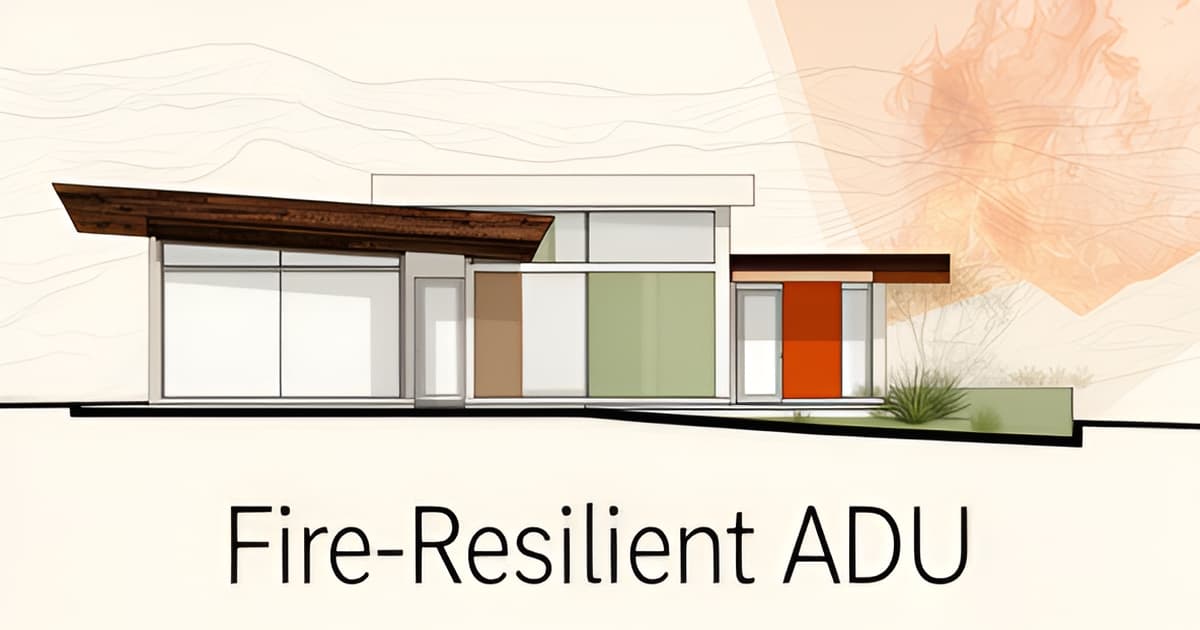
ADU in a Fire Zone: Insurance Costs in Southern California's WUI
Key Facts
- CAL FIRE hazard zone maps do not affect insurance rates — insurers use proprietary catastrophe models instead, per Insurance Commissioner Ricardo Lara.
- California's FAIR Plan now covers 696,000 properties with $788 billion in exposure, LA Times reporting shows.
- State Farm is discontinuing coverage for 72,000 California homes and apartment buildings, per United Policyholders.
- Homes built after 2009 carry the lowest insurance costs — about $150 per $100,000 of home value, UC Berkeley's Terner Center found.
- The FAIR Plan caps wildfire claims responsibility at $500 million — policyholders pay anything above that, according to the LA Times.
- Structural hardening cuts wildfire risk by 40%, and 75% when paired with vegetation management, a NAIC study cited by CalMatters found.
- Retrofitting fire mitigation costs 'orders of magnitude greater than the insurance savings,' Resources for the Future researchers concluded.
The Hazard Map Myth: Why Your Fire Zone Designation Isn't What Sets Your Premium
Most Altadena homeowners assume their CAL FIRE Fire Hazard Severity Zone designation is the number that decides their insurance bill. It isn't — and understanding why could change how you plan your ADU entirely.
The California Department of Insurance has been unusually direct on this point. As Insurance Commissioner Ricardo Lara put it: "The CAL FIRE hazard maps are not used for insurance rates or underwriting decisions." Instead, insurers rely on proprietary wildfire catastrophe models — computerized simulations that estimate the probability and severity of losses on your specific property and its surroundings.
So what do the hazard maps actually do? They drive local planning and permitting decisions — which matters for your ADU project in Altadena, where state law requires the maps to inform community planning. Your zone designation shapes what gets built and how; it does not set your premium.
This distinction has real consequences for ADU insurance costs:
- Insurers price your ADU through catastrophe models that evaluate construction details, defensible space, and site conditions — not your zone label.
- Under California's Sustainable Insurance Strategy, those models must now account for homeowner and community mitigation efforts, per the CDI's consumer alert.
- Newer construction performs better in these models: Terner Center data shows homes built after 2009 carry the lowest insurance costs — about $150 per $100,000 of home value versus roughly $200 for 1990s–2000s homes.
That last point is why building fire-resilient features into your ADU from day one matters more than chasing a favorable zone designation. A newly built ADU with a Class A roof, enclosed eaves, and ember-resistant vents enters the insurance market as a modern structure — exactly what catastrophe models score favorably.
The practical takeaway: don't assume a "moderate" zone label means cheap coverage, and don't assume a "very high" label makes insurance impossible. What your insurer's model sees on your property — construction, clearance, access, surrounding risk — drives the number. Two homes on the same Altadena street, in the same zone, can receive very different quotes.
When Altadena ADU Builder walks homeowners through feasibility, insurance is part of that early conversation — because design choices made before the first permit drawing affect both insurability and cost. Local builders like JMB Builders LLC (CSLB #1103479), whose Eaton Fire rebuild work is documented on jmb-builders.com, design to wildfire-resilient standards from the start rather than retrofitting later.
The Shrinking Market and the FAIR Plan Fallback
If your Altadena property sits in the wildfire-urban interface, you've likely noticed how hard it's become to keep — or find — comprehensive coverage. Understanding why the market contracted, and what the FAIR Plan actually covers, is essential before you build or insure an ADU.
The squeeze started in early 2022, when major carriers — State Farm, Allstate, and Farmers — began shedding thousands of wildfire policies across California. State Farm alone is discontinuing coverage for 72,000 homes and apartment buildings, pushing many homeowners toward the state's insurer of last resort. Meanwhile, the Department of Insurance is now allowing insurers to factor escalating climate risk into pricing, so further rate hikes are likely.
The FAIR Plan has absorbed the fallout. It has grown to 696,000 properties with $788 billion in exposure as of June 30 — a massive expansion beyond its original 1960s mission, according to LA Times reporting. But it is a thin safety net, not a substitute for a conventional policy:
- Fire-only basic coverage — no theft, liability, or water damage protection found in standard policies
- A $500 million cap on wildfire claims responsibility, with policyholders paying anything above that
- All-or-nothing mitigation discounts — you must complete every qualifying measure to earn a credit
The $500 million cap, imposed by Commissioner Lara after the January 2025 LA firestorm, deserves special attention. If a catastrophic event exhausts that pool, FAIR Plan policyholders share the excess costs — a real risk for a plan whose exposure UC Berkeley's Nancy Wallace notes has become unbalanced, with low-risk areas subsidizing high-risk, high-value homes.
For a property with an ADU, the implications are practical. A fire-only policy may not fully address the ways you actually use a rental or family unit — liability for tenants, theft of belongings, or water damage from a plumbing failure simply aren't covered. If your ADU houses a family member or generates rental income, you'll likely need to layer a separate "difference in conditions" policy on top of the FAIR Plan, adding cost and complexity.
This is also why design choices matter. New construction is the cheapest moment to build in the features the FAIR Plan rewards — Class A roofing, ember-resistant vents, noncombustible wall bases, and 5-foot ember-resistant clearance — rather than retrofitting later. At Altadena ADU Builder, we encourage homeowners to weigh these insurer criteria during the feasibility stage, alongside costs and permits. Builders like JMB Builders LLC, our featured local builder, bring relevant experience here, including Eaton Fire rebuild work in the community.
The FAIR Plan is a fallback, not a plan. Designing your ADU to be insurable from day one is the more durable strategy.
Mitigation Credits: Real Discounts, Oversold Relief
On paper, California's wildfire mitigation credits look like a real reward for hardening your home. In practice, the math and the delivery often fall short — and Altadena homeowners planning an ADU should understand both sides before spending tens of thousands of dollars chasing a discount.
Start with what's officially on offer. The FAIR Plan's discount program provides 10% off for structural hardening, 5% for hardened surroundings, 14.5% for completing both, plus an additional 10% for living in a Firewise Community. Broader marketwide, the Department of Insurance has approved 140 insurer discount plans under the Safer from Wildfires framework adopted in 2022.
The structural discount, however, is all-or-nothing. To qualify, a property must have every one of the following:
- A Class A roof
- Noncombustible material on the bottom six inches of exterior walls
- Ember- and fire-resistant vents with wire mesh
- Multipaned windows or shutters
- Enclosed eaves
That last item illustrates the cost problem. Enclosing open eaves alone can run $40,000, and researchers at Resources for the Future concluded that retrofit costs are "orders of magnitude greater than the insurance savings" under current discount structures. A 14.5% cut on a FAIR Plan premium rarely recovers that kind of outlay.
Delivery is the second problem. Neither the commissioner's office nor insurers can say how many homeowners have actually received discounts under those 140 approved plans. CalMatters has documented homeowners being non-renewed despite completing mitigation, and Nevada County Supervisor Heidi Hall reports residents spending tens of thousands on hardening while carriers "are still leaving." One Santa Cruz Mountains homeowner saw his expected premium double from $2,500 to $5,000 after being dropped despite fireproofing.
The honest takeaway: mitigation is worth doing for safety and insurability, but treat the credits as a bonus, not a business case. This is where building new helps. An ADU designed from day one with ember-resistant vents, enclosed eaves, multipaned windows, and a 5-foot ember-resistant zone meets the FAIR Plan criteria at a fraction of retrofit cost — and homes built after 2009 already carry the lowest insurance costs per $100,000 of value, according to UC Berkeley's Terner Center. At Altadena ADU Builder, our free feasibility consultation with a cost-quiz concept render is where that fire-resilient design conversation starts, drawing on local rebuild expertise including JMB Builders LLC's (CSLB #1103479) Eaton Fire rebuild work.
Build It Right the First Time: Fire-Resilient ADU Design That Insurers Reward
Here's the uncomfortable math: retrofitting fire mitigation onto an existing house can cost $40,000 just to enclose open eaves, while building those same features into new construction adds a fraction of that to the budget. For Altadena homeowners planning an ADU, the design phase is the single cheapest moment to get this right.
The numbers back this up. A UC Berkeley Terner Center analysis found that homes built after 2009 carry the lowest insurance costs in the state — roughly $150 per $100,000 of home value, compared to about $200 for homes built in the 1990s and 2000s. Newer construction codes translate directly into lower premiums.
The FAIR Plan makes the checklist explicit. Its structural hardening discount — worth 10% on its own, or 14.5% when combined with hardened surroundings — requires all five of the following:
- Class A fire-rated roof covering
- Noncombustible material on the bottom 6 inches of exterior walls
- Ember- and fire-resistant vents with wire mesh
- Multipaned windows or shutters
- Fully enclosed eaves
The surroundings discount adds a 5-foot ember-resistant zone around the structure, cleared vegetation under any raised floors, and removal of combustible outbuildings within 30 feet. Note the word "all": the FAIR Plan requires all-or-nothing completion of these criteria, so a partially hardened ADU earns nothing.
Be realistic about what hardening buys you. Research from Resources for the Future finds that retrofit costs are orders of magnitude greater than the insurance savings, and CalMatters has documented homeowners who completed mitigation and still lost coverage. The discount is real but modest — the bigger payoff is insurability itself, and the 40% risk reduction from structural modifications that a National Association of Insurance Commissioners study identified.
This is why design decisions matter more than discounts. Specifying a Class A roof, dual-pane windows, and enclosed eaves on paper costs a builder almost nothing extra during construction. Reopening walls, replacing vents, and re-roofing later costs tens of thousands. Structural modifications reduce wildfire risk by 40% on their own, and 75% when paired with vegetation management.
When Altadena homeowners sit down with us for a free ADU feasibility consultation, fire-resilient specs are part of the conversation from the first sketch — not an afterthought. Local builders like JMB Builders LLC (CSLB #1103479), whose Eaton Fire rebuild work is documented on jmb-builders.com, build to these standards because their own community depends on it. Build it right once, and you never pay the retrofit premium.
Your Next Step: Plan an ADU That's Insurable From Day One
Here's the honest bottom line: no public data source — not the California Department of Insurance, not the FAIR Plan, not any insurer — publishes ADU-specific premium figures for fire zones. That gap is actually useful information. It tells you that the smartest move isn't shopping for a quote after you build; it's designing an ADU that meets insurer and FAIR Plan criteria before you pull a single permit.
The economics back this up. Terner Center research shows homes built after 2009 carry the lowest insurance costs — about $150 per $100,000 of home value versus roughly $200 for homes built in the 1990s and 2000s. New construction is your one chance to get wildfire resilience right cheaply. Retrofitting later is punishing: United Policyholders reporting documents that simply enclosing open eaves can cost $40,000.
Build these FAIR Plan discount criteria into your ADU plans from day one:
- A Class A rated roof, plus noncombustible material on the bottom six inches of exterior walls
- Ember- and fire-resistant vents with wire mesh, and multipaned windows or shutters
- Fully enclosed eaves — cheap in new construction, costly to retrofit
- A five-foot ember-resistant clearance zone, with clear vegetation under any deck and no combustible outbuildings within 30 feet
Meeting all of these can earn the FAIR Plan's combined 14.5% mitigation discount, plus an additional 10% if your community holds Firewise status. Be realistic, though: Resources for the Future researchers found retrofit costs run "orders of magnitude greater than the insurance savings." The discount matters less than the underlying fact — a hardened structure is far more likely to be insurable at all, and far more likely to survive.
That's why we at Altadena ADU Builder recommend a design-first approach: a free ADU feasibility consultation that includes a cost quiz and a concept render, so you can see exactly how fire-resilient features fit your lot and budget before committing. Our featured builder, JMB Builders LLC (CSLB #1103479), is an Altadena-based licensed general contractor with hands-on Eaton Fire rebuild experience — work documented on jmb-builders.com — which means the insurer criteria above aren't abstract to them. (Disclosure: JMB Builders is a paid placement on this site.)
In a market where carriers are shedding wildfire policies and the FAIR Plan now covers 696,000 properties, an ADU designed to insurer standards from day one isn't a luxury. It's the difference between a rental unit that's covered and one that isn't.
Frequently Asked Questions
Does being in a CAL FIRE very high fire hazard severity zone automatically make my ADU insurance expensive?
Can I get insurance for an ADU in a wildfire zone in Southern California?
What does the FAIR Plan actually cover for a backyard ADU or rental unit?
Do wildfire mitigation discounts really pay off for homeowners in fire zones?
Is it cheaper to build fire-resistant features into a new ADU or retrofit an existing home?
What fire-hardening features should I include in my ADU design to satisfy insurers?
The Bottom Line for Altadena Homeowners: Insurability Is Designed, Not Discovered
If there's one lesson to carry forward, it's this: your fire zone label doesn't set your premium — your property's actual construction and defensible space do. Insurers price through proprietary catastrophe models, the FAIR Plan is a thin, fire-only fallback rather than a real plan, and mitigation credits reward hardening but rarely justify retrofitting on their own. The math favors building right the first time: homes built after 2009 carry the lowest insurance costs in the state, roughly $150 per $100,000 of value versus about $200 for older construction. For an ADU, that means specifying a Class A roof, enclosed eaves, ember-resistant vents, multipaned windows, and a five-foot clearance zone during design — when these features cost a fraction of a retrofit. Your next step is to make insurance part of the feasibility conversation before permits, not after construction. Altadena ADU Builder's free feasibility consultation, including a cost quiz and concept render, is built for exactly that — and local builders like JMB Builders LLC (CSLB #1103479) bring hands-on Eaton Fire rebuild experience to every fire-resilient design.