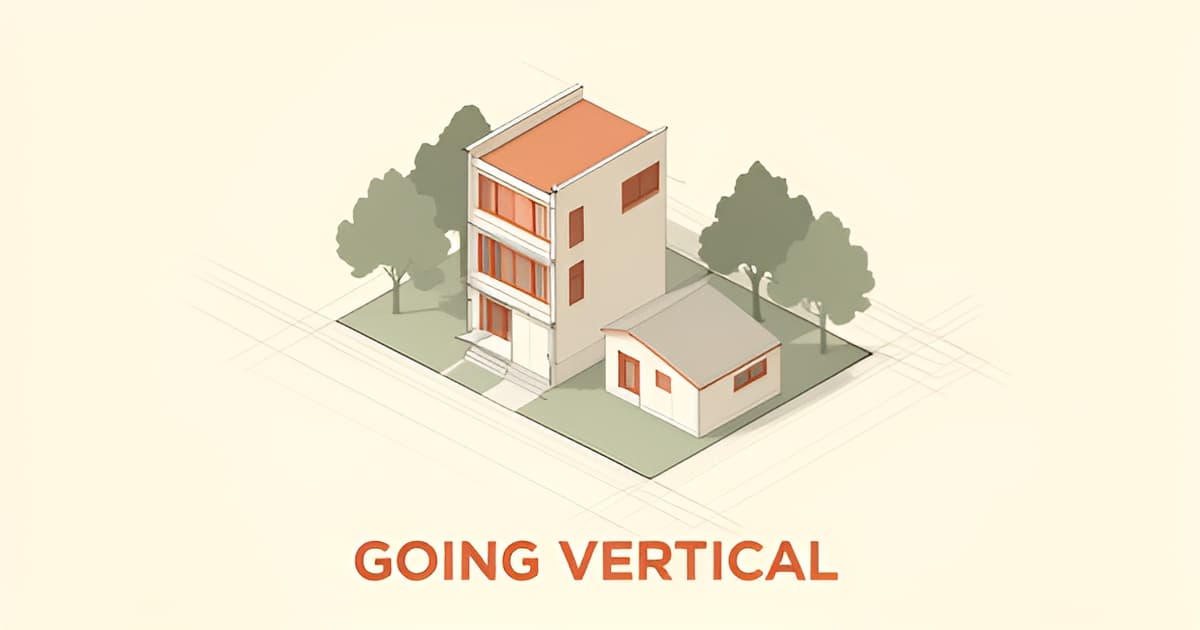
2-Story ADU in Los Angeles: Height, Setbacks, and Cost Differences
Key Facts
- A two-story ADU can deliver 840 square feet of living space on just a 448-square-foot footprint — nearly double the floor area, according to LA builder cost data.
- Unincorporated LA County permits detached ADUs up to 25 feet tall, which often allows a full two-story design, per county ADU guidelines.
- Building up adds roughly $50 per square foot, making two-story ADUs run $280,000–$420,000 versus $180,000–$350,000 single-story, Maxable estimates.
- ADUs under 750 square feet are exempt from LA County impact fees — a threshold two-story designs often blow past, per county requirements.
- No prefab manufacturer offers two-story ADU models, so vertical builds must be entirely site-built, per builder project data.
- A Mar Vista homeowner built a 650-square-foot two-story ADU for about $225,000, and rental income nearly paid off the build, the Los Angeles Times reported.
- New construction requires 4-foot side and rear setbacks, though same-footprint garage conversions escape them entirely, per LA ADU zoning rules.
The Two-Story Trade-Off: Why Altadena Homeowners Go Vertical
On a typical Altadena lot, the backyard you can actually build on is smaller than it looks. Narrow frontages, hillside lot-coverage limits, and 4-foot side and rear setbacks shrink the buildable footprint before design even begins — which is exactly why so many local homeowners start asking about going up instead of out.
The math is compelling. According to LA ADU cost data, a two-story design can deliver 840 square feet of living space on a footprint of just 448 square feet — nearly double the floor area on the same ground. As architect Isabelle Duvivier told the Los Angeles Times after completing her own two-story ADU: "I like using two stories because you can never get the land back."
The vertical premium is real, though. Maxable estimates that building up adds roughly $50 per square foot to a project, which is why two-story detached ADUs run $280,000–$420,000 versus $180,000–$350,000 for single-story builds. That premium buys back yard space, privacy from neighbors, and room for larger floor plans that a constrained lot simply cannot fit on one level.
What makes vertical designs feasible here is LA County's unincorporated-area height allowance. County ADU guidelines permit detached ADUs up to 25 feet tall, which often allows a full two-story design — a key advantage for Altadena's unincorporated parcels.
But two-story plans in this area face complications that flat-lot neighborhoods don't:
- Lots in both a Very High Fire Hazard Severity Zone and a Hillside Area face restrictions that can bar city-ordinance ADUs entirely — though state-law units up to 800 sq ft are exempt from that bar.
- Two-story ADUs must be site-built; no prefab manufacturer offers two-story models, so factory-built shortcuts are off the table.
- Units over 750 square feet lose the county's impact-fee exemption, which matters when a second story tempts you to maximize size.
- Power-line clearances of 5–6 feet can constrain placement on hillside-adjacent lots.
That's why Altadena ADU Builder recommends a feasibility-first approach: before falling in love with a two-story design, confirm your lot's fire-zone and hillside designation, verify setbacks, and run the honest cost comparison. The vertical premium pencils out when the footprint is the binding constraint — and on many lots here, it is.
Height and Setback Rules That Shape a Two-Story ADU
Two stories of height can double your floor area without touching your yard — but only if your design clears a tangle of height caps, setbacks, and fee thresholds first. The rules differ depending on whether you fall under City of LA ordinance, state law, or, as most Altadena homeowners do, LA County unincorporated jurisdiction.
The height math comes down to jurisdiction. In unincorporated LA County, detached ADUs can reach 25 feet, which "often allows for a two-story design" and is, per Realm's county guide, a fantastic way to maximize living space on a smaller footprint. The state-law pathway is tighter: ADU zoning rules set 16 feet as the standard, rising to 18 feet near major transit, and 20 feet when the roof pitch matches the main house. That City-versus-County discrepancy means the same two-story design that sails through in Altadena could hit a ceiling elsewhere in LA — which is why verifying with LA County Regional Planning before finalizing plans matters.
Setbacks shape the footprint more than most homeowners expect. New construction requires 4-foot side and rear setbacks, including for any added second story over an existing garage, though same-footprint conversions escape them entirely. Once you subtract those buffers, plus lot-coverage limits, a narrow lot can shrink fast — one reason vertical designs like an 840-square-foot unit on a 448-square-foot footprint work so well on constrained lots, per Cali-ADU's project data.
Beyond height and setbacks, three thresholds quietly reshape the budget:
- 750 square feet — ADUs under this size are exempt from impact fees in LA County, so a two-story build that pushes past it forfeits real money.
- 1,200 square feet — the cap on detached ADUs, subject to floor-area and lot-coverage limits.
- 5–6 horizontal feet — the clearance new structures need from power lines; ADUs often sit closer and require utility approval, a bottleneck the LA Times documented in its Mar Vista two-story case study.
Two more requirements round out the picture: new detached ADUs must include solar panels, and lots in both a Very High Fire Hazard Severity Zone and a Hillside Area face restrictions on city-ordinance ADUs — a combination common in foothill communities like Altadena. Because these rules shift and interpretations vary by reviewer, Altadena ADU Builder treats a feasibility check with LA County Regional Planning as the first step, not an afterthought.
The Real Cost Difference: Two-Story vs. Single-Story
Going vertical can add roughly $100,000 or more to an ADU budget — but on a narrow lot, it may be the only way to get the square footage you actually need. Understanding where that premium comes from, and where it disappears, is the difference between a smart investment and an expensive mistake.
The headline numbers are straightforward. Two-story detached ADUs in Los Angeles run $280,000–$420,000, compared with $180,000–$350,000 for a comparable single-story build. Maxable, an ADU consulting firm, estimates that building up adds about $50 per square foot to a project — and its advice is blunt: if your budget is tight, stay single-story.
That premium buys more than just height. A two-story design delivers up to double the floor area on the same footprint — one model delivers 840 square feet on a 448-square-foot base, which matters enormously on narrow lots where setbacks and lot coverage eat into buildable space. For hillside properties in Altadena, where lot coverage limits are a real constraint, that footprint efficiency is often the deciding factor.
There's also a middle path worth pricing. A garage conversion topped with a second-story addition runs $225,000–$400,000+, using the existing garage structure as a cost-saving foundation. Because the conversion portion requires no new setbacks, this route can sidestep placement problems that stall all-new builds.
Before committing to any budget, account for the costs that don't show up in the base bid:
- A two-zone HVAC system adds roughly $2,500 to a two-story design
- New detached ADUs require solar panels, per California requirements
- Property taxes rise — in one documented case, from $6,000 to $9,000 per year
- A contingency of at least 10% of expected cost is recommended to absorb surprises
One real project shows when the math works. In Mar Vista, a homeowner built a 650-square-foot two-story ADU for about $225,000 in 2019 — a figure that included landscaping, fencing, pavers, and the garage conversion, according to the Los Angeles Times. The rental income nearly paid off the build, and the owner credits the supplemental income with keeping her in her home.
The lesson from that project goes beyond cost. The owner chose the lowest contractor bid, then had to hire separate subcontractors for HVAC, gutters, and more — and later said a single comprehensive bid would have been less stressful. At Altadena ADU Builder, we recommend getting all-inclusive pricing from a licensed contractor like JMB Builders LLC (CSLB #1103479) before breaking ground, and running your lot through a feasibility check to see whether the vertical premium pencils out for your specific footprint.
The short version: two-story ADUs cost more per square foot, but they can unlock square footage that a single-story simply cannot fit — and on a constrained lot, that makes all the difference.
When a Two-Story ADU Pencils Out (and When It Doesn't)
Two stories or one? The answer comes down to a single question: what's actually stopping your build — your lot, or your budget?
A two-story ADU wins when footprint is the binding constraint. If setbacks, lot coverage, or a narrow lot prevent you from fitting your desired floor area on one level, going vertical nearly doubles your space on the same ground. The Fairfax model, for example, delivers 840 sq ft on a 448 sq ft footprint — a ratio that matters enormously on Altadena's tighter hillside lots, where buildable area shrinks fast once 4-ft side and rear setbacks are applied, per LA's ADU rules.
Architect Isabelle Duvivier, whose Mar Vista two-story ADU delivered 650 sq ft for roughly $225,000, puts the logic bluntly: "I like using two stories because you can never get the land back," as reported in the LA Times. Her client's rental income nearly paid off the build — the kind of return that justifies the vertical premium.
That premium is real. Maxable estimates building up adds roughly $50 per square foot, and two-story builds run $280,000–$420,000 versus $180,000–$350,000 for single-story detached, according to builder cost data. If your budget is tight, staying single-story is the defensible call.
Single-story also wins when staying under 750 sq ft preserves LA County's impact fee exemption, per county ADU requirements. A two-story design pushing past that threshold forfeits meaningful savings, and LAUSD charges $5.38/sq ft on ADUs over 500 sq ft from August 2026.
A few practical realities to weigh before committing:
- Prefab is off the table. No prefab company offers two-story models — factory and transport constraints make it impossible — so two-story ADUs must be site-built.
- Design for privacy early. Raised windows deliver light without sightlines into your main house — "You don't see out, you see up."
- Bid comprehensively. One Mar Vista homeowner who took the lowest bid later had to separately hire subs for HVAC, railings, and fencing, and regretted it.
Altadena ADU Builder helps homeowners run exactly this math — footprint, budget, and fee thresholds — before committing to a design direction. If the numbers point toward two stories, a site-built custom approach with a local contractor like JMB Builders LLC is generally the only path available.
Your Next Step: Feasibility Check for Your Altadena Lot
Before you fall in love with a floor plan, spend a weekend verifying what your Altadena lot will actually allow. The most expensive mistakes in ADU projects happen in the first month, not the last — and most are avoidable with an early feasibility check.
Start with the constraints that can kill a project outright. Lots that sit in both a Very High Fire Hazard Severity Zone and a Hillside Area face restrictions that can bar certain ADU pathways entirely, per LA ADU zoning rules — a real concern in the foothills. Power lines matter too: new structures generally need 5–6 horizontal feet of clearance, and utility approval is a known bottleneck, as one Mar Vista two-story ADU project discovered. Add the 4-foot side and rear setbacks for new construction, and your buildable envelope shrinks fast.
Then demand comprehensive bids. The Mar Vista homeowner chose the lowest contractor bid — and regretted it, having to separately hire subcontractors for HVAC, gutters, landscaping, railings, fencing, and the kitchenette. Her takeaway: "It may have been less stressful if I had included everything in one higher bid." A bid that looks cheap because it excludes plumbing and electrical — which can consume roughly 23% of an ADU budget — isn't a deal.
Your pre-design checklist should cover:
- Fire zone and hillside designation for your parcel, which determines which ADU pathway applies
- Power line locations and clearance, plus utility approval timelines
- Setback and lot-coverage math, especially on narrow hillside lots
- The 750 sq ft impact-fee exemption threshold — crossing it changes your cost basis
- Solar requirements and a contingency of at least 10% of expected cost
Run the numbers before committing to two stories. Building up adds roughly $50 per square foot, pushing two-story builds into the $280,000–$420,000 range versus $180,000–$350,000 for single-story, per ADU cost research. If your lot can fit your target floor area on one level, that premium may buy you nothing. If it can't, vertical is the only path to the square footage you want.
Because Altadena sits in unincorporated LA County, city-of-LA guides and pre-approved plans won't fully apply to you — county rules govern your height limits, setbacks, and fees. That's why we at Altadena ADU Builder start every project conversation with a free ADU feasibility consultation tailored to unincorporated LA County: we review your lot constraints, walk through realistic costs, and provide a cost-quiz concept render so you can see the possibilities before spending a dollar on design. Our featured builder, JMB Builders LLC (CSLB #1103479), is an Altadena-based licensed contractor experienced with local hillside conditions, including Eaton Fire rebuilds. No permit or timeline guarantees — just an honest read on whether a two-story ADU pencils out on your lot.
Frequently Asked Questions
How much more does a two-story ADU cost than a single-story one in Los Angeles?
Can I legally build a two-story ADU on my Altadena lot?
Why would I go two-story instead of just building a bigger one-story ADU?
Can I save money with a prefab two-story ADU?
Are there hidden costs I should budget for beyond the construction bid?
Does a two-story ADU actually pay off financially?
The Bottom Line: Build Up When Your Lot Says You Must
Two stories or one comes down to a single question: is your footprint or your budget the binding constraint? On Altadena's narrow, hillside-adjacent lots, the answer is often the footprint — and that's where a vertical design shines, delivering up to 840 square feet on just 448 square feet of ground, per LA ADU cost data. The trade-offs are real: roughly $50 per square foot more, no prefab shortcut, and the 750-square-foot impact-fee threshold worth respecting. But as one Mar Vista homeowner proved, rental income from a well-planned two-story ADU can nearly pay off the build. Before you commit to a floor plan, confirm your fire-zone and hillside designation, verify setbacks, and demand comprehensive bids — not the cheapest one. Altadena ADU Builder offers a free feasibility consultation with a cost-quiz concept render, so you can see whether two stories pencil out on your lot before spending a dollar on design. Start there, and build on facts, not hope.